Showing posts with label Quito. Show all posts

Thursday, August 29, 2013

Last Days in Quito

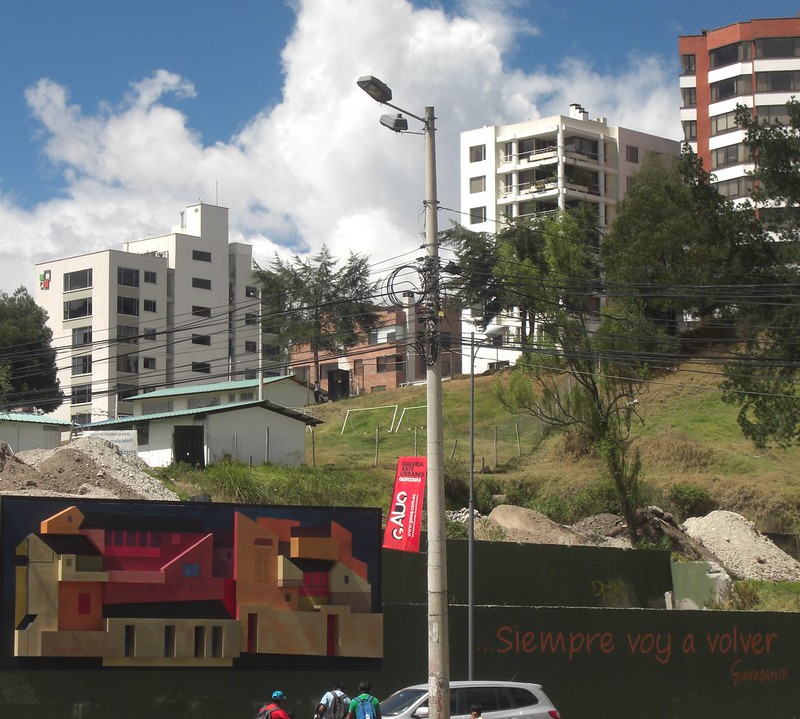
"The shortest poem in the world is you..." - my favorite graffiti in Quito
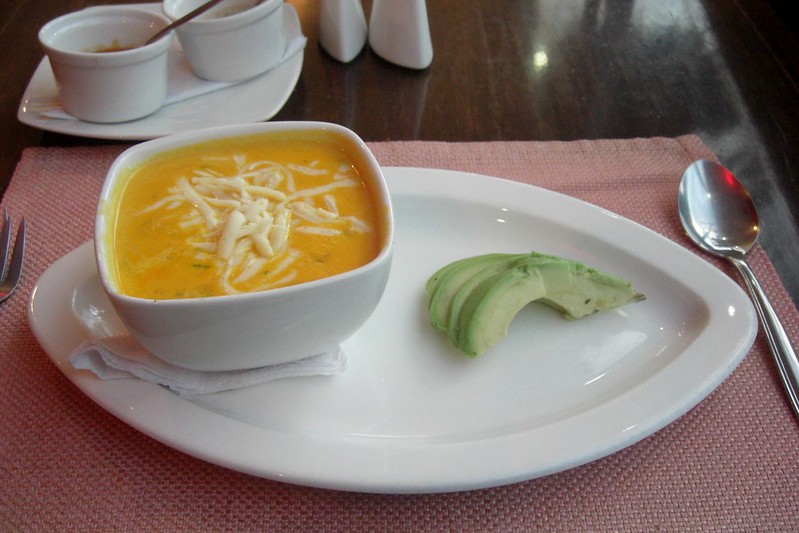
I spent my last two days in Quito basically just wandering around the city and visiting placed that I wanted to see before I flew out Thursday night.  On Wednesday, I wandered around to find a post office where I could buy some Ecuadorian stamps for a friend from my hometown.  Unlike Lima, there are only a couple post offices in Quito and they have regular office hours so I never had time to get to one while I was working.  I managed to buy a couple different stamps then wandered around Quicentro Mall to try to find some wrapping paper for the little torito that I bought as a gift.  I was not able to find anything that would work until I ran into a store by Baca Ortiz on my way to La Mariscal.  I wound up at the mercado artisenal on Juan Leon Mera to look at any last-minute items.  I ended up buying myself a large, bright blue alpaca scarf/shawl for $4.00 USD.  I also met up with one of my best friends from work at Achiote for the best locro in Quito.  Packing that night did not take very long either.
you know you're hungry now
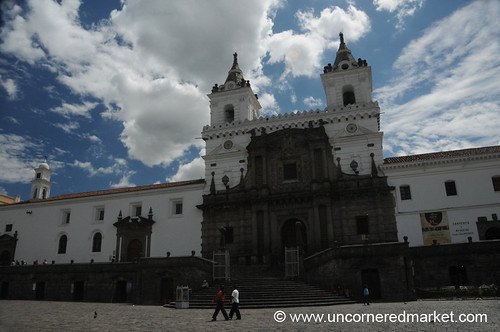
On Thursday, August 29, 2013, I went to the Centro Historico and walked from Plaza Grande over to Basilica Voto Nacional.  I thought I was taking a decent route when I had looked on a map beforehand, but between the plaza and the church was kind of empty (not a good thing for a street to be in the centro historico), so I walked really fast (all uphill) to get to the basilica.  After about seven or eight blocks, I arrived.  There is a plaza on the southwest side of the church and the towers were open.
Main Towers, Basilica Voto Nacional (Basilica of the National Vow)
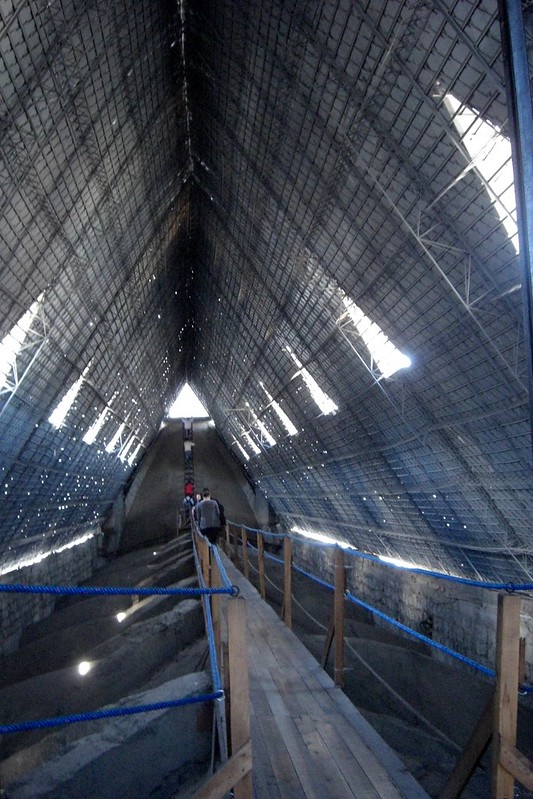
I went up the first tower but to go to a second tower, you have to cross a small wooden bridge suspended over part of the church below and then climb up some spiral stairs.  I put one foot on the bridge and the wooden board beneath me creaked loudly so I jumped back and decided that it was not worth it and I didn't really need to go to the other side (I probably would not have chickened out so badly if I had a friend with me, but I went alone so...).  The clocktower though was pretty nifty.  The views from the towers were amazing.  I think I was even able to see the peak of Cotopaxi.  From the windows on the way down from the clocktower, you could see the duck and pelican gargoyles on the church, which made me laugh.
aw hell no...
My taxi driver friend picked me up from the airport and when I gave him the wrapped bull, he gave me a gift too.  It was a hand-carved wooden Galapagos tortoise with a sticker on the bottom shell that had his name on it, so that I would not forget who gave it to me.  It was so kind of him.  Along the way to the airport, he told me about all of the places I will have to be sure to visit next time I come to Ecuador.  As much as I did not like my experience in La Mariscal, it is important to remember that there are wonderful people everywhere and that it is important to be kind to everyone because otherwise you will miss out on making friends with some wonderful people.  
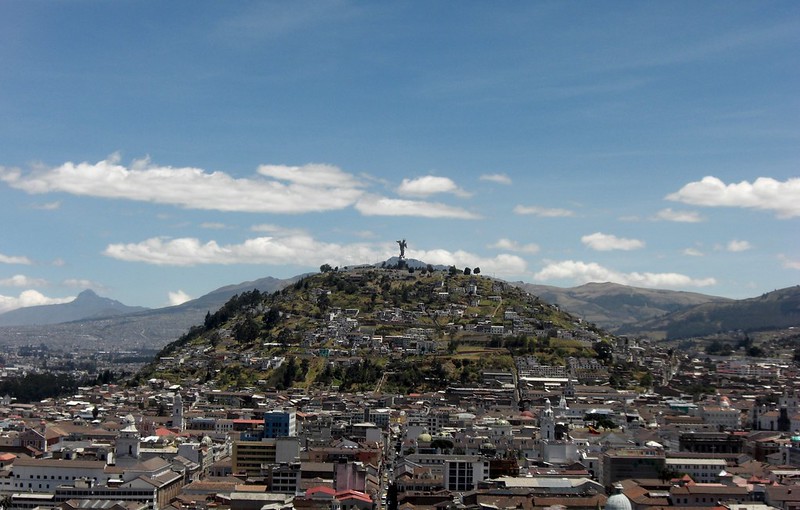
El Panecillo, as viewed from the Basilica's tower
By this time tomorrow, I'll be back in Michigan with my family and getting ready for the next adventure - my third and final year of law school!!!!

"I will always return." ~ Oswaldo Guayasamin

Saturday, August 3, 2013

Waterfalls in Sangolqui and Loreto

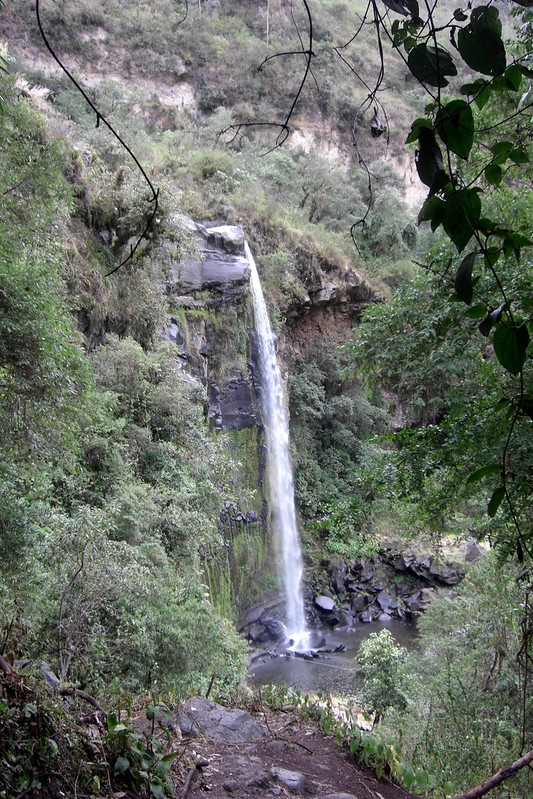
This Saturday, four of us from the office went to a suburb of Quito about 45 minutes by bus, Sangolqui, to meet up with one of our other coworkers who lives with her boyfriend's family there.  We met up with the two of them as well as two of our other Ecuadorian friends, at a giant multi-colored statue of corn (chocro in Kichwa) at the center of the town.  From there, the eight of us hopped into a pick-up truck that took us up through hills and through the little pueblo of Loreto to the entrance closest to the largest waterfall.   Four of us rode in the cab of the truck, and four of us rode in the bed of the truck (I was in the cab).  The bed of the truck looked pretty bumpy.  At one point, the truck drove over a wooden bridge - this bridge was made of planks of wood placed across one another.  I thought that the truck would fall through, but apparently the wood is holding up....so far.
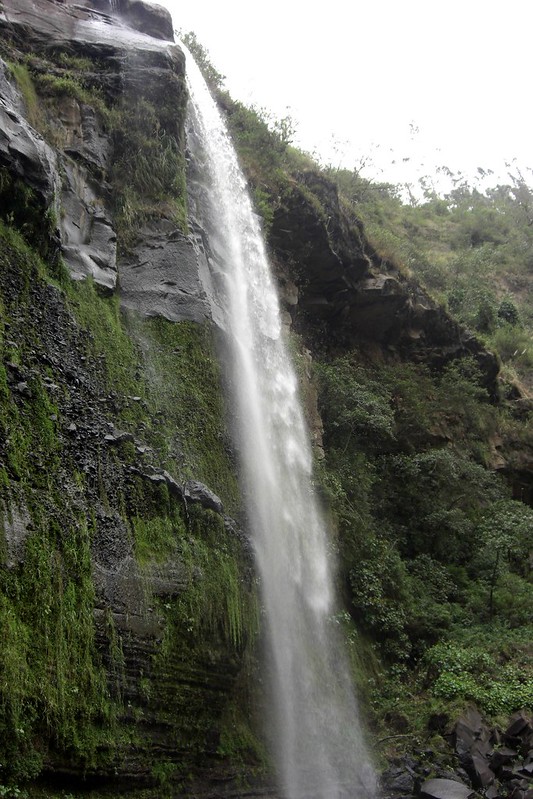
We hiked in a little ways and found ourselves at the top of the waterfall.  You could go all the way up to the edge.  There usually is a small pool at the top that you can swim in and then dry yourself on the rocks.  However, the water levels were pretty low so we just climbed around on the rocks.  There were some yellow arrows that I think were painted on there to direct hikers.  The area seemed to be popular among local people.
We then went back to the trail and hiked down to the bottom of the waterfall.  We had brought our swimsuits but when I put my foot in the water and could not feel my ankle any more, we decided against swimming and stuck to the hiking.  The waterfall was beautiful though.  After spending some time at the base of the main falls, we decided to hike more through the woods to reach other falls that we could see from a distance.
Along the hike through the forest trail, we crossed a small wooden bridge over a little river and saw a cow with tags on its ears standing by the side of the river.  We had no idea how the poor cow got there, because there were no farms nearby and the trail is pretty heavily wooded, even for people, that for a cow to navigate a narrow, steep trail seems impossible. I went up to the cow, but it turned away and walked a little bit down the river to eat a tree.  Poor cow - I hope it finds its way home.
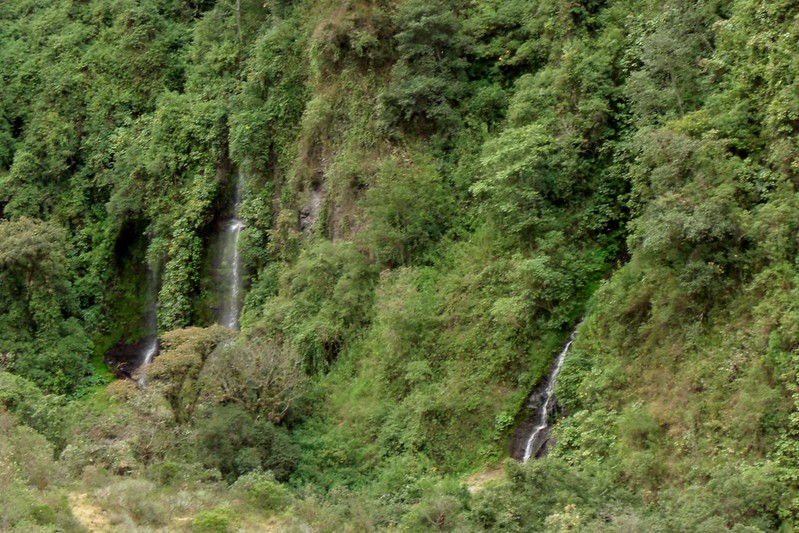
We did not spend too much time at the other waterfalls, as they were much smaller, but it was cool to see them naturally in the forest.  We hiked back to the entrance where we started (it was much more difficult because now we were going uphill the entire time).  We managed to find another pickup truck that could take us to Loreto where we could catch a bus for $0.25 to Sangolqui.  The four people who had ridden in the truck bed first were adamant about riding in the cab this time, so we switched groups.  It was actually a lot of fun to ride in the bed.  Pretty dusty, but fun, and definitely a 100% Ecuadorian experience.

Sunday, July 21, 2013

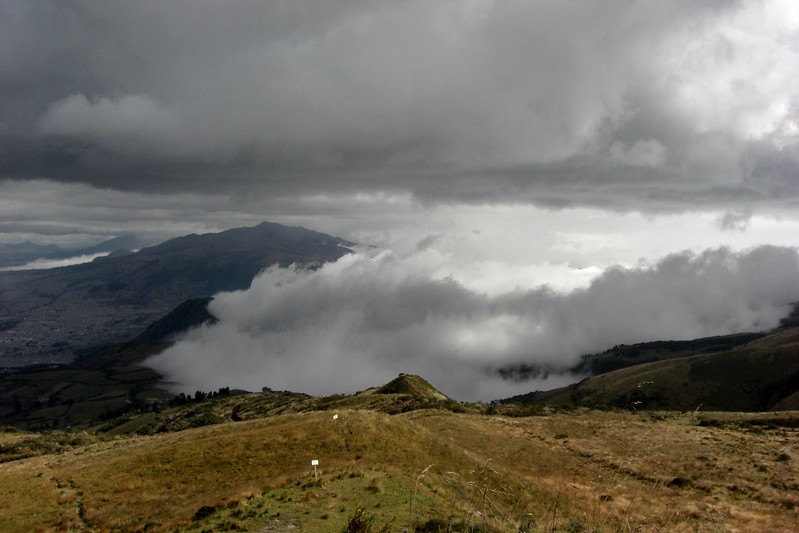
Pichincha on a Cloudy Day

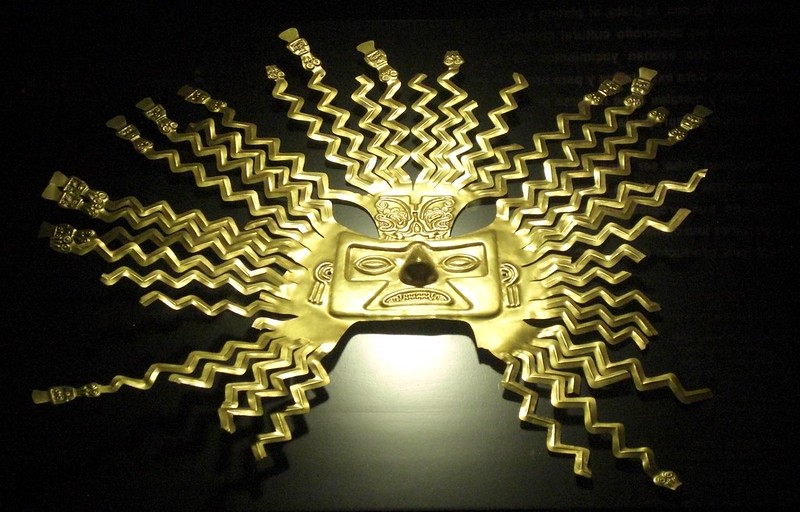
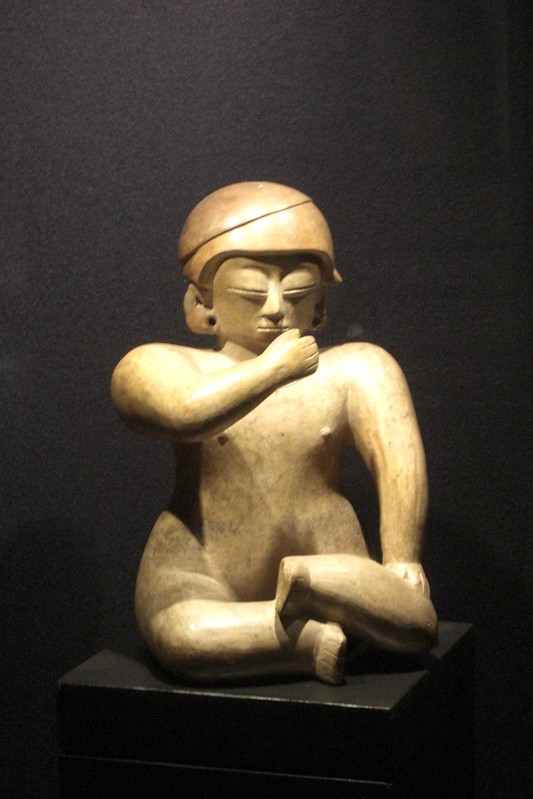
On Sunday, July 21, 2013, two friends from work and I, tired from the early trip yesterday to Otavalo and Peguche Waterfall, decided to spend the day in Quito checking some things off of our bucket list.  We met up on the Ecovia in the morning and headed first to the Casa de Cultura to see the Museo Nacional Banco Central which is supposed to have the best archeological exhibits of the museums in Quito.  Aside from the Guayasamin Museum, the Museo Banco Central was pretty good.  There was a lot of ancient pottery as well as an exhibit of Incan gold.
After the museum, we walked to a restaurant in La Mariscal called Baalbek, located on 6 de diciembre y Wilson.  It was probably the nicest restaurant that I have been to in Quito so far and we had quite a full menu for about $22 a person, including appetizers, main plates, desert, juices, and tea.  It was amazing food, and the best customer service I've had here in Ecuador and compared to Spain as well.  The owner is also quite a personality and will personally attend to each of the tables in the restaurant to speak with the clients as well as suggest dishes and menus for the patrons.  We are definitely planning on going back to Baalbek.

Helado de Baklava --> going back for THIS

Delicious Tabouli, Falafel, Kibbe, Rice, Hommous, etc. It's all amazing.
After Baalbek, we took the Trole to Plaza Grande to visit La Compañia church.  Unfortunately, you are not allowed to take pictures inside the church, but it is absolutely beautiful.  Inside, the church is covered in gold leaf almost everywhere with intricate plaster and masonry work everywhere.  I didn't even try to sneak a picture, but just to have an idea of how intricate the church is, here are a couple pictures.
The Outside

The Inside
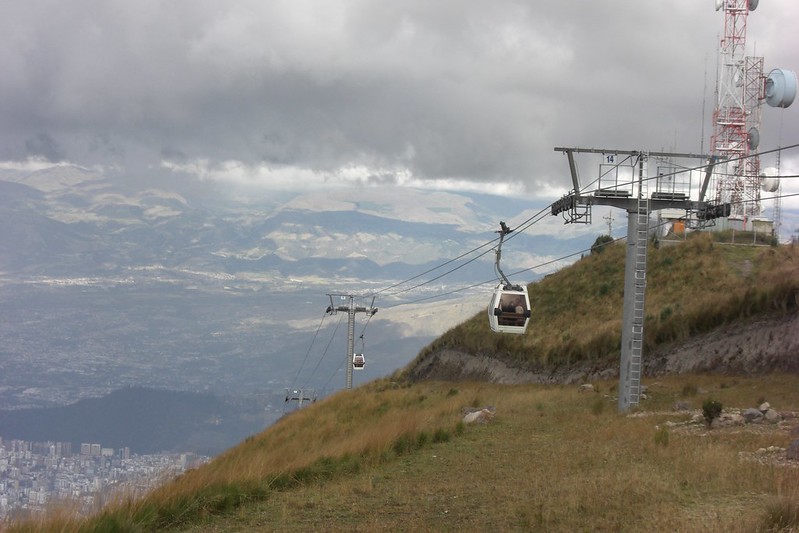
We didn't spend too much time in La Compañia and left to take a taxi from Centro Historico to the TeleferiQo.  Quito has an elevation of about 2,800 meters above sea level and the top of TeleferiQo has an elevation of about 4,200 meters above sea level.  So even though we have all done fine at Quito's elevation about 9,000 feet above sea level, we all had to walk a little bit slower at the top of the TeleferiQo.  It was also significantly colder up top (we were not really prepared for that) so we hiked around for about a half hour and then went back inside a cafe at the top.  While it was cloudy and we couldn't see the top of Mount Pichincha, but it was still pretty cool to be up there and to see the different patterns of sun and shadow that covered Quito and the mountain range from above.

Wednesday, July 10, 2013

Refugee Law in Ecuador


Now that I have been working with the NGO for a few weeks here in Quito and developing a client base, now might be a good time to do a post about the refugee system here and a few of my observations so far.  The first thing to note is that it is pretty crazy.  Ecuador has really lax visa laws to get into the country, but once you are here (and especially if you are a refugee), it is really hard to stay legally.  Because Ecuador borders Colombia, the vast majority of those applying for refugee status are Colombian, but due to the lax entry requirements, I have clients from literally all over the world, fleeing a whole host of really serious, scary situations.

Refugees only have 15 days from the time they enter Ecuador to apply for refugee status (this is generous considering that Ecuador only allows 3 days for appeals).  According to Ecuadorian refugee and administrative law, it is supposed to be 15 business days from the day they arrive and you start counting on the next day, but in practice, the Direccion de Refugio counts 15 calendar days.  Which means that the time frame to apply, assuming the person fleeing for their life a) knows about their right to apply for asylum and b) knows they only have a certain timeframe in which to do so, is even shorter than it is legally supposed to be.  The timeframe is also a huge challenge, both for original petitions and for appeals, because many people do not live in Quito or in an area where they are physically or financially able to travel to a DR branch to apply for status or submit their appeal.

This leads to a lot of cases where applicants for refugee status are denied right away because they passed the 15 day timeframe.  The next step is to appeal (they can appeal twice - once through an apelacion and once through a recurso de reposicion; there is also a third recurso extrodinaro, but the only cases that have a chance of succeeding with this are the really, really extreme cases).  I am not really sure how successful the appeals are at actually getting people refugee status - sometimes they just get denied again so then the person has to find another means of staying in Ecuador legally (usually a work visa or a visa through a blood relative that has Ecuadorian citizenship), and sometimes the applicant actually gets the solicitante status, meaning that his or her case will be considered for refugee status.

The decisions regarding refugee status are supposed to be made within 4 months (5 at the most).  This usually does not happen.  Usually, people will go back to the DR to check on their case and they just get the solicitante status for longer.  A lot of people end up waiting years to hear about a decision in their case. This is problematic because they start building a life here in Ecuador while waiting, but if their case gets denied, then they only have 15 days to get their affairs in order and leave the country.

If they are really a refugee, then they can't go back to their old country, so many end up staying illegally, which makes it even harder to find work and they live in constant fear of imprisonment and deportation.  According to international legal norms and the 1951 Convention Relating to the Status of Refugees, a country cannot send a person to a country where he or she will be persecuted, but if the Ecuadorian government does not recognize the person as a refugee, there is a change that the individual could be deported back to his or her country of origin from which they fled and could be in real danger.

Being a solicitante is also hard because there is also a lot of discrimination based on national origin.  Solicitantes and Recognized Refugees are supposed to have the same rights as Ecuadorian citizens but are often the victims of discrimination, especially when it comes to their children in school and obtaining legal employment.  Clients have been told that employers don't want to hire them because they are refugees or refugees from a certain country.  Children also face problems, including violence and bullying, in school at the hands of other students and faculty and staff.  In Ecuador, you need a lot of different documents notarized to apply for a whole range of things, which gets really expensive for people.  Notaries know this and take advantage of people in migratory situations, especially refugees, applicants, and those with irregular (illegal) immigration status.

According to article 177 of ERJAFE (Ecuador's major administrative law), if an applicant does not hear back from the administrative agency in two months, it is considered a default judgment in the applicant's favor.  In this case, if the person applying for refugee status does not receive an answer in their case from the DR within two months after the 5 month timeframe (so seven months of waiting total), then the administrative silence should be interpreted as granting refugee status to the applicant.  However, this legal right is non-existent in practice.  If it were actually followed, there would be a ton of people getting refugee status, but instead people are kept waiting in limbo for years.

Even if a person is successful in getting refugee status, it is granted as a visa valid for only 2 years.  Every two years, the visa is reviewed again and the Ministry and DR reconsider whether they think the person should be a refugee.  Recently, many Colombian males between 18 and 26 years of age have found out that their refugee status was revoked when they went to renew their visas.  Even people who are recognized refugees often opt to change their type of visa to something that will be more secure if they are fortunate enough to be able to do so.  For example, those with Ecuadorian children, silblings, or partners are able to apply for a visa de amparo based on their relative's Ecuadorian nationality.  This visa lasts for the duration of the applicant's passport - so if you were to apply when your passport is brand new, your visa de amparo would last for about 10 years instead of having to renew their visa and ID card every two years.

In addition to these problems, article 76(7)(L) of Ecuador's most recent constitution (number 19, from 2008, with over 400 articles) requires that decisions granting or denying status be explained.  Often, clients will get rejections of status for minor things from interviews, like "applicant failed to name group persecuting him so not credible story" or "applicant is denied because failed to file within 15 day timeframe," and the decisions do not adequately explain why the person was rejected for a legitimate reason.  Decision-makers also do some pretty crazy things in interviews, like fail to provide translators in the applicant's native language or conduct 3 or 4 hour interviews on the day the person arrives and then deny the individual status because he or she missed one date or name or place during the entire interview.

Another really important point about the Ecuadorian refugee system is that up until May 30th, 2012, Ecuador used a much broader definition of what constitutes a refugee.  Instead of using the 1951 definition, Ecuador and other Latin American states used the Cartagena definition.  See how the two compare:

First, the 1951 definition from the Convention on the Status of Refugees:
...Owing to wellfounded fear of being persecuted for reasons of race, religion, nationality, membership of a particular social group or political opinion, is outside the country of his nationality and is unable or, owing to such fear, is unwilling to avail himself of the protection of that country; or who, not having a nationality and being outside the country of his former habitual residence as a result of such events, is unable or, owing to such fear, is unwilling to return to it.
...In view of the experience gained from the massive flows of refugees in the Central American area, it is necessary to consider enlarging the concept of a refugee, bearing in mind, as far as appropriate and in the light of the situation prevailing in the region, the precedent of the OAU Convention (article 1, paragraph 2) and the doctrine employed in the reports of the Inter-American Commission on Human Rights. Hence the definition or concept of a refugee to be recommended for use in the region is one which, in addition to containing the elements of the 1951 Convention and the 1967 Protocol, includes among refugees persons who have fled their country because their lives, safety or freedom have been threatened by generalized violence, foreign aggression, internal conflicts, massive violation of human rights or other circumstances which have seriously disturbed public order.
On May 30th, 2012, that changed with the publication of Decreto 1182.  D.1182 re-established solely the 1951 definition and eliminated the Cartagena Definition from Ecuador's refugee process.  Because of this, it has become much more difficult for people fleeing some pretty serious situations that would be recognized under the Cartagena Definition to get the same rights and recognition as a refugee under the narrower 1951 definition.  This means that a lot of people try to fall into "particular social group," but this is  often not recognized.  This affects a lot of Colombian applicants in particular.

These are just some initial observations after the first few weeks working with clients.  It is difficult because so many have such difficult, dangerous situations, but there are so many points in the process for them to get denied status that could give them much-needed protection.  Sometimes, hearing their stories about how they were persecuted relentlessly in their home country and how they came here but now cannot get help from either the Ecuadorian government or UNHCR, can be very emotionally draining. And with the complicated process designed and implemented to be tough for people applying for protected refugee status, it is really difficult to have a client sitting in front of you asking you for help and having to tell them that this is all you can do and that they have to find other ways to avoid being sent back to a place where their lives and those of their family could be in very real danger.  And it's not like Quito is a safe place to live or raise a family, so the fact that they fled here should be telling.  I guess I hope that whatever I write for people or however I can make the process a little easier to understand and navigate will result in people being able to improve their situations - the gratitude that the clients have for the little that we are able to do is truly humbling.

Peace.


Wednesday, June 26, 2013

First Two Weeks in Quito

For my very first weekend in Quito, I managed to fill it with a lot of interesting, random things.  On Thursday night (June 13), I went with some students from my undergraduate university to Calle de la Ronda for a chill time.  We tried a famous Ecuadorian drink called canelazo, which is a hot alcoholic drink made with wine, cinnamon, and fruit.  We tried the mora kind (raspberry).  It wasn't bad, but was pretty thick and a bit syrupy (pretty sweet too) so we had to get some empanadas to go with it.  We wandered to another restaurant down the street and tried some chocolate de Ambato (Ambato is a city in Ecuador) and the hot chocolate was really good.  

However, even though La Ronda was bustling with people when we arrived, by the time we left at midnight, the entire street had been abandoned.  We were pretty surprised because usually it isn't like that, but unfortunately, we discovered this as soon as we had left the restaurant with the hot chocolate, closing the door behind us (bad move - next time, we will stay inside until the cab arrived).  There were two security guards, but one went to deal with a crackhead under a bridge further down the way, and the other was paid by the only other group in the street to escort them back to their way (meaning that both guards had left their posts totally abandoned - not cool bro).  We walked up the street, staying alert, and found more cops at the corner where upon our cab driver came flying through, up the street, past a police barrier to pick us up.  Muchas gracias, taxista!  The street is really pretty at night,so it is too bad that you can't really just walk along the streets in the historic district (or anywhere really at night).  I ended up going back to La Ronda during the day later on in the weekend and was able to get a couple nice photos.

On Friday morning (June 14), I went to the QuiCentro Mall to meet up with more people and walk around a bit.  As we were in the mall, we saw two American basketball players in warmup uniforms.  I went  up to them to ask them if they were Americans and what they were doing in Ecuador, and found out that they were playing for a professional Ecuadorian club basketball team called Mavort.  They ended up giving me all the tickets that they had in their pockets for their game on Saturday.  So that was awesome.  Later that night, the same friends and I ended up going to a nightclub in Quito called Times.  It was pretty fun with great music, but it can be hella expensive so watch out.
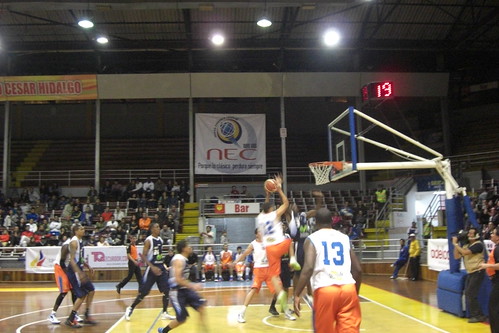
Saturday night (June 15), I went to the Mavort v. CKT basketball game with a friend from work.  It was quite the experience.  We were two of four total extranjeros there and the court was about the size of a high school court.  The CKT (away) team must have brought a bus full of people with them because their fan sector came prepared.  They all had matching blue hoodies with vuvuzelas, fired off two glitter guns during the game, and had a bass drum from a marching band that someone kept banging the entire game.  Our team lost that game, but it was quite the experience.
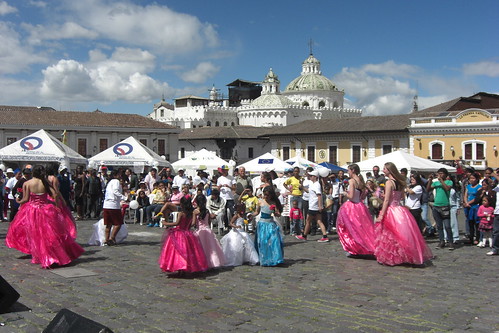
On Sunday (June 16), I went to the Dia de Refugiado Mundial festival in Plaza de San Francisco.  It was my first trip to the historical center and a very beautiful place.  The fair was very interesting too - lots of organizations there as well as refugees selling craft items and delicious food and performing spoken or musical pieces in the plaza.  Some volunteers from an organization were even roped into participating in a princess fashion show with some little girls too.  Only in Ecuador, jajaja.  
It was also Father's Day in Ecuador, and so of course I skyped with the padre.  Managed to find two videos from the events in the plaza too (not of the princess show though):

Drummers in Plaza de San Francisco for the Dia de Refugiado Mundial Festival


An NGO participating in the Dia de Refugiado Mundial fair:


Last week was my first week of work at the organization.  It was mostly spent getting familiar with the Refugee Status Determination (RSD) process here in Ecuador and learning Ecuadorian constitutional and administrative law.  In 2008, Ecuador wrote its 19th constitution, so we're using that and an administrative law called ELJAFE.  Everything is all in Spanish again so there will definitely be a learning curve, but I am positive that by the end of the summer, my Spanish language abilities will greatly improve.  I also really like the other volunteers and employees that are here at the center - mostly from Canada and the U.S., but some from Ecuador, Colombia, and Spain.

This past weekend, I met up with two friends from work to go to see El Panecillo in the Historical Center.  Two of us ended up being late because on the way to meet up with the third person, I saw a tiny Persian corner store in Quito called Shirin, so of course I had to stop and see what it was all about.  It is a really cool place, and I will definitely have to go back.  The owner is a man named Ali who has been living in Ecuador for quite some time.  I was amazed that it actually wasn't too difficult to switch into Farsi (and only a random few Spanish words crept in when I forgot the Farsi counterparts).
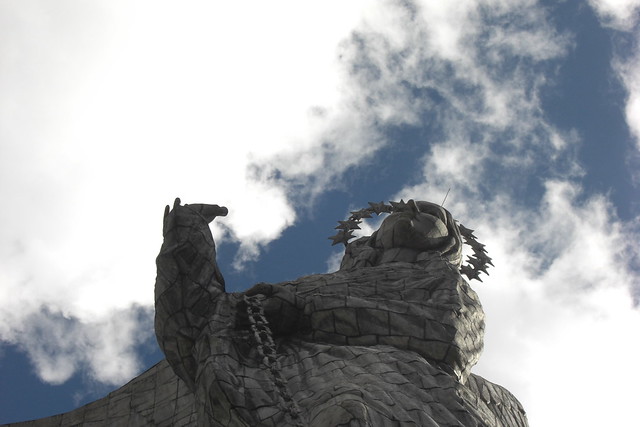
El Panecillo was pretty cool.  It's dangerous to walk up the stairs to the statue on top of the hill (thieves and muggers are waiting for dumb tourists), so we were able to take a taxi to the top.  It was interesting to see the contrast between the old and the new parts of Quito as well as to be able to view the mountains and whole city below.  The statue itself is of Virgin Mary who is said to protect the city.  The name "Panecillo" itself comes from the shape of the hill the statue sits on.  When viewing the hill from afar, it looks like a little bun of bread, hence the name "panecillo."  On the way back down, we had the taxista drop us off at the Basilica de Voto Nacional.  It is a beautiful church, but unfortunately we arrived 15 minutes past the last entry up the spires, so we'll have to go back for another view.

On Saturday, June 22nd, my friend from work and I were sent to Santo Domingo to assist with a workshop ("taller") about refugee rights and other types of visas for the Colombian refugee population living there.  The ride to Santo Domingo from Quito can take anywhere from 2.5 hours to 4 hours, depending on how fast your driver decides to take the curvy highway up or down the mountain.  Our drivers made it in 2.5 hours (possibly less).  Which meant my head was spinning for some time afterward.  The highway however is absolutely beautiful, passing through lush, green mountains and farmland in the hills.  Even sticking my camera out the window, I was able to get some great pictures.
The city of Santo Domingo itself is another story.  After telling four different Ecuadorian friends that I was going there for work and was looking for something to see, they each said almost verbatim that the less time one spends there the better because it's a dirty, disorganized city.  This made me feel really sorry for pobre Santo Domingo because even the guidebook said that the only reason to go to Santo Domingo is to take a bus somewhere else.  Pobrecita ciudad!  When we arrived to the city, however, the image didn't entirely change.  The climate there is muggy because it is lower in elevation and closer to the coast.  We didn't see much of the city, but of what we did see, the nicest and newest building was a Kentucky Fried Chicken.  Getting sick for two days after off of the chicken I ate in Santo Domingo (not at the KFC) there hasn't really changed the image unfortunately. Apparently, there are festivals there.  Maybe next time.
Monday, June 24th, was my first day of client interviews.  They went well for the most part, especially given that it was my first time doing them and everything, with the exception of one interview, was conducted in Spanish.  It is really interesting to learn about all the different types of legal issues associated with immigration of all kinds to different countries.  While not all of those I spoke with were refugees, it was a really interesting experience.  It is difficult sometimes for me to understand certain Latin American accents, but I think this will become easier over time and important to be able to do.

On another note about the work in general, working on these types of issues really puts your life into perspective.  Just looking at the dates of some of the things I have seen over the years, it is crazy to think about what was happening for that person and what was happening for me at the same time.  While someone might have been fleeing for their lives, I was enjoying an undergrad study abroad in Spain or griping about law school classes and exams being difficult.  A month after my last birthday, I was still able to hang out with my friends, come and go as I please from my university, home, or wherever, and my biggest concern was probably finding a summer job and managing student loans (these are still valid concerns).  But no one was coming to my family's home, threatening them or me with death or forced recruitment, and I wasn't leaving everything behind to flee and arrive in a brand new country penniless.  One of my friends was working at UNHCR a while ago and found a sign in a hallway in her office building that said, "A Refugee Would Like to Have Your Problems."  So true and so humbling.

Thursday, June 13, 2013

First Day Out and About en Quito

Condor y Toro

After hunting down where exactly my internship building location is, I walked up this hill to the Fundación Guayasamin.  It is a museum in the house of a famous Ecuadorian artist, Oswaldo Guayasamin, with a connected building housing more of his art.  The painting above is called Condor y Toro, and it represents the tension between the Spanish and indigenous Ecuadorian cultures.  It is a gigantic piece, and was my favorite of the visit to the museum.
[casa de Guayasamin]
The house, built in 1977, is absolutely beautiful and $3 gets you a guided tour of everything, including the little bonus of sneaking into the library (which apparently is not part of the tour but could be tossed in if you asked nicely).  At the end of the tour inside the house, there is a quote on the wall that was very poignant and moving:
Si no tenemos la fuerza de estrechar nuestras manos con las manos de todos, si no tenemos la ternura de tomar en nuestros brazos los niños del mundo, si no tenemos la voluntad de limpiar la tierra de todos los ejércitos, este pequeño planeta será un cuerpo seco y negro, en el espacio negro.
If we don't have the strength to reach our hands out to the hands of everyone, if we don't have the tenderness to take the children of the world into our arms, if we don't have the will to clean the world of all the armies, this little planet will become a dry and black body in a dark space.
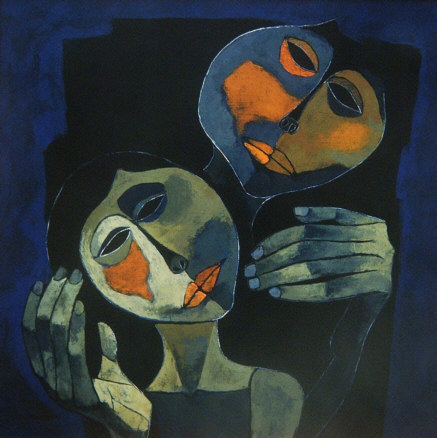
Despite becoming very rich and famous as a painter and artist, Guayasamin came from humble origins (the eldest of 10 siblings born in 1919 and whose father was a taxi driver).  He described himself as being a painter and a voice for the poor and voiceless, and his many different paintings of Quito nestled among the Pichinche mountains were reflections of his various moods as captured by the mountains.  Another famous Guayasamin quote:  "Yo lloraba porque no tenía zapatos hasta que ví un niño que no tenía pies."  It means, "I was crying because I didn't have any shoes until I saw a boy who didn't have any feet."

[another view of Quito y Pichinche]
Quito Azul
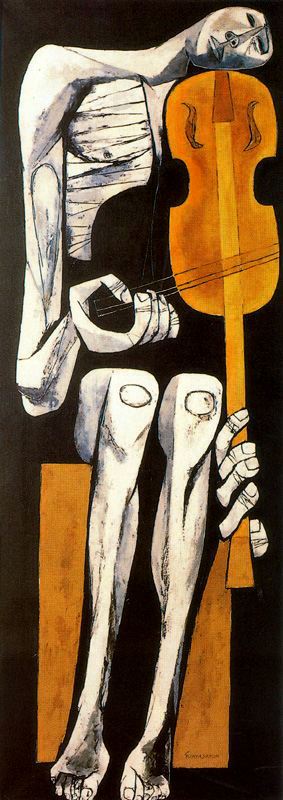
El Violinista

[dead/dying souls reaching for freedom]
After the Guayasamin museum, I had enough time to visit a small museum toward Mariscal, called Mindalae.  To get there, it was my first time on the Ecovia bus (there are three lines that basically run north-south throught he city).  You've got to be careful on the buses because they get crowded, pickpockets and thieves are adept at their crafts, and unaware tourists make great targets.  However, I managed to get myself and all of my $3.25 off the bus without incident.
Ecovia, Red Line
The museum was really small so it took just the right amount of time to go through.  It has a small, but nice, collection of indigenous art, pottery, ceramics, weaponry, textiles, and clothing from all of the indigenous groups in Ecuador.  It was really interesting to see the differences in dress among the groups, as well as learn about how many diverse indigenous groups there are in the country. 
[indigenous Ecuadorian clothing]

Tuesday, June 11, 2013

Flying In and Day One


I've been fly so long I fell asleep on the --- plane.

The lyric by Weezy (aka Lil Wayne) is accurate.  Despite my best efforts to stay awake, I fell asleep on both the flight to Atlanta and to Quito, which was probably for the better to avoid motion sickness.  De verdad, the flight was not bad at all.  Only about 5 hours in the air from ATL to UIO.  And the weezy part is also kind of accurate given that Quito is about 9,300 feet above sea level.  The good news is that aside from being a bit tired with a mild headache in the afternoon, so far so good with the altitude.

Aside from flying in yesterday and taking it easy today just running a few errands, it's been chill so far.  A couple first impressions:

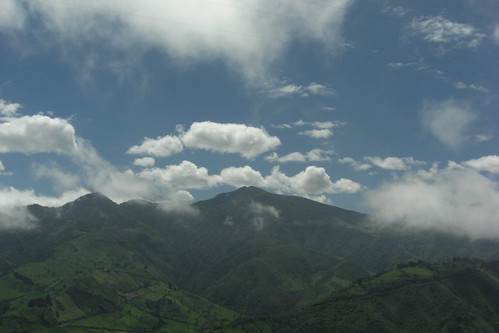
The city is beautiful - I can't wait to get to the historic center and walk around buildings and streets from the 1500s (or older).  During the day, you can see the green mountains and hills with the roads winding through them.  The sky is really blue with big, fluffy, white clouds.  As the summer goes on, I am told that there will be fewer clouds and more blue sky.
  

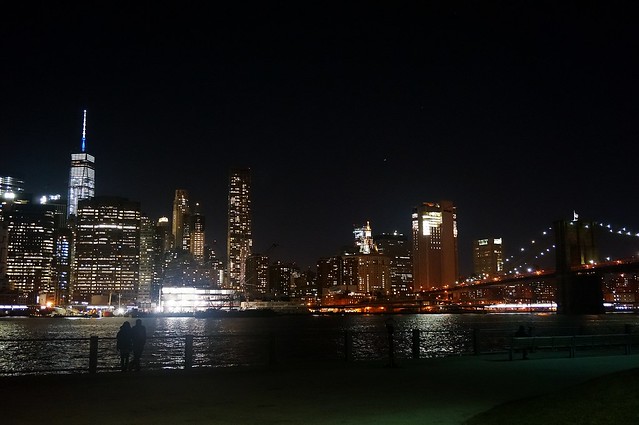
The sun started setting around 7:45/8:00pm and the view of the city at night is equally beautiful.  At night, the roads are lit up with this yellow light from the houses and cars, making the long, narrow city look as though it is made up of golden veins snaking their way through the terrain.  Seeing that from above was pretty cool.

Going around the stores today, it is still odd to me to be in a foreign country and using US dollars.  Ecuador has its own coins but they are used interchangeably with US coins (including US dollar coins which I am gathering are used far more often here than I've ever seen them used in the US).  At least this takes away the issue of worrying about exchange rates and having to check xe.com all the time to find the best rate.

Driving in Ecuador (at least Quito) is a whirlwind.  Cars follow some rules more than others, but basically lanes and speed limits don't really matter and stop signs and yielding are optional.  It's a game of aggressive and defensive driving that everyone plays so I'm glad that I'll just be a passenger (with a seatbelt).  Most of the cars that I have seen so far are little Suzuki, Honda, or Chevy SUVs (with some compact cars).  And most of the cars here are manual (stickshift) drive, which is impressive considering the "hills" (aka mountains) that Quito's roads are on.   Lots of steep hills that would more than test most American stickshift drivers on their best days.

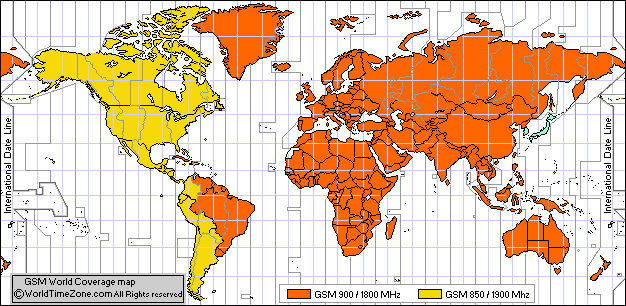
I thought that the phone I used while in Spain, Morocco, and Switzerland would work just as well in Ecuador with a new sim card.  No such luck, amigo.  Apparently, although pretty much the entire world uses a cell phone frequency different from the US and Canada, Ecuador and a few other Latin American countries follow the US frequencies.  Meaning that I'll most likely have to buy an Ecua-phone for my sim card since I cannot figure out how to change the frequency on the euro-phone.  So much for trying to be prepared on the communication end.  

For future reference (yours & mine): http://www.worldtimezone.com/gsm.html
2013 GSM World Map - GSM Country List

Today there was a World Cup qualifying match between Ecuador and Argentina (they tied, 1 to 1).  The whole city was pretty much preoccupied with the match.  At night, there was even a short burst of fireworks (I am assuming because of the game).  

Monday, June 10, 2013

Going to Ecuador!

By this time tomorrow, I will have already landed in Quito and hopefully be home to my new residence for the next few months.  Quito was the first city to be named a UNESCO world heritage site and I am looking forward to seeing how blue the skies are 9,000 feet above sea level.  I'll have one week of relaxation (and mostly adjusting to the altitude) before starting my internship.  Will update soon!


Look at those skies.  Beautiful at any time of the day or night.


Twitter Delicious Facebook Digg Stumbleupon Favorites More

 
Design by Free WordPress Themes | Bloggerized by Lasantha - Premium Blogger Themes | Walgreens Printable Coupons