Showing posts with label mosque. Show all posts

Sunday, August 1, 2010

Weekend in Morocco

For one of our last free weekends to travel, I went with six other Michigan State students to Marrakech, Morocco. We all wanted to travel somewhere entirely different and had heard that Marrakech was one of the nicest cities for tourists to visit in Morocco. Since US citizens do not need visas to enter Morocco, we grabbed some RyanAir tickets and spent the night before our early flight in the Barajas airport.

We arrived in Marrakech bright and early around 9:00am on Friday, 30 July, 2010, where it was already as hot as Madrid is during the daytime. After exchanging my euros for the second time this summer, we bartered with a taxi driver to get to the hostel. Since tourism is big in Morocco, we had no trouble finding people to speak English or Spanish with us (other languages spoken include Arabic, French, Italian, and German). At first when the taxi driver dropped us off, we thought we were taken for a ride, but after talking with him further, he lead us through the old neighborhood alleyways to the door for our hostel. We thought street signs were bad in Spain, but it’s nothing compared to Marrakech! I don’t remember seeing a single street sign or traffic light in the parts of the city we visited.

Our hostel turned out to be a riad, an old Moroccan mansion converted into a hostel for travelers. Our hostel, Riad Massin, was beautiful with an amazing staff and by far one of the cheapest hostels I’ve stayed at, only 11 euro per night for ensuite rooms. After checking into our rooms, the hostel owner brought out mint tea for us as he gave us maps and explained the city. In the heat of the day, we headed out to the Majorelle Gardens. On our way, we got lost trying to follow the map and wandered around for a while until we found a small shop to buy water. The Majorelle Gardens were beautiful, with fountains and bright blue buildings everywhere. After the gardens, we went to a nearby restaurant for our first sample of authentic Moroccan cuisine. The tagine and cous cous were amazing and the prices were a nice change from Madrid’s restaurants.

After the Majorelle Gardens, we returned back to the hostel for a siesta on the roof lounge area. After the 120 degree heat died down a bit, we ventured back out to the Koutoubia mosque, the souks, and the main square, Jemmaa el-Fna. The mosque takes its name from an ancient book market that was located in front of the mosque. The souks are the markets on the edges of the square selling anything from spices and food products to clothing and handmade textiles and crafts. After wandering through the souks for a few hours, we went back out into the square just as it was getting dark.
The plaza at night transforms from a maze of merchants, locals, and tourists, into hundreds of outdoor restaurants. Traditionally, the square has numbered food booths that serve similar types of Moroccan tagine and cous cous. After eating dinner at booth number one (the best food booth there), we went up through a restaurant building to a roof-top café that overlooks the entire square with a beautiful view of the mosque. The evening prayer drifted out over the plaza but the pace didn’t slow down. We wove back through the plaza to return to the hostel. Once back at the hostel, we went up to the roof with the other guests at the hostel.

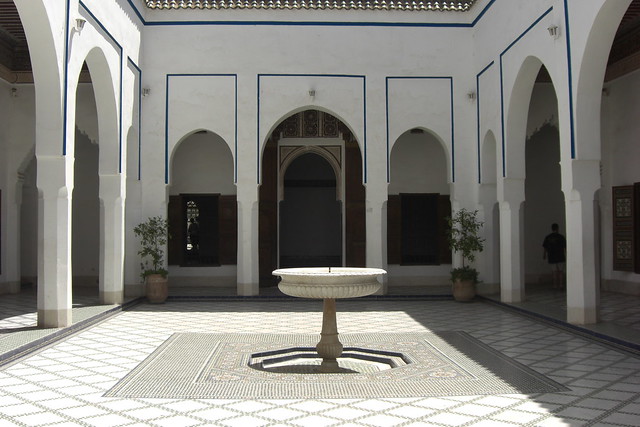
The next day, we decided to leave early in order to avoid the heat, but found that Saturday was hotter than Friday. Our first destination was the Sa’adin Tombs, with burial dates from 1557 to 1792. The tombs were neglected until their re-discovery by the French in 1917. The tombs were beautiful, with intricate mosaics and carvings everywhere. After the tombs, we wandered back through the edges of the spice souks to visit the Bahia Palace. On the way, we found a hole-in-the-wall shop where a man was weaving colorful blankets in the back. The walls of the store were overflowing with other scarves and blankets in all sizes. We spent some time in the store and then went back out to the street and went to the Bahia Palace. The palace was built between 1894 and 1900 in the popular Alawi architectural style for Ahmed Ibn Moussa (Ba Ahmed). In addition to the impressive rooms and courtyards in the palace, there is also an equally impressive garden.
From the palace, we took more time to go back through the spice souks, even visiting one stand where the worker took the time to explain to us, in English, what everything was and how it was used. He even let the women in our group sample the perfumed soaps. From the spice souks, we went to a restaurant on the way back to the hostel. After lunch, we went back to the hostel where we divided into groups to go to the hamams. After the hamams, we went back to the hostel, where the women had henna done by one of the women who took us to the hamams. The woman doing the henna was very talented and told us that she taught herself henna artwork at home. While the henna was drying, we went back up to the rooftop to relax until the weather cooled down enough for dinner. While we were on the rooftop, the two women who had taken us girls to the hamam and did our henna came up to the roof to say goodbye to us. They knew we were leaving the next morning and wanted to wish us a safe trip before they left work for the day. They even made the boys take a group picture of us.

We went back to the souks as it started cooling off and wandered around all of the shops with some of the other guests from our hostel. As people started closing their shops, we were amazed at the number of people riding motorcycles and mopeds through the walkways which we had incorrectly assumed were just for pedestrians. Although Booth #1 did have amazing food, we decided to try something different than the previous night and went to Booth #22, which was good but not as good as Booth #1. After dinner, we walked to the fresh orange juice stands in the square, where we all bought a glass. Turns out, it was watered down, resulting in half the group (luckily not me) getting pretty ill for the next two days.

We returned to the hostel after spending more time wandering around the square and went back to the rooftop where all of the other guests had gathered. We stayed up well into the night but did manage to sleep before having to wake up at 5:00am to get ready to go back to the airport. We were about a half hour away from missing our flight because our driver was late and there was a discrepancy regarding the actual boarding time on our tickets, but we ended up making our tiny RyanAir flight back to Madrid.
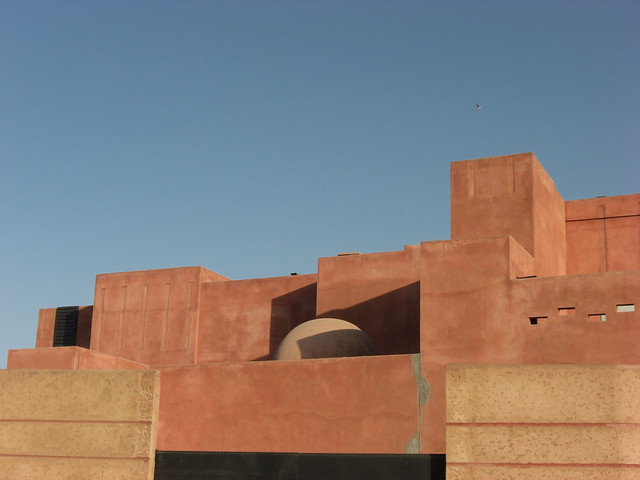
Morocco was amazing and so refreshingly different from any place that I have previously visited. If possible, it would be great to return to Marrakech and then to travel around to more of the cities. If there had been more time, we could have taken a two day camel ride out to the Atlas Mountains, so that will be something on the list for next time. An additional benefit of Morocco being 120+ degrees Fahrenheit each day was that when we returned to Madrid, the 100+ Madrid heat didn’t seem so bad.

Tuesday, June 29, 2010

Mosques, Black Sand, and Sun Tans

This past weekend, 24 through 27 June 2010, a MSU friend and I went to Malaga and Córdoba, in the south of Spain. Because the buses in Spain are crazy, there is no bus directly from Madrid to Córdoba, so we had to take the midnight bus Thursday night to Malaga and then round-trip between Malaga and Córdoba. I am convinced that we will never have a normal bus ride in Spain. On the way to Malaga from Madrid, there was a guy behind us who spoke a little bit of English, would eavesdrop on our conversation and say "oh yeeaah" every time he heard one of us say "yeah," would leave every so often to smoke a cigarette in the bus bathroom, and would poke my friend's face every time she fell asleep. He also brought beer with him on the bus, which made him more annoying at first, but was a blessing in disguise because he passed out for the second part of the trip. After getting about one hour of sleep on the bus ride, we arrived in Malaga early in the morning. Since we were busing to Córdoba in the evening, we had no place to store our backpacks and walked around Malaga with all of our belongings.

We visited the house where Picasso was born, Castillo de Gibralfaro, and the Picasso museum on Friday (the cathedral was closed to visitors for a holiday). The house was small, but had some unique artifacts in it. Around the corner from the Picasso house, there is an amazing pandelería that had the best and cheapest pastries either of us have had thus far in Spain (they had discounted prices between 8:00am and 2:00pm). After the Picasso house, we climbed the pathway up the mountain with all of our gear to reach the castle at the top. The view of the Mediterranean Sea from the castle and the hike upwards was incredible. After climbing all of the walls and towers of this small castle, we made our way back down the mountainside to visit the Picasso Museum. It was really interesting to see the breadth of Picasso's artistic ability - far beyond the Cubism paintings for which he is most famous. We then walked around Malaga a bit more before returning to the bus station to catch our connecting bus to Córdoba.

From Malaga to Córdoba was probably the most normal bus ride yet, but it had so many different stops in tiny, obscure places that we had difficulty figuring out where/when we were supposed to exit. In Córdoba, we Senses & Colours Seneca Hostal, which was actually a very nice hostal. We met a couple from the United Kingdom (Belfast and London) who had been in Córdoba for a few days and showed us around the Judería neighborhood (a really cool neighborhood with lots of narrow, winding streets), the mosque, and the center of the small city, where we watched the soccer game between Spain and Chile. Córdoba was very different from Madrid and the lack of people on the streets felt like a ghost town. On Saturday morning, we visited the mosque (it is free at 8:30am). The mosque was incredible. When the Muslims were expelled from Spain, the mosque was converted into a cathedral - the Christians tore down the dome and added a Gothic belltower, chapels, and some gothic touches around the mosque's walls. However, the layout of the mosque is completely different than Spanish cathedrals; hence the proper name is the Cathedral-Mosque of Córdoba. However, all of the pamphlets about the mosque just labeled it as the Cathedral of Córdoba.

After spending a lot of time wandering about the mosque, we visited the Alcázar right next to the mosque with some of the most beautiful gardens so far in such a building, the arched Roman bridge behind the mosque, one of three synagogues remaining in Spain (the other two are in Toledo), and an old Jewish house that served as a museum about the Jewish history of Córdoba.

Córdoba is also in the running to be named the most historic city in Europe in 2016. They have started the campaign to get signitures already, so like a good tourist who likes history, I signed their petition. The people working the table outside the Alcázar were so excited that I had signed it (and spoke in Spanish with them) that they just kept trying to give me free stuff from their booth. I turned down the flyers, but I now have buttons, a pen, and some cool postcards. Finally, we had to catch our bus back to Malaga.

In keeping with the tradition of crazy bus rides, there was a group of guys in the back of the bus who kept speaking very loudly. One kept laughing like a hyena. Turns out, they ended up staying at our hostal (Residencia Malaga Backpackers). Pretty much the only thing going for this hostal compared to all of the others we have stayed at so far is that it is close to the beach. We also learned the lesson that if one stays in a hostal with good showers and bathrooms, one should take advantage of this and use them. This part of Malaga was also not a place to be walking around at night, even with other people. Nothing is open at night and there are no people around. Additionally, Malaga is like the rest of Spain and has a chronic lack of well-placed street signs. However, right on the beach close to our hostal is this amazing Italian restaurant called Pizza Pino's. They had very good, cheap food, so we went there twice. The manager/owner loved us and kept giving us free drinks each time. On Sunday when we went back for lunch, he asked us if we were coming back that evening and we felt very bad that we had to return to Madrid. After spending all day Sunday on the beach in Malaga (the Malaga beaches are famous for their black sand - not caused by oil spills) with our SPF 50 sunscreen, we caught the bus back to Madrid.

The story would almost be over, save for the last quirk of the bus adventure. Because the bus ride back was about eight hours, there were two in-bus films shown. The first one was a dubbed over version of The In-Laws, with Michael Douglas. The second film, Imagining Argentina, was with Antonio Banderas and was about the disappearances in Argentina between 1976 and 1983. It was a very good, but extremely graphic film, making my friend and me question the judgment involved in selecting this movie for the bus ride. The English trailer is below; we watched the film dubbed over in Spanish. The good thing about Antonio Banderas is that he does his own dubbing and so it is easier to watch than listening to another actor's voice.

Twitter Delicious Facebook Digg Stumbleupon Favorites More

 
Design by Free WordPress Themes | Bloggerized by Lasantha - Premium Blogger Themes | Walgreens Printable Coupons