Showing posts with label Geneva. Show all posts

Wednesday, October 8, 2014

World Buddies

After spending time working in Geneva among international organizations and observing the United Nations system, specifically during its sessions during the 2014 Human Rights Council, one of the challenges encountered was reconciling the apparent disconnect between what happens at a very broad, high-level general assembly/HRC session translating into real, positive changes for people on the ground experiencing actual human rights violations and suffering.  Seeing the discussions happening in Geneva, surrounded by the type of politics that accompany such exchanges and knowing some of the problems faced by real people in other countries, is disconcerting and tough to account for.  The Daily Show did an excellent job in this segment capturing some of these feelings that many exposed to the system experience, and in doing so, hopefully challenged citizens and their diplomats around the globe to work better and smarter together for a greater, common good.


Monday, May 5, 2014

Last Day in Genève :(

I cannot believe how fast the semester has flown by.  Already, it is my last day in Geneva.  After packing up my suitcase a bit, I met one of the last people in our Michigan program who was also still in the city at the Parc des Bastions (or, the park by Place de Neuve on the #12 tram, or the park with the Reformation Wall).  It was such a beautiful, sunny day that we just enjoyed all of the sun and walked around the old town. 
We continued through the Old Town until we passed down by the lake and the flower clock at Jardins Anglais and decided to continue walking along the water until we reached the Brunswick Monument.  I had my last dinner in Geneva at the Cottage Café, one of my favorite lunch spots in the town.  The restaurant sits right in the middle of a beautiful little park facing the Brunswick Monument and the Lake.
It was such a great experience this whole semester to live and work in Geneva, and to have the opportunity to do so much travelling.  I was able to get to know the unique city and country in which I was living, as well as see many different parts of it.  I was also able to see some new places in Europe, meet family, and continue to develop my language skills.  What a great way to finish law school.  Now, it's back to the USA to graduate!
Deuces, Geneve!
I'll be back!


Monday, April 28, 2014

Three Country Corrida: Switzerland, Liechtenstein, and Germany in One Crazy Day

Time for a magical train trip!
I've posted before about how great the Swiss trains are (and the benefits of travelling with the demi-tariff if you take more than two or three train trips within Switzerland), but it gets even better.  Each city and town in Switzerland has daily passes that you can reserve that are valid for 24 hours and good on any Swiss train, bus, tram, or any other kind of public transportation in the country.  In French, these are called "carte journaliere," and in Geneva, they cost 40 CHF (as opposed to the unsubsidized price of 71 CHF with the demi-tariff).  The only catch is that you have to be registered as a resident of that particular town or city in order to be able to purchase the tickets.  They also only have a limited number available for each day, so you have to check the online calendar and move quickly to reserve one.

Even though I live in Geneva, I was not officially registered as a resident (apparently, HR never turned in that paperwork), but luckily I have great coworkers who were able to reserve a ticket for me for Monday, April 28th.  Since I only had 24 hours and had to be on my last train before midnight to avoid buying additional tickets, I planned out an intense route for the day.  My plan was to leave Geneva early, head to St. Gallen (for the Abbey Library and the old town), go from St. Gallen to Sargans to then cross the Swiss border into Liechtenstein and bus to Vaduz (the capital), go back to Sargans from Vaduz, head to Konstanz in Germany across the northern Swiss border, then from Konstanz back to Geneva, all using only public transportation and my 40 CHF pass.  Ambitious, I know.  

BUT I DID IT!
BOOM
 But I did it, and so I am able to document the trip in this blog post.  This was my entire route and distance traveled for the day, beginning at 5:30am and getting back to Geneva 12:30am the following day (Tuesday, April 29th, 2014).


First stop: St. Gallen.  St. Gallen is Switzerland's largest eastern city with a beautiful Altstadt (old town) and known for centuries as both an intellectual center and the source of some of the world's finest needlework (including the embroidery work on Michelle Obama's gown at Barack Obama's 2008 inauguration ceremony).  
The city is named after the Irish monk, Saint Gallus, who came to the region in 612 AD to live in a hermit's cell in the Steinach Valley.  In 719 AD, an abbey was founded on the site where Saint Gallus died.  The abbey became a major cultural focus in medieval Europe, especially when the abbey built a library of awesome proportions.  It was this library that I came to St. Gallen to see.
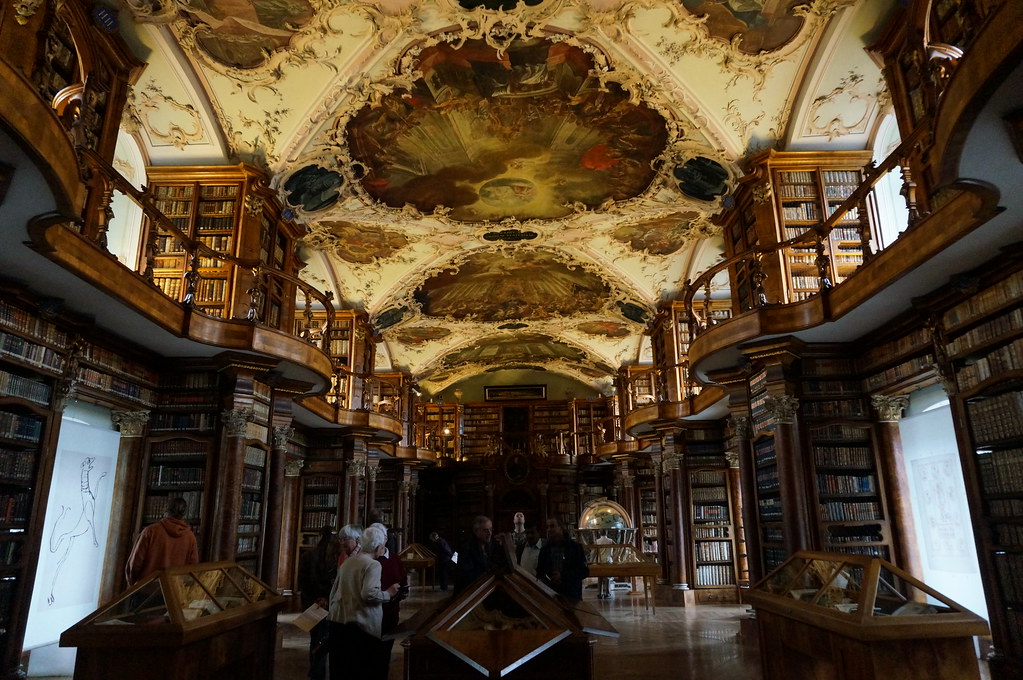
This is the ceiling in the Library's baroque reading room.
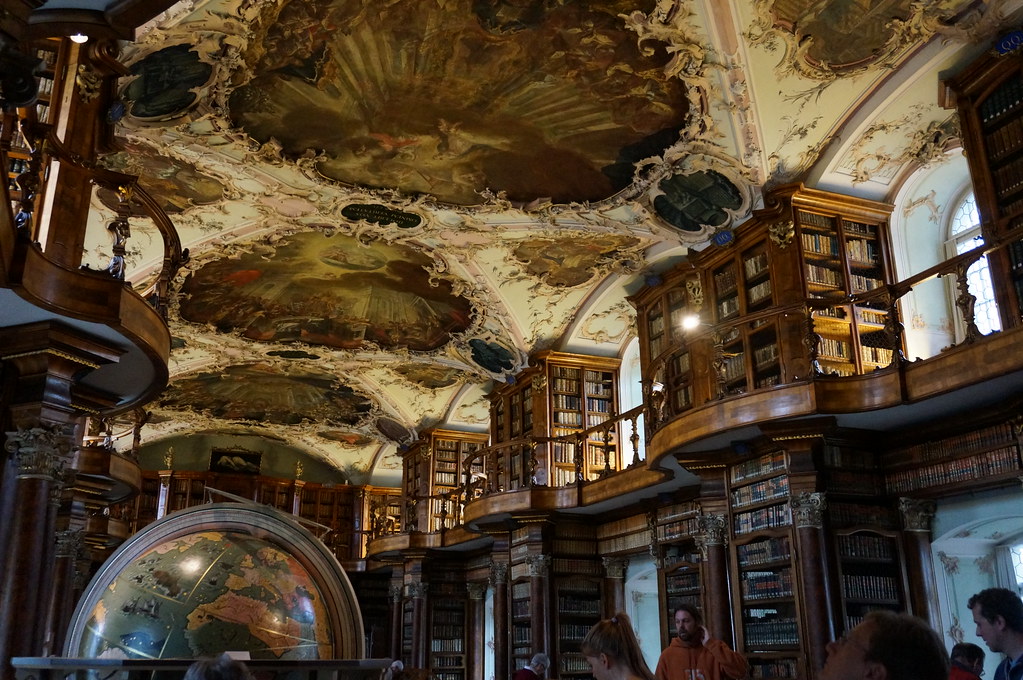
The abbey library (the Stiftsbibliothek in German) was built between 1758 and 1767 and still holds an impressive collection of over 100,000 manuscripts.  Of these, there are some 1,200-year-old illuminated manuscripts, forming one of the world's oldest and most impressive scholarly collections.  There is also a random Egyptian mummy and its inner coffins dating from 700 BCE on display in the Baroque reading room.  My favorite piece though has got to be the giant globe representing the world in 1571, with the continents painted as they would have been in the 1500s.  Apparently, Zurich took the original globe about 300 years ago, and this reproduction was given to St. Gallen in 2009 in place of the original one.
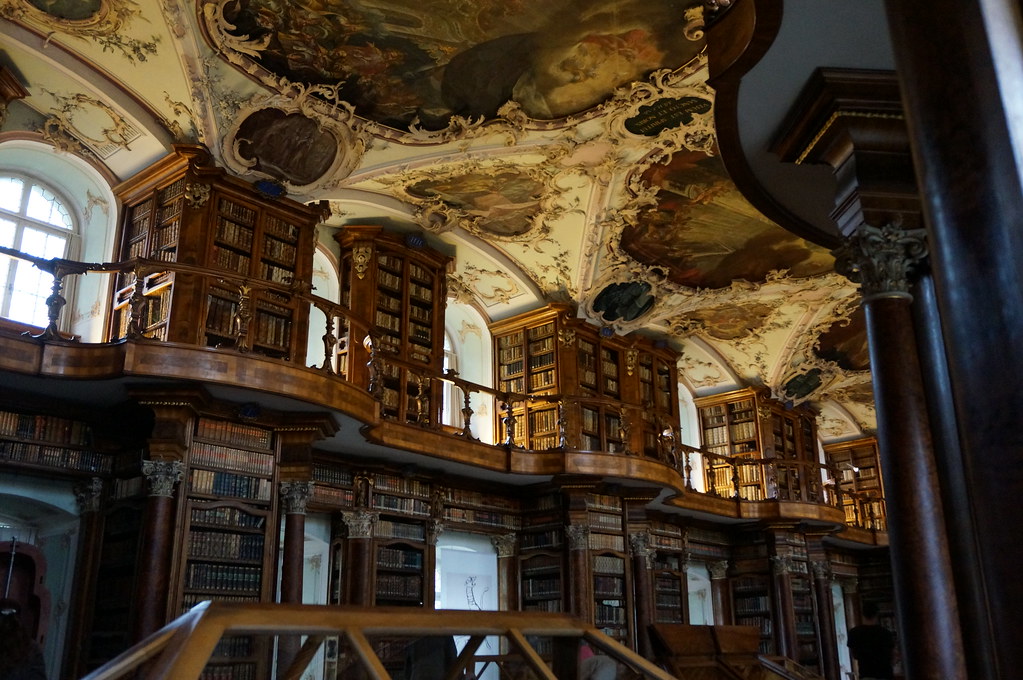
The library's baroque reading room itself is incredible.  The wide angle lens used for every picture that you see of the library makes the room appear bigger than it really is, but no matter the size of the room, the frescos on the ceiling and the rows of ancient books across the hardwood floors and beautiful wooden columns are amazing.  It really felt like stepping into the library from Beauty and the Beast.
I mean, this is the library from the movie:

This is the library in St. Gallen, in real life:

In addition to the globe and the mummy, the library also had a really interesting display about old forms of paper, books, and illuminated manuscripts.  Some of the old illuminated manuscripts copied by the monks who lived in the abbey even had book curses on them.  The monks would write curses into the beginning and ending pages of the books they copied.  Supposedly, the curses would protect the books from being stolen by cursing all those who harmed the books or took them from their rightful owners.  The display cases also had old paper from Ancient China and papyrus paper from Ancient Egypt, along with old scrolls of parchment sewn together.  

There were also old "notebooks" used in the Middle Ages that I found ingenious.  They were made of little wooden tablets that were hollowed out to have wax placed inside them.  The wax was written on using a metal stylus.  The writing end of the stylus was pointed while the opposite end had an edge to smooth out the wax so that it could be reused.  These wax-and-wood tablets were then bound together like a three ring binder so that they formed a kind of mini medieval notebook.  Pretty cool stuff.
Wax and Wood Notebook from Medieval times with a writing & smoothing stylus
But in short, that library was stunning.  Also on my list for future travels are all the libraries on this blog's list.

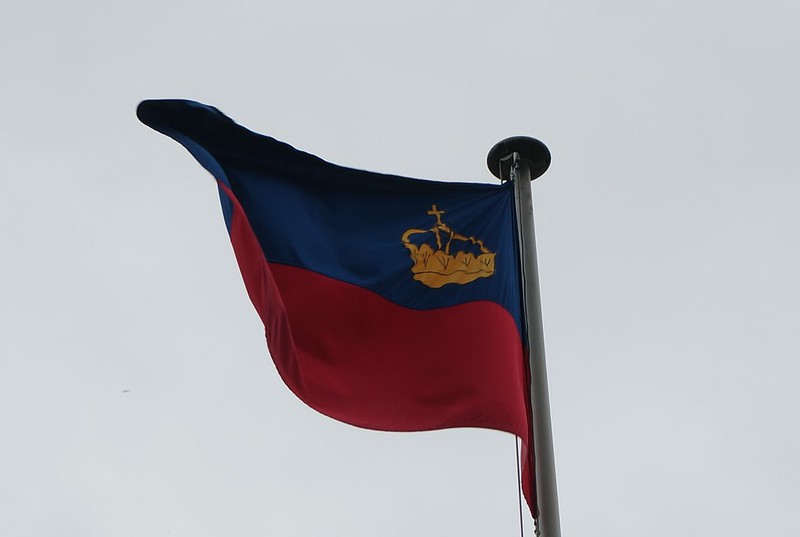
On to the next stop: Liechtenstein.  This whole time that I've been in Switzerland, Liechtenstein has been calling my name.  Well, right back at 'cha, Liechtenstein.
I mean, seriously, who wouldn't want to see what such a teeny tiny country is actually like (even if it's pretty similar to Switzerland)?  From Sargans, I was able to hop a bus into Vaduz, Liechtenstein's capital, for a roundtrip ticket of 12 CHF.  Also, just to tell you how much this trip was worth it, the Liechtenstein Tourism Office has a booklet with facts all about Liechtenstein entitled, "Liechtenstein: Experience Greatness - Princely Moments." Indeed.
House on the hilltop next to Vaduz Castle
There is not a whole lot to see in Vaduz.  I went on a Monday, so the famous art museum unfortunately was closed.  
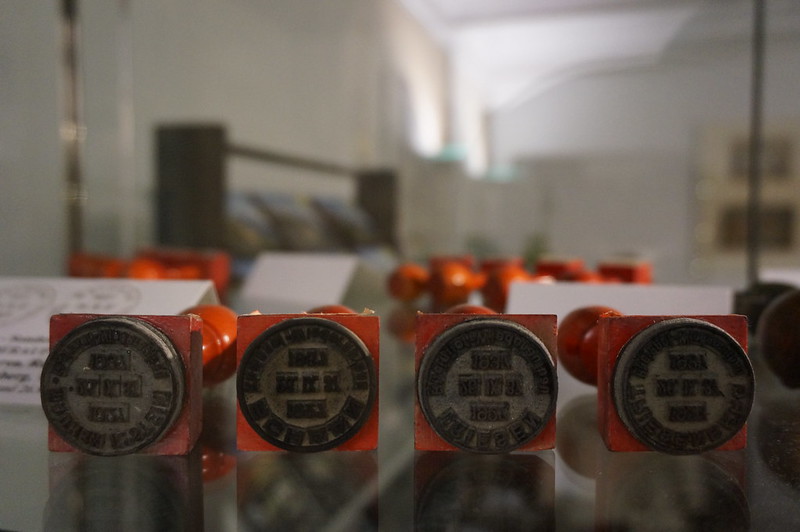
However, Liechtenstein is apparently known for its stamps, and the Postmuseum was open to visit for free.  It is just a small museum comprising only one floor in a building next to the tourism office, but it has an impressive collection of stamps.  There is also a video that describes the whole stamp-making process and how the process has evolved over the years.  
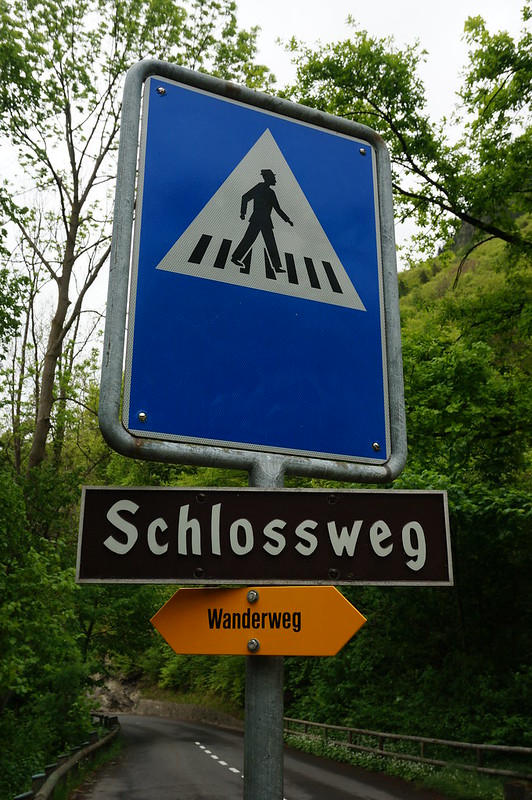
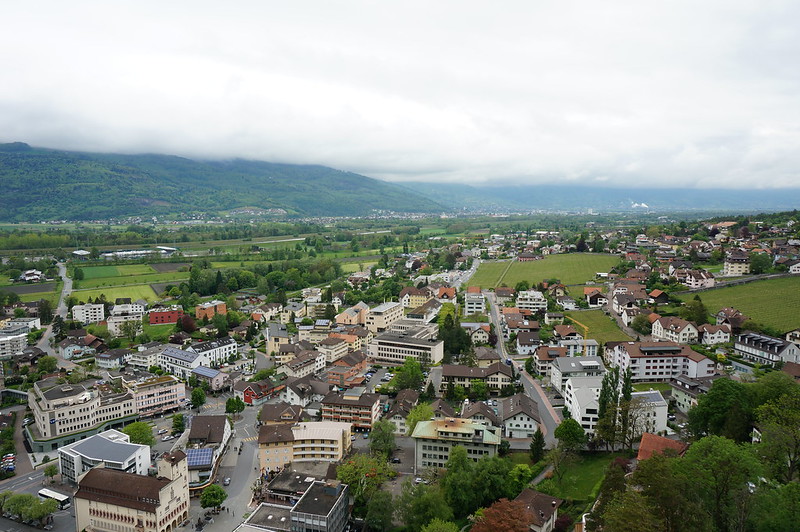
There is also the walk up the hillside to the Vaduz Castle.  The prince and his family live in the castle so you cannot enter it, but you can walk right up to it and alongside of it, with a great view of Vaduz in the valley below.
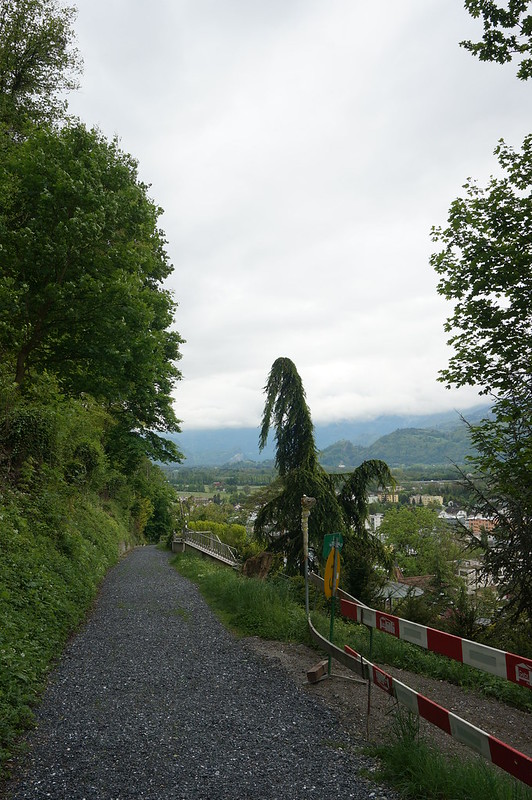


Along the way up to the castle, there are signposts with pieces of history all about Liechtenstein.  Because it seems like such a unique thing that Liechtenstein is still its own independent country, I thought I should include the facts here too.
Vaduz is the capital of the country with 5,000 inhabitants.  It is also the residence of the Princely House, the Seat of the Government.  
The Principality of Liechtenstein is a constitutional hereditary monarchy upon democratic and parliamentary basis (1921 constitution).  The power of the state is vested in the prince and the people, and the prince is the head of state.  Laws come into force only on receiving the assent of the monarch.  State administration is carried out by the government.  There is a complete system of courts of justice.
History since the foundation of the Principality:
  • 1699: Prince Johann Adam Andreas of Liechtenstein purchased the Lordship of Schellenberg
  • 1712: Andreas also purchased the County of Vaduz
  • 1719: Elevation of both territories to become the Imperial Principality of Liechtenstein, with immediate status, by Emperor Karl VI
  • 1806: Liechtenstein becomes a member of the Confederation of the Rhine, no longer part of the Empire
  • 1815 to 1866: Membership of the German Confederation
  • 1852 to 1919: Customs Treaty with Austria
  • 1868: Abolition of the Liechtenstein Army
  • 1924: Customs Treaty with Switzerland
  • 1978: Member of the European Council
  • 1990: Joins the United Nations as its 160th member
  • 1991: Member of the EFTA
  • 1995: Joins the European Economic Area (EWR) and the World Trade Organization (WTO)
Liechtenstein's Economic Activity: 44.8% is Industry and Industrial Trade; 40,3% is Commerce and Miscellaneous Services; 13.6% is Financial Services; and 1.3% is Agriculture and Forestry. 
In the 4th century AD, conveyance of the Christian religion by the Roman army of occupation of the area that is to become Liechtenstein.  Around 500 AD, proclamation of the Roman Catholic faith by Bishop Lucius, and Liechtenstein becomes part of the diocese of Chur (in Switzerland). Country patron is Saint Lucius.  The Roman Catholic church is the national church in accordance with the constitution (1921).  In 1997 the elevation to the rank of Archbishopric of Vaduz by Pope John Paul II.
The family of the Lords of Liechtenstein is first recorded in the first half of the 12th century, when the knight Hugo of Liechtenstein is mentioned.  The original family seat was the Modling Castle, south of Vienna.  Many members of the House of Liechtenstein serve the emperor as diplomats and generals.  In 1608, Karl I of Liechtenstein was elevated to the hereditary rank of prince.  The first ruling prince of Liechtenstein was Johann Adam Andreas, who died in 1712.  Prince Hans-Adam II is the 13th reigning prince of Liechtenstein.  Hans-Adam II was born on February 14th, 1945, with his accession as reigning prince on November 13th, 1989.  On July 30th, 1967, he married Countess Marie Kinsky of Wchinitz and Tettau.  Hans-Adam II has four children: Prince Alois, born 1968 (take-over of the government business in 2004 as representative of the sovereign prince); Prince Maximilian, born 1969; Prince Constantin, born 1972; and Princess Tatjana, born 1973.
Vaduz castle was first mentioned in documents in 1322.  The tower dates from the 12th century.  It was partially destroyed in the Swabian War of 1499.  Two round towers were added in the 16th century.  Further extensions were completed under the Counts of Hohenems in the 17th century.  It served as the residence of the prince's bailiff for part of the 18th century, then as a prison.  Buildings gradually fell into a state of disrepair.  The castle was used as barracks for the Liechtenstein army, then as a tavern, until 1896.  The castle underwent extensive renovation under Prince Johann II between 1905 and 1912.  The castle contains 130 rooms, and since 1938, has been the permanent residence of the ruling princes and closed to the public.

The view from the hilltop where the castle sits was beautiful.  The total size of the country though is something like 62 square miles with a population of 36,000 people. Smaller than Michigan State University's campus and student body, and smaller than the University of Michigan's student population.
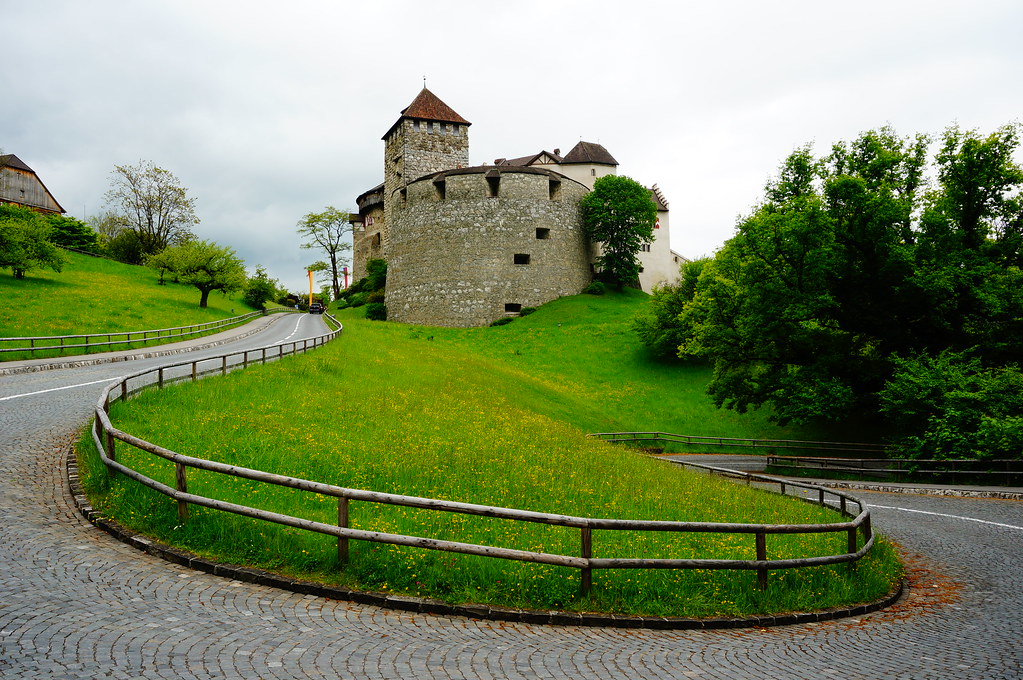
Vaduz Castle
From Vaduz, I made my way back into Switzerland to Sargans to hop the train to take me up the eastern border to Konstanz, Germany.  The last time I went to Germany was accidental (also how I first ended up in France, #Fraaaaaaaance) when I was driving on the highway from Geneva to Schaffhausen to see the Rhinefall.  I was in Germany for a grand total of about 10 minutes then, and due to the rain and train schedules, I would spend about fifty minutes in Konstanz, bringing my total time in Germany to about one hour (perhaps even less).  At some point, I should probably spend longer in Germany, although I would rather visit more impressive cities like Dresden, Berlin, and Munich.
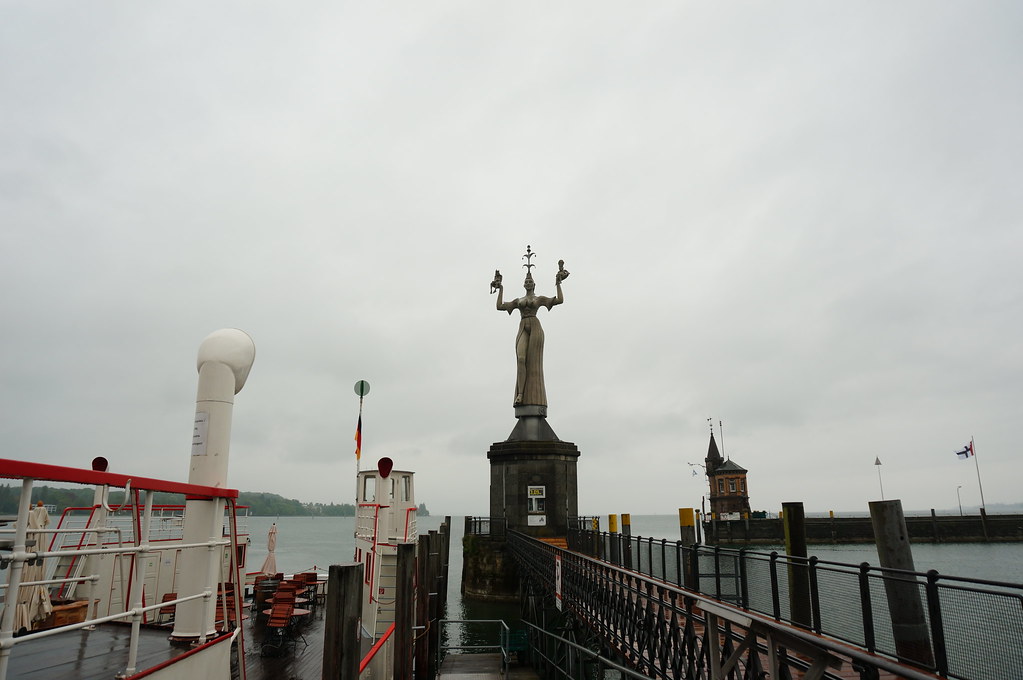
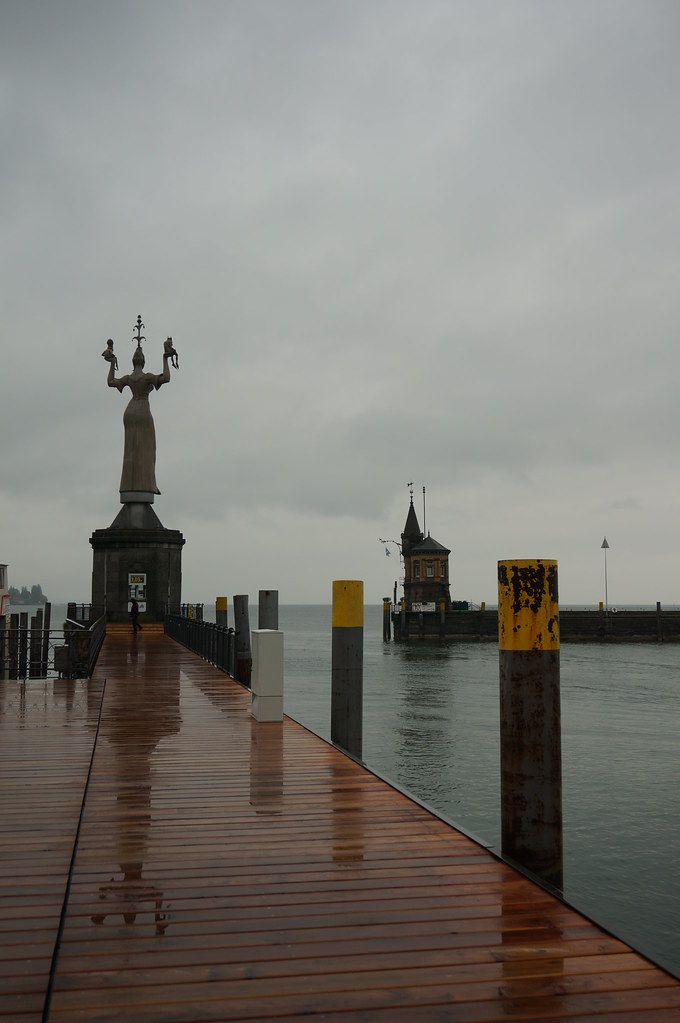
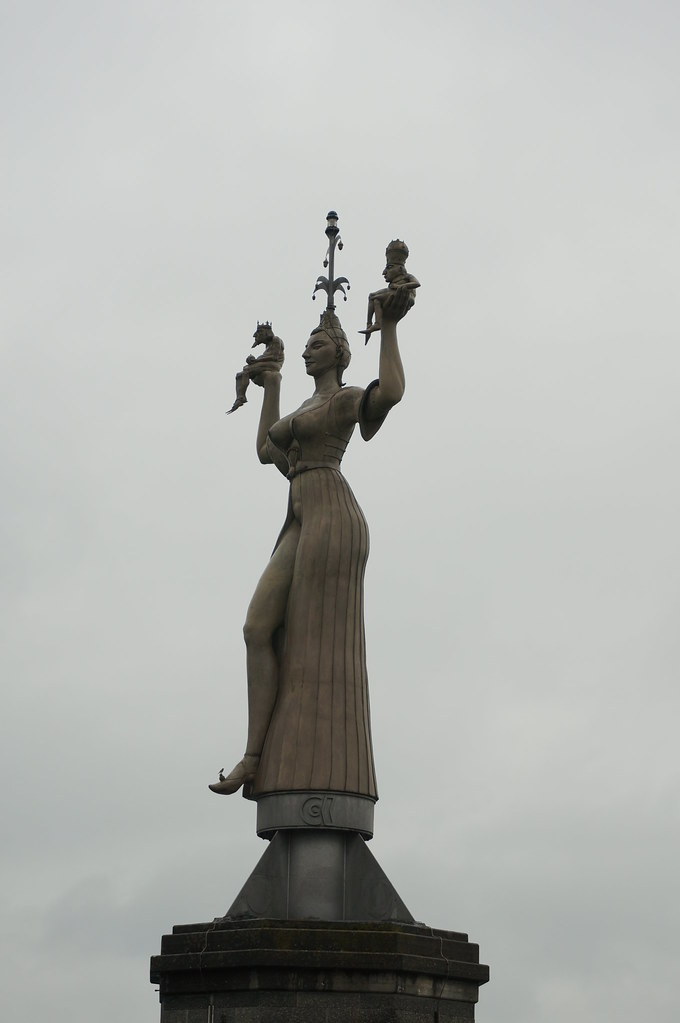
Konstanz is located on the Bodensee (see means "lake" in German) on the Swiss-German border.  The city was first inhabited during the Stone Age and is famous for its harbor, protected by the Imperia.  The statue rotates 360 degrees every four minutes and commemorates the Council of Constance that took place in the city between 1414 and 1418.  The city also has a beautiful Old Town area where there are remnants of its medieval city wall and is famous for its university (more things too, according to Trip Advisor).  And a fun fact: Konstanz is the birthplace of Count Ferdinand von Zeppelin, the inventor of the Zeppelin airships.  All in all, I was in Konstanz long enough to see the harbor and the Imperia, but since it was raining, there was not a good view of the lake and because of the train schedules, I did not have too much time to make the walk from the train station into the Old Town.

The trip back to Geneva from Konstanz was the trickiest part of this whole adventure.  I had to be on my last train to Geneva before midnight to still make my day pass count and I also had to arrive in Geneva before 1:00am when the trams would cut off for the night and would leave me stranded at Gare Cornavin.  Luckily, I had stopped at the SBB/CFF offices along the way to have them print out timetables for me.  I was able to use these printouts, my knowledge of Swiss trains, and the phone-a-friend lifeline to verify my alternative route back to Geneva from on the train without internet.

Konstanz
Dep. 19:21 (April 28th, 2014)
Weinfelden
Arr. 19:54
Weinfelden
Dep. 19:59
Bern
Arr. 21:58
Bern
Dep. 22:04
Lausanne
Arr. 23:15
Lausanne
Dep. 23:21
Geneva
Arr. 00:05 (April 29th, 2014)

All in all, the trip was great and I was able to see three countries in less than 24 hours, all for 62 CHF.  The abbey library in St. Gallen was magnificent and Liechtenstein was just about as randomly awesome as I had hoped.  Maybe a bit longer in some other parts of Germany (with better weather) next time, but definitely a good trip in my last week in Geneva.


Next stop, Rome!

Tuesday, April 22, 2014

Picnic with Mahatma

Springtime Gandhi!
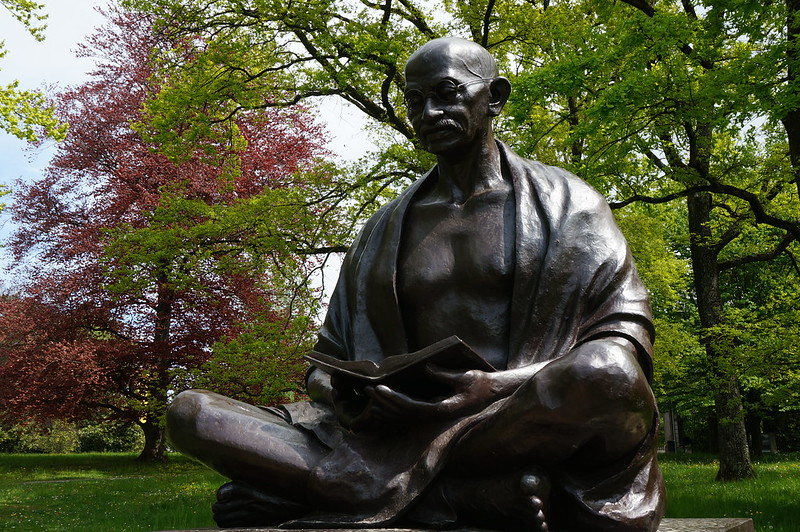
Every day on the way to work, I pass this statue of Mahatma Gandhi sitting between the two main entrances to the United Nations complex in Geneva.  And every day, I have been waiting for some beautiful spring weather to take a blanket out, spread it in the grass, and have a lunchtime picnic with Gandhi during my break at work.  
Winter rain Gandhi.  Best to wait for nicer weather.
Well, today Geneva was finally warm enough and sunny enough to make for a beautiful picnic.  I sent an email out to all of my classmates, and three friends showed up so that we could all spend our lunch hour for the day outside enjoying the beautiful springtime weather, with none other than Mahatma Gandhi watching over us.  It was a great break from work (our last week, too!), and it was so relaxing to enjoy the sunshine and fresh air.
Picnic Gandhi loves Budget Migros Paprika Wave Chips too!
In other news from Geneva today, I found this brilliant cartoon from the New Yorker magazine that perfectly sums up our new copy machine system at work.  A couple of weeks ago, someone decided that it would be a brilliant idea to not let people print from the large printers on each floor unless they had their ID badge with them at the printer to retrieve the job.  Never mind that our office is notoriously slow for giving people properly functioning ID badges in the first place.  Or that now they have to retrain the entire building for this new addition to the printer which really isn't that helpful (as in, resources could probably have been better allocated).  It's not such a big deal for me, since I print to an old printer right next to my office, but the cartoon made me and my coworkers laugh.  Enjoy.
New Yorker cartoons are the best.

But now, only a few more things on my Geneva bucket list before heading back to the great state of Michigan in the USA to graduate from law school!  BOOM!
You're not too shabby, Geneva.

Friday, March 28, 2014

United Nations in Geneva


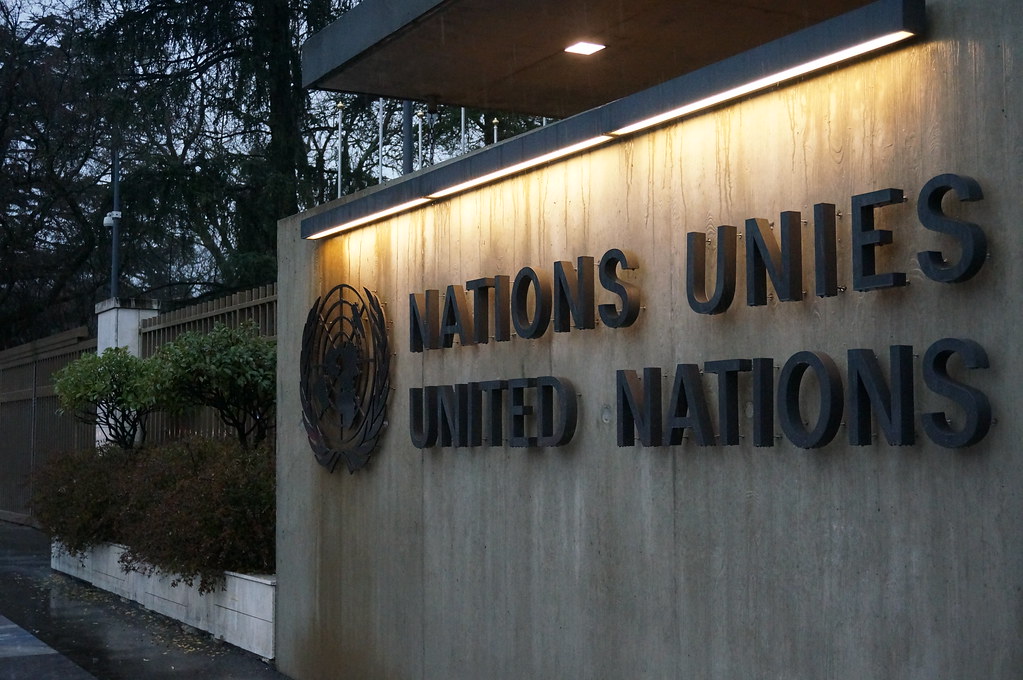
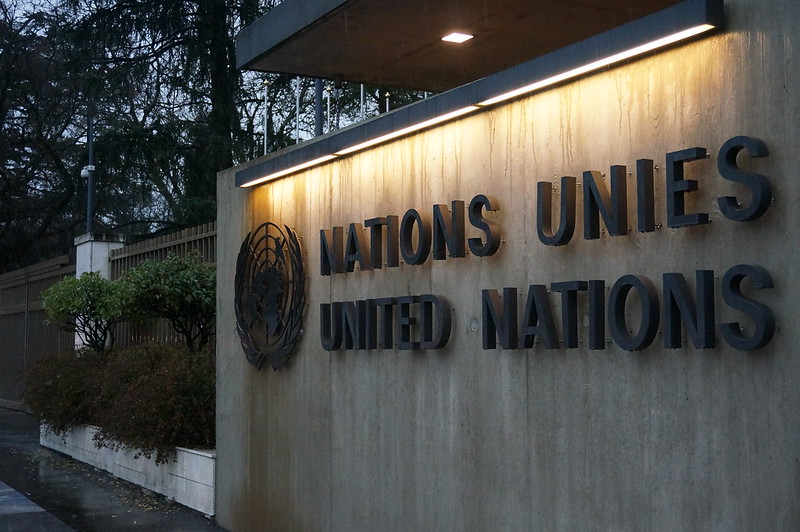
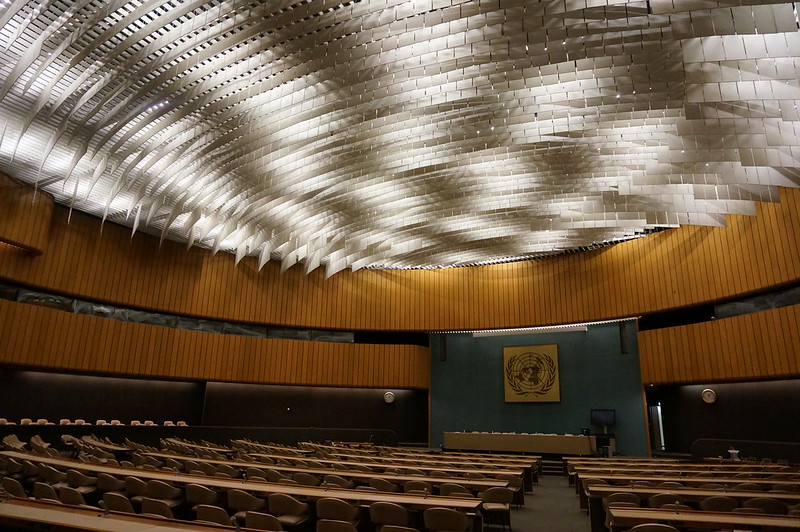
All the way back on January 16th, 2014, in the first week of our program, we were able to visit the United Nations.  The current Palais des Nations was built between 1929 and 1936 for the League of Nations.  After World War II, the complex became the headquarters for the European office of the United Nations in 1946, quickly evolving into the largest center for multilateral diplomacy in the world.  Today, Geneva's Palais des Nations hosts about 9,000 conferences and over 25,000 delegates each year.  It is second largest nexus for United Nations operational activities after New York.
Grand Chamber, largest conference room
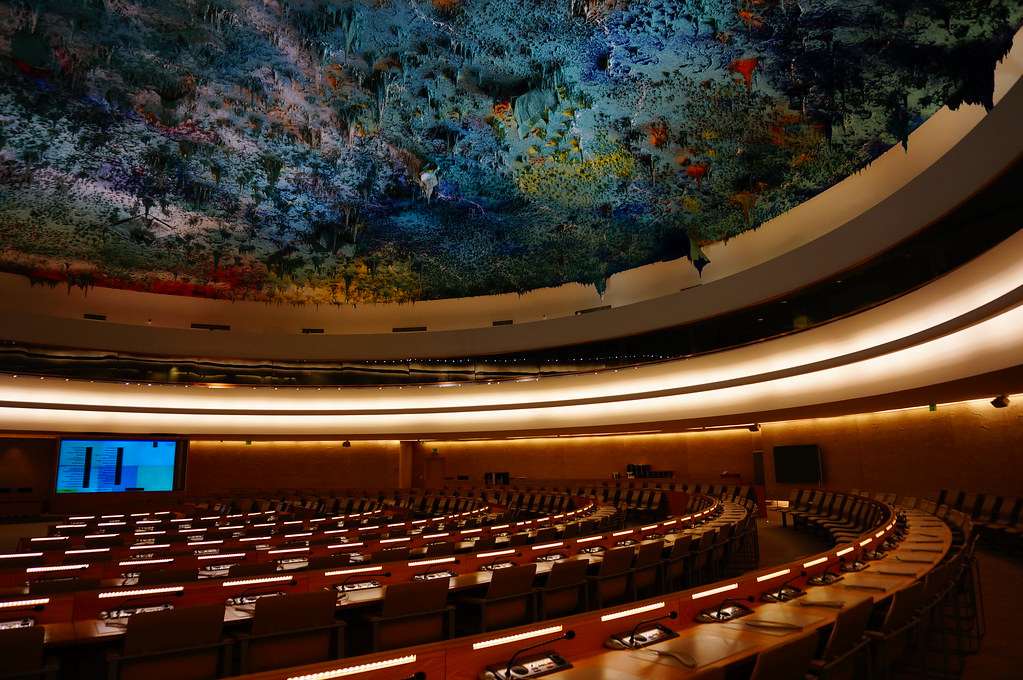
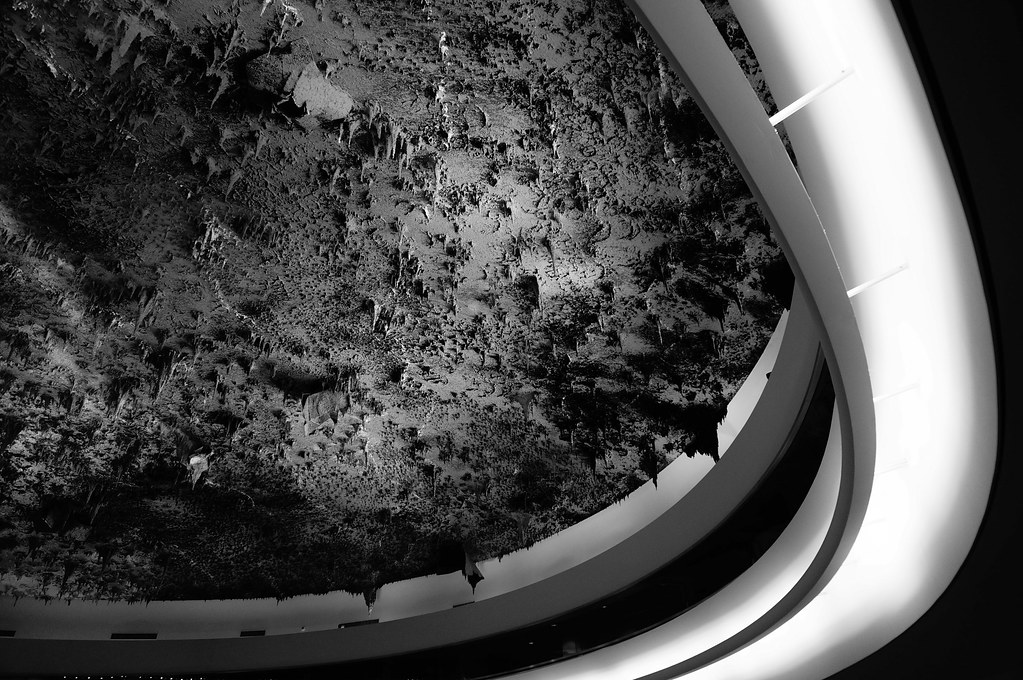
On our tour, we were able to learn more about this fascinating history and see the works of art that each country donated to the United Nations upon gaining membership to the organization.  We also were able to see and sit in the delegates' seats in both the Grand Chamber and the Human Rights Council Chamber.  The Human Rights Council chamber is beautiful with the new ceiling, a gift from Spain and finished in 2008.  It is called, "The Ocean" and made by Spanish abstract artist Miquel Barcelo.  The ceiling first had to be reinforced so that it could handle the weight of the art to be installed.  For the ceiling, Barcelo used 35 tons of paint!  The whole project cost $23 million to boot.  The concept for The Ocean and the multicolored stalactite forms are meant to represent a sea and a cave, in absolute and opposing union, where the each nation is unique, just like each individual stalactite, but together with the ebbs and flows of the water, they can move together in harmony.  Barcelo has said that he found his inspiration "on a day of immense heat in the middle of the Sahel desert [where he saw] the mirage of an image of the world dripping toward the sky...flowing drop by drop."  The ceiling is impressive from all angles, and I loved looking at its colors and forms.
So cool to be on the floor of the HRC!
I could stare at this ceiling art all day, and this only one small section!
It is even stunning in black and white.
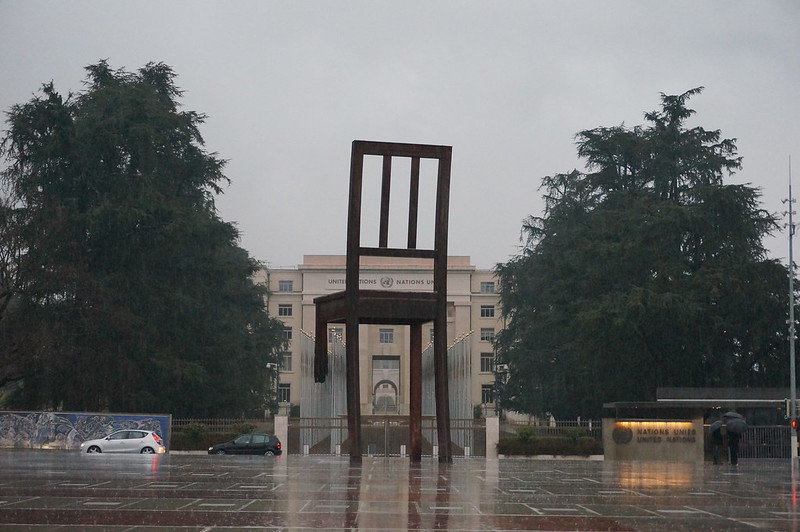
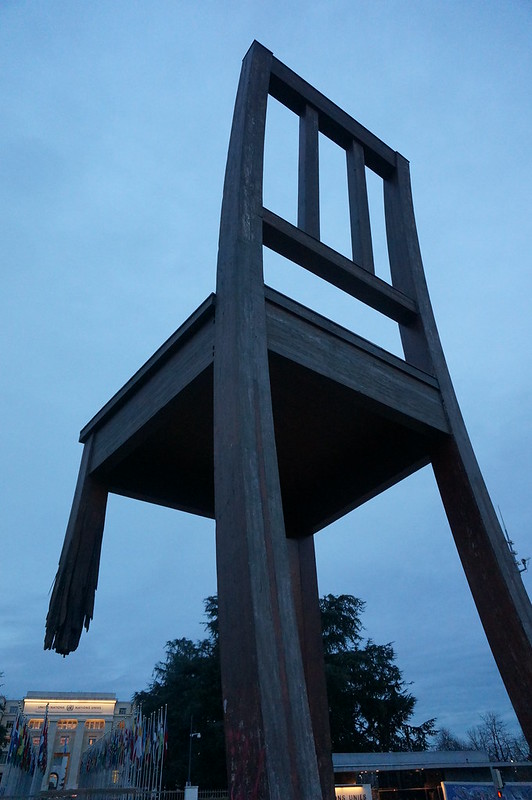
Out front, the United Nations also has another important large work of art.  It is the Broken Chair by Swiss artist Daniel Berset.  It is made of 5.5 tons of wood and stands 39 feet (12 meters) tall.  The statue was made in 1997 for the NGO Handicap International.  The broken leg on the chair is meant to symbolize the harm caused by land mines and cluster bombs and acts as a reminder in front of the Palais des Nations to governments to ban the use of these weapons.
Broken Chair in the rain
Broken Chair at dusk
Since our United Nations visit, I have returned to the Human Rights Council chamber several times to watch various sessions.  One of the largest events in Geneva at the Human Rights Council are the Universal Periodic Reviews (UPRs).  These are reviews conducted on each individual country by the Human Rights Council where the country must give a statement about the status of human rights in its country and then answer questions posed by the Council about its human rights record.  

Sometimes, these kinds of events are frustrating to me because it is hard for me to see how this kind of dialogue of reading two minute, pre-drafted statements (that are already made available on record to the public) is at all interactive or likely to lead to improving the status of human rights on the ground in individual countries.  However, unlike UN activities in New York, NGOs can participate in the Human Rights Council in Geneva.  NGOs are able to ask questions and be present to record the responses given by national delegations to questions posed by the Council.  Sometimes, the NGOs can then use these statements made in international forums such as the UPRs to gain political capital at home and hold the government accountable.  In other examples, where progress on specific indicators can be tracked annually, this can also lead to improvements, albeit gradual, in human rights on the ground.  

In case you are interested, you can watch one of the UPRs here:


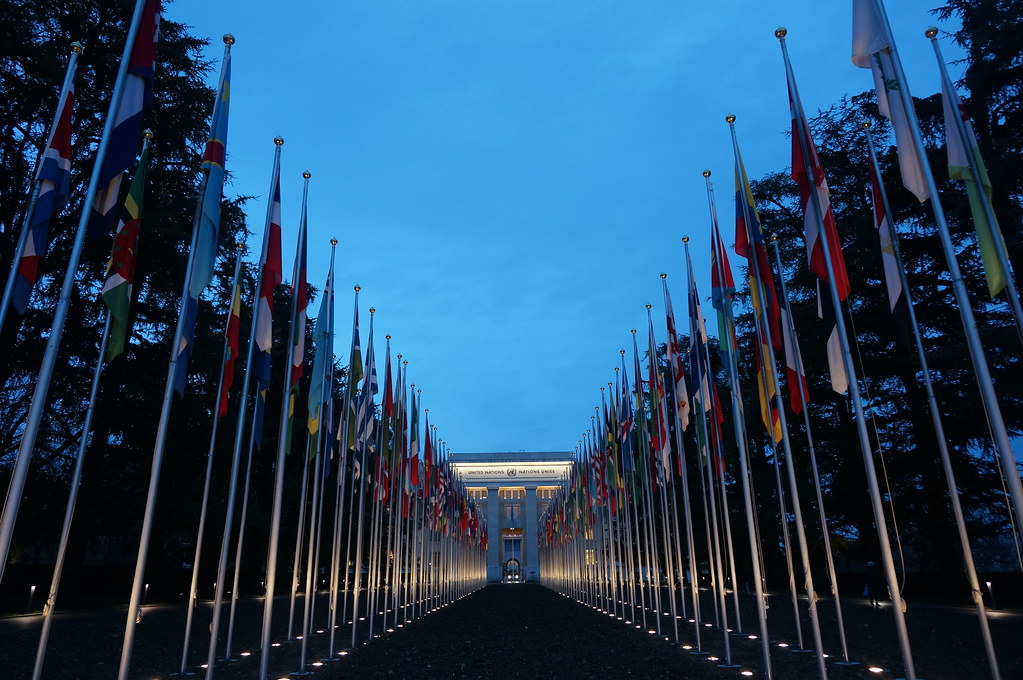
When I first visited the United Nations in January, the flags had been taken down for maintenance on the grounds.  Now the flags are finally up.  After work one day, I was able to stop by with my camera and take some pictures of the flags at dusk as night fell.  
Flags at Dusk
Being able to actually experience some of the different types of events that take place at the United Nations has been a great experience in my internship here in Geneva.  It is so cool to see things I read about first-hand and learn how the international system works.  What a wonderful way to finish my last semester of law school.
Flags at Night


Tuesday, March 25, 2014

Norouz at the United Nations


Thursday, March 20th, 2014 was the first day of Spring.  The following Tuesday, the Iranian mission to the UN and eight other central Asian countries (Afghanistan, Azerbaijan, Kazakhstan, Kyrgyzstan, Tajikistan, Turkey, Turkmenistan, and Uzbekistan) hosted a Norouz lunch and cultural event at the Palais des Nations in Geneva.  It was great to see so many countries putting on a great event together to share this beautiful piece of shared culture with the United Nations community.  Each country had a table with information about its particular celebrations for the holiday as well as food and sweets from that country.  There were also musicians that played from a classical Iranian musical group after the delegates made speeches and wished the attendees a happy new year.
Classical Iranian Music
For thousands of years, Iranians, and those in Central Asia influenced by Persian culture from the empire's spread thousands of years ago, celebrate spring's arrival in a holiday called Norouz.  Norouz literally translates as "new day" and has its roots from thousands of years ago in ancient Zoroastrianism.  It marks the beginning of the year on the Iranian (solar) calendar, so while it's 2014 in the USA, it's 1393 in Iran (Iran's calendar begins its years counting in 621 AD when Mohammad PBUH made the pilgrimage to Medina).  Every year except this year (on account of me being in Geneva), our family has been together to celebrate, even when I was in DC.  As we do not have as many relatives nearby, we take the opportunity each year to invite over different friends to join us in celebrating.  There are also shows each year put on by student organizations at the universities, like last year's 1392 celebration at Michigan.
Norouz is celebrated by over 300 million people around the globe and dates back more than 3,000 years.  Norouz is even recognized by the UN General Assembly in Resolution 253 (A/Res/64/253) and included on the UNESCO list of Intangible Cultural Heritage of Humanity.  It's a great holiday and something my family celebrates every year (alongside our American traditional holidays), so I'll provide more of a description below.

The holiday celebrations last for thirteen days, although preparations begin before, including khaneh tekani - "shaking the house," otherwise known as "spring cleaning" - and chaharshanbeh soori.  Chaharshanbeh Soori takes place on the eve of the last Wednesday of the year (Tuesday night) and involves jumping over a fire while shouting, "sorkhie to az man va zardie man az to!" This chant asks the fire to give the jumper its healthy red color and take away the jumper's sickly yellow pallor.  The idea is to have the fire cleanse the jumper, removing all sickness and bad luck from the past year so that he or she can start fresh for the new year to come.  Unfortunately, I grew up in a city with too small an Iranian population, so we only ever celebrated this part of Norouz once - in a family friend's driveway at night jumping over a hay bale set ablaze.  Welcome to Michigan.

For the holiday itself, there are some traditional foods associated with the celebrations.  This typically means a bean and noodle soup (ash-e reshteh), fish with herbs and rice (mahie sabzeh), and desserts (think baklava and cardamom rice cookies).  However, the Iranian table switched it up and did chicken kubideh (ground meat kabobs) with rice and fessenjan (a chicken pomegranate dish).  The food was all still amazing.
Unconventional Haft Sin - everything was purple-themed
The biggest aspect of preparing for Norouz on the day itself though is setting up the special table - sofreh-e haft sin (pronounced "seen"), the "table of the seven s's."  "Haft sin" refers to placing seven items on the table that start with the letter "س" in Farsi and each have a special significance, many having to do with rebirth, health, and prosperity.  Setting the table as a family is very similar to placing ornaments on a Christmas tree together.  The "seven s's" and their significance are as follows:
  1. Sabzeh (سبزه) - green sprouts from lentils or wheat, with a red ribbon tied around, symbolizing life.  On the 13th day of celebrations, Sizdah bedar, families go on picnics and people tie the sprouts together and throw them into moving water so that the current will carry their wishes onward to be fulfilled in the New Year;
  2. Samanou (سمنو) - dish made of wheat germ or lentils (we don't usually, or ever, have this on our table), symbolizing affluence;
  3. Sib (سیب) - apples, symbolizing beauty and health;
  4. Sonbol (سنبل) - hyacinth flowers, one of my favorite flowers for its fragrance;
  5. Senjed (سنجد) - dried fruit from a lotus tree, symbolizing love;
  6. Seer (سیر) - garlic, symbolizing good health;
  7. Somagh (سماق) - sumac, a deep fiery red color representing beauty and the color of the sunrise. 
Haft Sin Norouz table - 1391
There are also other "non-س" items that are placed on the table that carry their own significance.  These include:
  1. A Qur'an;
  2. A book of poetry (Divan-e Hafez shown in picture above);
  3. Vinegar (serkeh سرکه), symbolizing old age and patience;
  4. Gold coins (sekkeh سکه), symbolizing wealth and prosperity;
  5. Goldfish, symbolizing life;
  6. Rosewater for its fragrance;
  7. Colorfully dyed eggs, symbolizing fertility;
  8. An orange floating in a bowl of water, representing the earth in the universe (it is believed that the orange will rotate ever so slightly at the exact moment of the vernal equinox);
  9. Candles lit for each child in the family; and
  10. A mirror, placed behind the lit candles so that it reflects the light back to the viewers.
Even though I am in Geneva, it was great to be able to see a bit of Norouz at the UN, and to run into coworkers at the event as well.  Wishing everyone an amazing 1393!


!!! نوزوز تان پیروز

Twitter Delicious Facebook Digg Stumbleupon Favorites More

 
Design by Free WordPress Themes | Bloggerized by Lasantha - Premium Blogger Themes | Walgreens Printable Coupons