This
past summer, I was placed as an intern in the Hispanic-Paraguayan Center. The Paraguayan community is a significant
immigrant community in Madrid, comprising approximately 4 percent of the city’s
immigrant population.[xxvii] This CEPI offers legal, employment, and social
services, in addition to its staff and community volunteers teaching courses
ranging from basic computer skills to job training for elderly care. However, as with all other CEPIs, the Center
is open to people of all backgrounds and many of its clients come from other
South American countries, a few African countries, as well as Romania. The CEPIs also offer multicultural events in
hopes to promote positive interactions between the native Spanish and the
immigrant communities throughout the city.
Being able to work and observe the way in which this center strived to
achieve its goals of promoting integration was a great experience. However, although all of its employees are
committed to promoting and facilitating integration of Madrid’s immigrant community, the events of
the FIFA 2010 World Cup highlighted the divides in Madrileño society.
 |
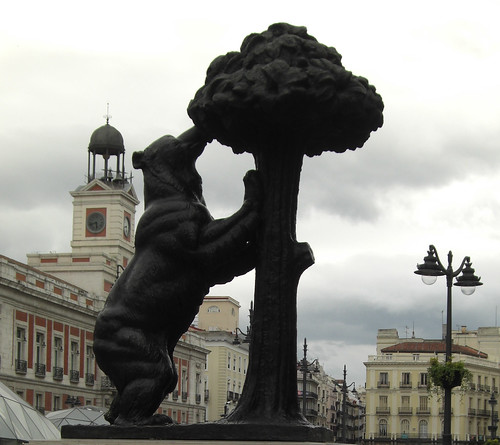
Oso y Madroño, A Symbol of Madrid
Source: Taken by Takhte-Sarah, June 2010, Madrid, Spain. |
Public Display during the
World Cup: Within the Workplace
As
the Spanish national team kept advancing in the World Cup, public displays
became very apparent in within Centro Hispano-Paraguayo and resulted in telling
interactions between its employees. This
CEPI employs nine workers, of whom two are Paraguayan and the rest are white
Spaniards, although some have familial roots in other European countries. All the employees range from 24 to their
early forties, with the majority between their late twenties and
mid-thirties. Excluding the other Michigan State University
student and myself, there are four women (although one woman’s contract expired
in the middle of the summer) and five men employed in the office. Two of its employees, the receptionist and
labor services specialist, are Paraguayan and fluent in both Castilian Spanish
and Guarani. The language politics
definitely feature into office dynamics and can be observed during the one and
a half hour lunch period. During this
time, the two Paraguayan employees sit on one end of the table in the break
room and carry on their own conversation, frequently speaking in Guarani to one
another. The other employees speak with
one another in Spanish, but did not engage us as interns very often and the
conversations appeared to be dominated by the male employees.
Despite
the goals of the CEPIs to foster integration, within the workspace, the divides
in this Comunidad Madrid policy were clearly visible during the World Cup. Public national displays were prominent
within the Centro Hispano-Paraguayo, and the first example can be seen in the
young Paraguayan receptionist bringing in a Paraguayan national jersey to wear
on the days Paraguay
had matches. Luz, one of the Paraguayan employees, also wore and displayed
the jersey for two days prior to the Spain-Paraguay match. Santino writes that where symbolic objects
are placed is an important element in their impact.[xxviii] The content of the artifact and its location
“are both aesthetic and political considerations. These spacial relations combine to create
visual statements that communicate larger, somewhat more complex social and
political messages.”[xxix] As the receptionist, Luz is the first person
seen and with whom the center’s clients interact. Because all CEPIs in Comunidad Madrid are open to
people of all nationalities and ethnic backgrounds, it is especially important
that the goals of the Madrid Plan are implemented from the beginning. Additionally, the receptionist is the first
person to interact with representatives from the municipal government, other
organizations, teachers, and volunteers that might come to the center.
Luz bringing in
a Paraguayan national team jersey and wearing it as she interacted with clients
challenges the effectiveness of the municipal government’s success in
integration. By wearing this jersey, Luz
sends a strong message of affiliation with the Paraguayan nation (even if she
is part of the diasporic community not contained within the Paraguayan
nation-state’s physical borders), not the Spanish nation. In this instance, the World Cup national team
affiliation is used as a means to challenge the majority Spanish community’s
claims that Madrid is part of a united Spanish nation – and this challenge can
be seen the minute a client walks into the center.
However, Luz’s
own affiliation with the Paraguayan national team during the World Cup
tournament was not the only instance where national claims were made within the
office. After Luz wore and displayed her
Paraguayan jersey to work for a couple matches, one of the young male Spanish
employees, Juan, brought in his own symbol to be displayed in the back office area,
where three employees work in an open office space and two more with
glass-windowed offices facing the open area.
Although Juan, the community relations and event coordinator, has his
own office in this area, he chose to bring in a large Spanish flag and hang it
in his office window so that it faces outwards to the rest of the common office
space. The desks in this area that
directly faces the flag in Juan's office belongs to Beto, the other Paraguayan
employee in the office who is an employment specialist. Beto works with immigrants, both those
with and without legal permission to work, in order to schedule them for
interviews for open positions. He also
runs informational workshops for both legal and illegal workers in order to
offer them guidance about how to regularize their immigration status and advice
for obtaining and maintaining employment.
In analyzing the
ways in which public displays make claims about national identity, restricted
and unrestricted viewership or participation is crucial. These types of viewership highlight the
importance of where displays occur and for whom as essential determinants in
the construction of the nation. Although
the flag and its display in the office were restricted in the sense that this
part of the center was generally reserved for employees and clients that had
appointments with either Beto or one of the attorneys, it was also
unrestricted in that the area was surrounded by windows such that any passerby
would have been able to see Juan's flag and that often, Beto, the attorney,
and the other employees met with walk-in clients. The fact that the flag display was meant to
be so public and directly faced the only other Paraguayan who worked in the
center was an especially powerful reaction to Luz’s jersey. Juan’s gesture becomes even more significant
when considering that Beto constantly brings clients back into that part of
the office for employment consultations and that these clients are all
immigrants, the overwhelming majority from Latin American countries. The placement of this flag within the office
given the special relations of the office result in an important visual message
about the dominance of the Spanish national narrative in a place that is
supposed to be promoting a much more cosmopolitan vision for integration of its
minorities. The flag and its wide
acceptance within the office undermines the very claim that the Comunidad
Madrid center is open to people of any background with equal access, regardless
of the group(s) in which it specializes.
An interesting
side-note to Juan’s flag display occurs the day after the final match and
awards ceremony in South
Africa.
While all of the employees were discussing the final match and the
awards ceremony, Juan had become fixated with a person who tossed another
country’s flag into the air behind the Spanish national team as they were
receiving their medals on stage, as seen in Image 1.
 |
Image 1. Spanish National Team
World Cup Ceremony, South Africa, July 11, 2010
02:00
into video; man quickly holding up an Algerian flag behind the Spanish national
team.
Source:
http://www.youtube.com/watch?v=kQeP-2U2lYQ
|
He kept referring
to the incident as a conspiracy and wanted to know which country this flag
represented and why it was shown. After
some browsing, the group came to the consensus that it was the Algerian
flag. Juan then began referring to the
incident as the “Algerian Flag Conspiracy.”
Since Juan always enjoys playing office pranks and telling jokes, I
quickly drew and colored an Algerian flag on a small index card and taped it
facing outward in the corner of his office window with his Spanish flag
occupying the rest of the space when he was on a smoking break. However, once he returned from his break and
went back to his office, he did not find the joke as amusing as the rest of the
employees and again started talking about the “Algerian conspiracy.”
His seriousness
regarding any type of attention away from the Spanish flag and its national
team further demonstrates the importance of these public displays and also
suggests how Juan perceived the Spanish nation and threats to it. On such a historic moment for the Spanish
national team, Juan used the office and the Spanish flag’s particular display
within it as a means by which to promote Spanish national identity and its
power relations. Although seemingly
innocuous, such displays further serve to highlight the disparities between
Comunidad Madrid’s
message of integration through its CEPIs; this challenge becomes even more
significant when considering that these contested symbols are being used by and
targeted towards the social relations coordinator and employment specialist and
his clients respectively.
Public Display during the
World Cup: Santiago
Bernabéu
Located
within the northern part of Madrid
is the Chamartín district, home of the Real Madrid Football Club stadium. This district is known as the financial
district of Madrid and is where the government buildings comprising the Nuevos
Ministerios (New Ministries) complex. Of
Madrid’s 21 districts, Chamartín’s population is comprised of 11.9 percent
immigrants, one of the lowest percentages in the entire city.[xxx] The Santiago
Bernabéu stadium and its connection to the world’s richest club team for five
consecutive years (Wilson) is a testament to the
wealth, prestige, and symbolic importance of this district to the city of Madrid. During this past summer, the area in front of
the stadium was used as a public space to gather and watch the Spanish national
team play in all of its games except the final match with the Netherlands, as seen in Image 2. Hyundai hosted the games’ viewing at the Real
Madrid stadium and called the area the Hyundai Fan
Park. The area outside of the stadium was packed
and fenced off from the street, with police officers monitoring the entrance
through the fences into the viewing area.
 |
Image 2. Santiago Bernabéu
Hyundai Fan
Park, June 2010
West
side of Santiago Bernabéu Stadium, facing North, on Pasello de la Castellana.
Picture
taken by Shanna, June 2010. Madrid,
Spain.
|
The assemblage of Spanish fans at Santiago Bernabéu
stadium is important for promotion of a Spanish nation, as assemblage allows
for “the juxtaposition of elements that can be and often are displayed as
discrete units in order to modify, strengthen, or otherwise develop a symbolic
public statement.”[xxxi] Viewers and World Cup fans wore jerseys,
flags, scarves, and face painting with Spain’s colors to the match. Their specific choice of dress and
congregation in this area become acts of self-identification with the Spanish
national team and delineates this public place as a place for the supporters of
the Spanish nation. Noise and other
displays would also be used to identify this area as connected to the Spanish
nation, as fans would set off fireworks and firecrackers in the south part of
the lot, just outside the fences, as seen in Image 3. Instead of being merely passive observers,
these audience members gathering in this public place for the Spanish national
team’s matches transforms them into active ritual participants.[xxxii]
Image 3. Fireworks at Santiago Bernabéu
Southwest corner of Santiago
Bernabeu stadium, on Pasello de la Castellana.
Picture taken by Takhte-Sarah,
July 3, 2010. Madrid, Spain.
Although
the name of the viewing area became the Hyundai Fan
Park when sponsoring the
public viewing of World Cup games, the gigantic Santiago Bernabéu stadium towered in the background, making it impossible
to dissociate the location of the World Cup games’ viewing from the Real Madrid
club and its history and the implications for Spanish nationalism. The city of Madrid, as the country’s capital, already
emphasizes the power of the Spanish state.
While Real Madrid has a long, fascinating history as a club team, it has
also been historically affiliated with the state, especially under Francisco Franco’s
dictatorship, from 1939 until 1975.
Historically, the Real Madrid club promoted the “notion of a single,
centralized Spanish nation,”[xxxiii]
and it was used by Franco and his regime as a tool for promoting Spanish
nationalism.[xxxiv] During his rule, many military figures and
generals were in prominent positions of power in the soccer authorities and in
most clubs.[xxxv] Real Madrid even earned itself the nickname
of “the team of the regime.”[xxxvi] Although Franco’s regime ended with his death
in 1975, Real Madrid’s connection as an agent of the state, representing the
capital and its centralist policies,[xxxvii]
has not diminished.
The use of the Real Madrid stadium in the Chamartín
district, a district with relatively few immigrants, plays a powerful role in
reinforcing the dominance of the Spanish nation. This space connects the viewers and World Cup
fans not only to the city of Madrid,
but to the national government and its policies. The choice of placing the Hyundai Fan Park at the Real Madrid stadium over the other major Madrid football club’s
stadium (the Atletico Madrid club does not have the same history as Real Madrid
and is seen as a type of populist rival to Real Madrid’s dominance) sends a
further message that reinforces the narrative of the Spanish nation-state. The viewers, through their attire and manners
of celebrating, engage in a ritualization of public space that reinforces a
differential national identity placing the Spanish nation-state as superior to
all other nation-states. Given the role
of assemblage at the Santiago Bernabéu stadium, it is not surprising that the
crowd in attendance, from my observation, appeared to be majority white Spanish
fans as opposed to fans of other nationalities or affiliations. Even when gathering to watch and enjoy World
Cup matches, the municipal government’s goals of immigration have obviously not
materialized and the associations between the matches viewed at Santiago
Bernabéu and the Spanish national identity do not allow for widespread
inclusion of the city’s large immigrant population.
Public Display during the
World Cup: Plazas de Colón and Cibeles and the Autonomous Regions
For
the final match of the 2010 World Cup between Spain
and the Netherlands,
the area at Santiago Bernabéu was deemed to be insufficient for the number of
viewers expected. The Hyundai Fan Park was moved from the Real Madrid stadium to the
center of the city, with one big screen at Plaza de Colón (Christopher Columbus
Plaza) and another at
Plaza de Cibeles. The entire area
between the two major plazas in Madrid was closed to traffic and an estimated
250,000 people were in attendance.[xxxviii] The location of the final match in the city
known for its plazas and fountains is especially significant in analyzing
national identity construction through the World Cup. The Columbus
Plaza is a monument to the conquests
of Latin America financed by King Ferdinand
and Queen Isabella; a gathering at this location serves to glorify this
conquest and its role in defining the Spanish nation. The Plaza de Cibeles is the rallying point
for Real Madrid. The fact that this
plaza was also used as a viewing point for the final match reinforces the
dominant narrative of the Spanish state and its national team’s construction of
borders at the expense of the other.
 |
Image 4. Rushing the Fountain at Plaza de Colón
Crowds
broke down the gated barriers and rushed into the fountain at Plaza de Colón upon the Spanish national team
scoring the winning goal.
Picture taken by Takhte-Sarah, July 11, 2010. Madrid,
Spain.
|
However
central these two plazas are to the city, the crowds were contained until the
winning goal was scored against the Netherlands. Upon the Spanish national team’s dramatic
win, the crowds set off fireworks and firecrackers, poured out into the streets,
rushed into all of the fountains in the city (Image 4), and young men
with flags began using them to role-play bullfighting with oncoming traffic (Image
5). Bullfighting is another symbol
associated with the Spanish national identity and Barcelona received harsh
criticism this past summer for legislation banning bullfighting in Catalunya
set to take effect in 2012 because it was deemed to be a Catalunian nationalist
move to further isolate the region from and contest the narrative of the
Spanish state.[xxxix] Although the participants watching the final
match in the plaza gathered there voluntarily, once they began celebrating
through the rest of the streets and jumping in front of cars, the participants
began drawing involuntary participants into the celebrations of the Spanish
national victory. The assertive nature
of these celebrations across the city reinforces the supremacy of the Spanish
national community and its engagement of involuntary participants becomes a
tool to promote this narrative to a large audience, whether or not this
audience wants to participate in such identity constructions.
 |
Image 5.
Torrero and Car at Glorieta de Bilbao
Man role-playing a bullfight
with an oncoming car in the streets of Glorieta de Bilbao.
Picture taken by Takhte-Sarah,
July 11, 2010. Madrid, Spain.
|
Although
many of these displays of Spanish national identity and affiliation with the
state were peaceful, there were other responses in other communities within Spain. Both the Basque Region and Catalunya
constantly strive for greater autonomy from the Spanish government and view
their cultures as distinct from the greater Castilian-Spanish identity. Each of these regions also uses the Basque
and Catalán languages respectively.
During July 7 through 14 of every year, the Basque city of Pamplona celebrates San Fermín, better known in the United States
as “the Running of the Bulls.” On the
first day of this festival, July 7, 2010, a young man was stabbed in the Basque
city for wearing the Spanish national team’s jersey.[xl] The day before the final World Cup match,
there was a large Catalán demonstration in Catalunya in support of greater
regional autonomy.[xli] Additionally, 21 people were arrested in
Barcelona on July 11, the night of the Spanish national team’s victory, for
setting fires and breaking windows leaving 74 people injured.[xlii] While the community in Madrid publicly
appeared far more supportive of the Spanish national team and the identity it
represents, communities with longstanding grievances presently bound within the
state borders used the events as a means to attempt to challenge Spanish
hegemony. In addition to the tensions
with immigrants who might feel excluded and otherized by members of the Spanish
nation, those groups already bounded within Spain unsuccessfully attempted to
subvert the Spanish nation-state’s power, thus highlighting the challenges that
a campaign of integration faces both within the context of the Madrid community
and the rest of the country at large.
Implications of Heightened
Nationalism for Madrid’s
Project of Integration
Given the public
displays of nationalism during the World Cup, as seen in the CEPI and the
streets of Madrid, there are very significant
implications for Comunidad Madrid’s
project of integration. The goals of the
CEPIs work include providing legal advice to help immigrants obtain legal
residence and permission to work as well as employment opportunities in Spain’s
troubled economy, regardless of immigration status. These endeavors can only be truly successful
in integrating the immigrant population if the immigrants are accepted as
members of the Spanish nation instead of remaining outsiders. However, the hypernationalistic displays
during the World Cup serve to highlight the disparity between the surveyed
Spaniards who believe that Madrid
is integrated and welcoming to immigrants and the reality. Clearly, legalization of residence and
working statuses are not enough to allow the immigrant community to be included
within the borders of the Spanish nation.
The jersey at
the front desk is a signal to the clients coming to the center that there is a
division within the CEPI and that since she does not or cannot identify with
the Spanish nation, Luz chooses to represent ties to the Paraguayan national
community, in spite of the center’s published “mundialista” philosophy. Juan’s
uncontested flag sends a strong message about the superiority of the
Spanish nation, both to the Paraguayan employee who faces the flag on a daily
basis, but also to all of the incoming clients to the center from all different
backgrounds. The role of space in
assemblage at the Santiago Bernabéu stadium and plazas Colón and Cibeles indicate the lack of integration
within the city. Clearly, the
“mundialista” attitude is promoted, but not effectively implemented by the
staff of the Centro Hispano-Paraguayo or the general public.
Although
Comunidad Madrid
might be genuinely committed to the integration of its substantial and growing
immigrant population, the Spanish population’s strong nationalism as seen
through its public displays does not create an environment in which other
nationalities are appreciated or included as part of the Spanish nation. Even groups which the state considers part of
the Spanish nation-state, such as the Basque and the Catalunians, struggled
with these public displays in the northern regions of the country. Real integration is the “mundialista”
worldview, that people share the world and enjoying it together.[xliii] Not only would immigrants be fairly included
in economic opportunities and able to live and work legally in Spain, but also
that their own cultures and nationalities are appreciated within the Spanish
nation. Promotion of the “mundialista”
attitude in all arenas, not just legalization of immigration status, is real
integration and as the events of the World Cup as experienced in Madrid indicate, the
community still has many obstacles to overcome.
In the words of Florencio Dominguez, a journalist for the Basque news
agency Vasco Press, “Nationalism will not change. The territorial realities,
the problems of national identity will not vanish with a sports victory.”[xliv]
 |
| Source: Google Images. |
[i] “Madrid Economy 2009.” June 2009.
Observatorio Económico. 2 November 2010.
At 7. .
[ii] Id.
at 10.
[iii] “Población Extranjera en la Ciudad de Madrid: Padrón Municipal de Habitantes, 1 de
Julio de 2010 (Datos provisionales),” 1 July 2010. Madrid. 17 September 2010.
At 2.[iv] “Barómetro de
Inmigración 2009.” 27 January 2010. Comunidad
Madrid. At 27.[v] Anderson, Benedict. Imagined Communities:
Reflections on the Origins and Spread of Nationalism. Revised Edition. London: Verso, 1991. At 6.
[vi] Id.
at 7.
[vii] Crolley, Liz, and Vic Duke. Football, Nationality and the State. Essex, United Kingdom: Longman, 1996. At 4.
[viii] Cronin,
Mike, and David Mayall. Sporting
Nationalisms: Identity, Ethnicity, Immigration and Assimilation. Portland,
Oregon: Frank Cass & Co., 1998. At
2.
[ix] Anderson,
supra note 5, at 7.
[x] Crolley,
supra note 7, at 5.
[xi] Giardina, Michael D., ed. Sporting Pedagogies: Performing Culture
and Identity in the Global Arena.
New York: Peter Lang, 2005. At 7.
[xii] Id.
at 4.
[xiii] MacClancy, Jeremy, ed. Sport, Identity, and Ethnicity. Oxford: Berg Publishers, 1996. At 2.
[xiv] Id.
at 4.
[xv] Lawrence, Geoffrey, Jim McKay, Toby Miller, and David
Rowe. Globalization and Sport:
Playing the World. London: SAGE
Publications Ltd, 2001. At 31.
[xvi] Id.
at 43.
[xvii] Giardina,
supra note 11, at 7.
[xviii] Santino, Jack. Signs of War and Peace. New York: Palgrave,
2001. At 50-51.
[xix] Id.
at 28.
[xx] Id.
at 22.
[xxi] Id.
at 30.
[xxii] Población Extranjera, supra note
3, at 7.
[xxiii] Id.
at 8.
[xxiv] “II Plan Madrid de Convivencia
Social e Intercultural,” Madrid, 2009.
16 October 2010. . At 20.
[xxv] Id.
at 39-40.
[xxvi] “CEPI.” 2010. Madrid,
17 October 2010. .
[xxvii] Población Extranjera, supra note
3, at 7.[xxviii] Santino,
supra note 18, at 50.
[xxix] Id.[xxx] Población Extranjera, supra note
3, at 2.
[xxxi] Santino,
supra note 18, at 50-51.
[xxxii] Id.
at 28.
[xxxiii] Crolley,
supra note 7, at 6.
[xxxiv] Id.
at 33.
[xxxv] Id.
at 32.
[xxxvi] Id.
at 35.
[xxxvii] Id.
at 36.
[xxxviii] Peters, Katharina.
“Spain Celebrates First-Ever World Cup Title.” 12 July 2010.
Spiegel Online International.
2 November 2010. .
[xxxix] “(N)Ole! Spanish Region Says Adios to
Bullfighting.” 28 July 2010. National Public Radio. 2 November 2010. .
[xl] “Spain ‘United, Thanks to its Champions.’” 12 July 2010.
IOL Sport. 2 November
2010. .
[xli] Id.[xlii] Id.[xliii] “Boletín
Centro Hispano-Paraguayo.” July
2010. Centro Hispano-Paraguayo;
Comunidad Madrid. At 8.
[xliv] Spain
‘United, Thanks to its Champions, supra note 40.








 12:58 AM
 J-Mad
J-Mad

 First, after coming back from a beautiful summer in Spain, this whole snow & winter thing is more overrated than ever. That being said, I have made a decision to move from a place of polar-bear snow to a place of slightly less snow – Washington, D.C. After spending a sufficient two months of post-graduation relaxing and spending time with friends, I am back to being productive. I have found another internship, this time in DC, and will spend three months here. It is nice to be back in a bigger city, and working here (as opposed to just visiting) will be interesting too.
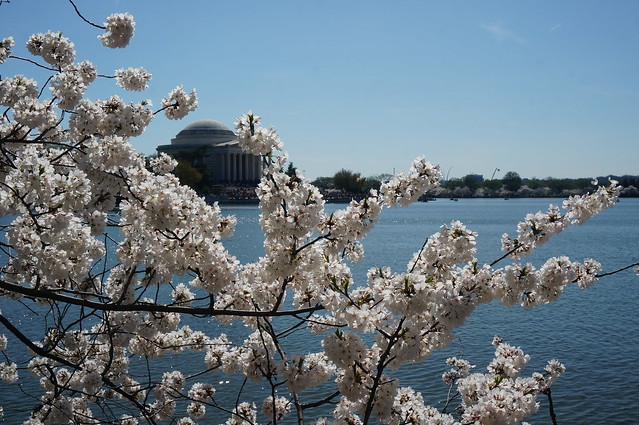
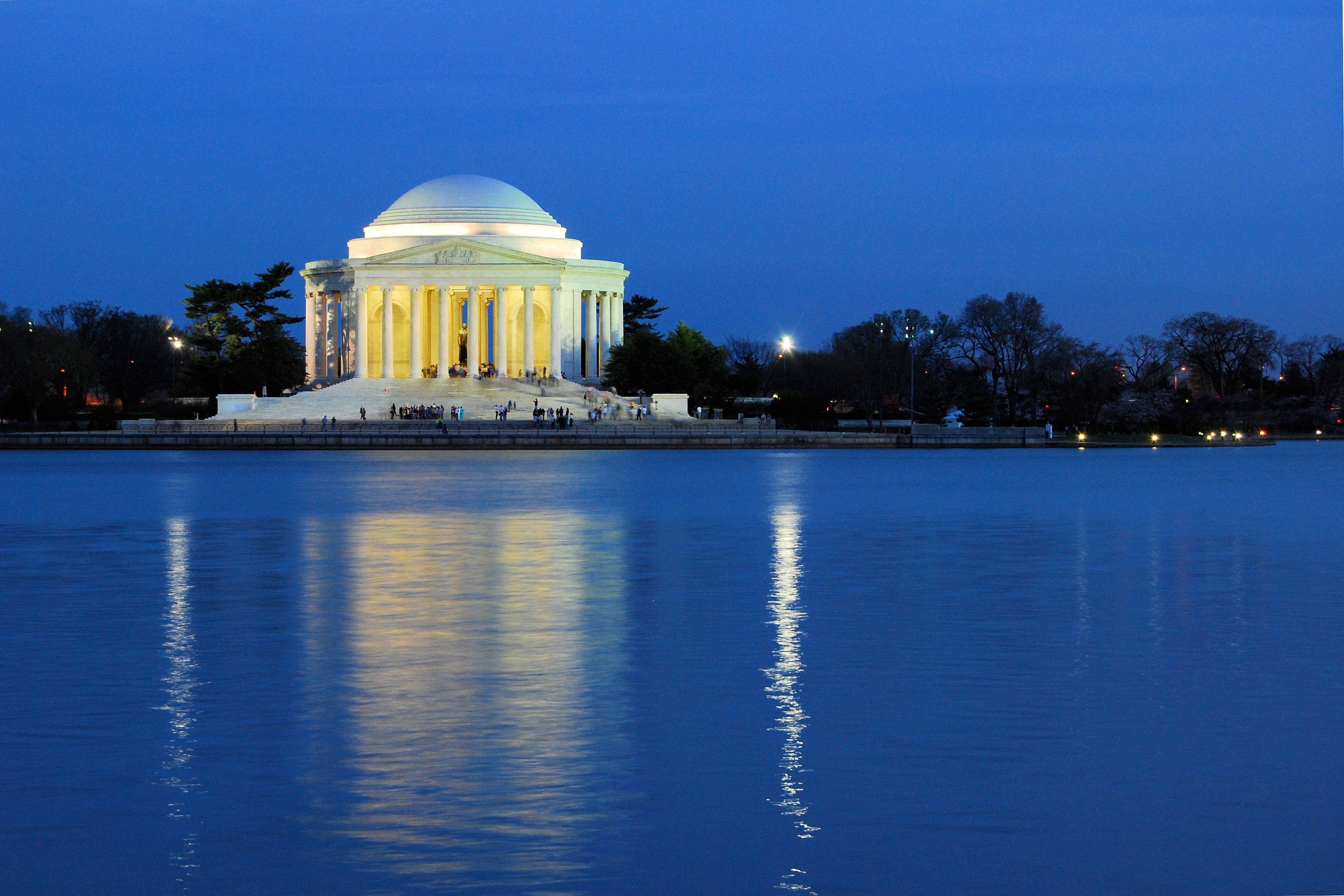
 For my first night here after unpacking all of my things, I took some time to call up a few friends and family members. After making some plans for later in the week, I went down to the desk to inquire about good restaurants to walk to. One of the people in the lobby recommended a restaurant overlooking the marina called Channel Inn Restaurant (it’s right inside the Channel Inn Hotel). It was a nice, relaxing dinner. The restaurant directly faces the marina, which was nicely lit, complemented by the restaurant’s selection of smooth jazz. I'm not entirely certain yet, but I think I might have even been able to see the Thomas Jefferson Memorial lit up down the river from where I sat. Below is a day-time view of the marina. Tomorrow, there will definitely be more exploring and venturing around the city (as well as some much-needed grocery shopping).
 Posted in: