Showing posts with label Rome. Show all posts

Saturday, May 3, 2014

Vatican Museums and Sistine Chapel

On Saturday, May 3rd, 2014, I had some time in the morning just before I had to leave to go to the airport to catch my flight back to Geneva.  I had tried on Wednesday to get inside the Vatican Museums and the Sistine Chapel, but without having a ticket reserved, the line would be an all-day wait.  Even the line for tours to skip the line had to wait for at least another hour.  So, I went back to the hostel that night and talked with some people and learned that you have to do the online reservation through the Vatican Museums' website.  Go through the steps on the website, put in your email address, and print out the voucher that will be emailed to you.  If you check the FAQs, you will see that you can only reserve a certain entry time and that you cannot change or refund your ticket.  Make sure that you select the time and date that will work for you.  I would recommend checking a couple days in advance to make sure that you get the entry time and date that you want.  For example, right as I was filling out the first page of information, the 10:30am time-slot I had selected sold out and I had to move to the 11:30am time-slot (the only other one available for that day).
I checked out of the hostel Saturday morning and, with all of my belongings, threw my duffle bag over my shoulders and hiked it over via a fully packed bus over to the Vatican Museums.  The line itself turns into a mass of people all trying to get in, fended off by one poor security guard who must be so stressed out all the time.  Again, showing up early helps and I was able to get in about 20 minutes before my time-slot was scheduled.  Security was a breeze and off I went.  There are maps posted around the Museum path which is helpful, but you can also check out the route online if you need to move a little quicker.

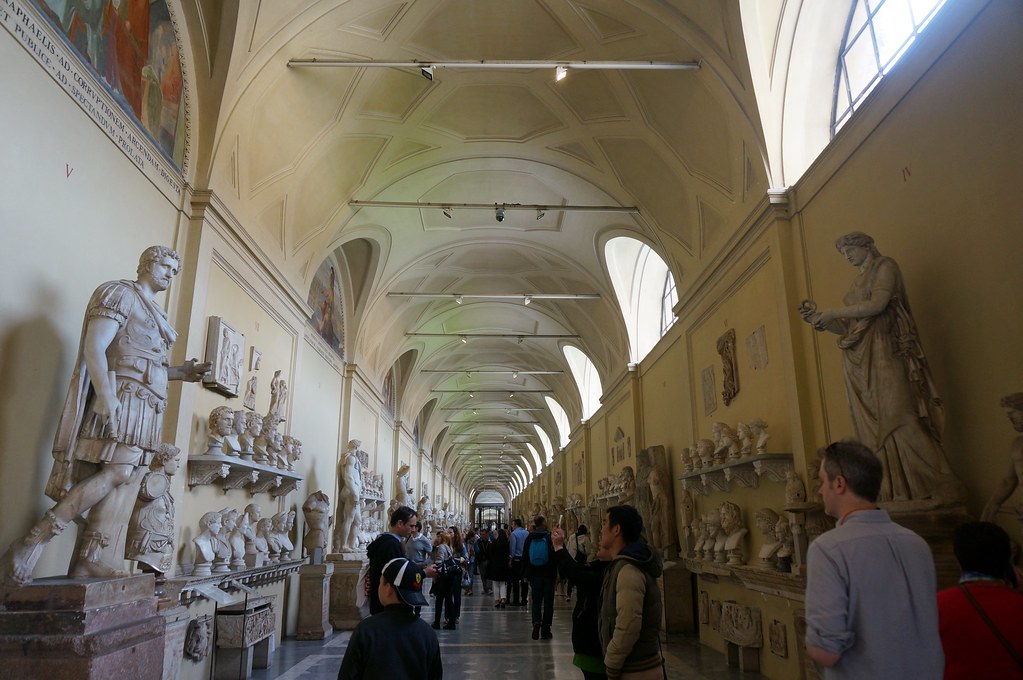
Museo Chiaramonti
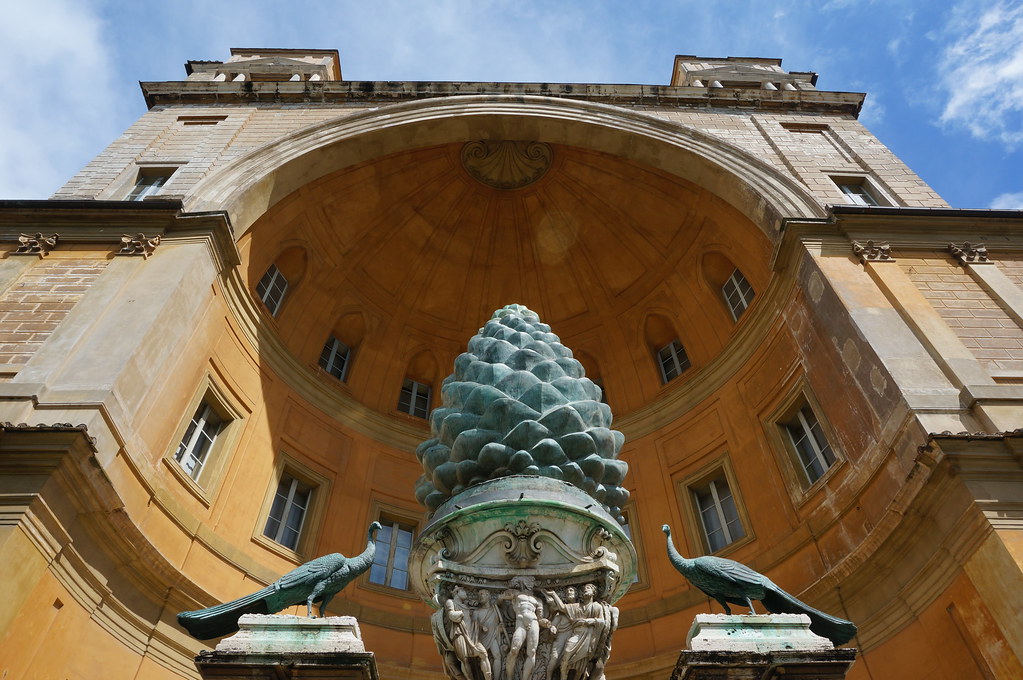
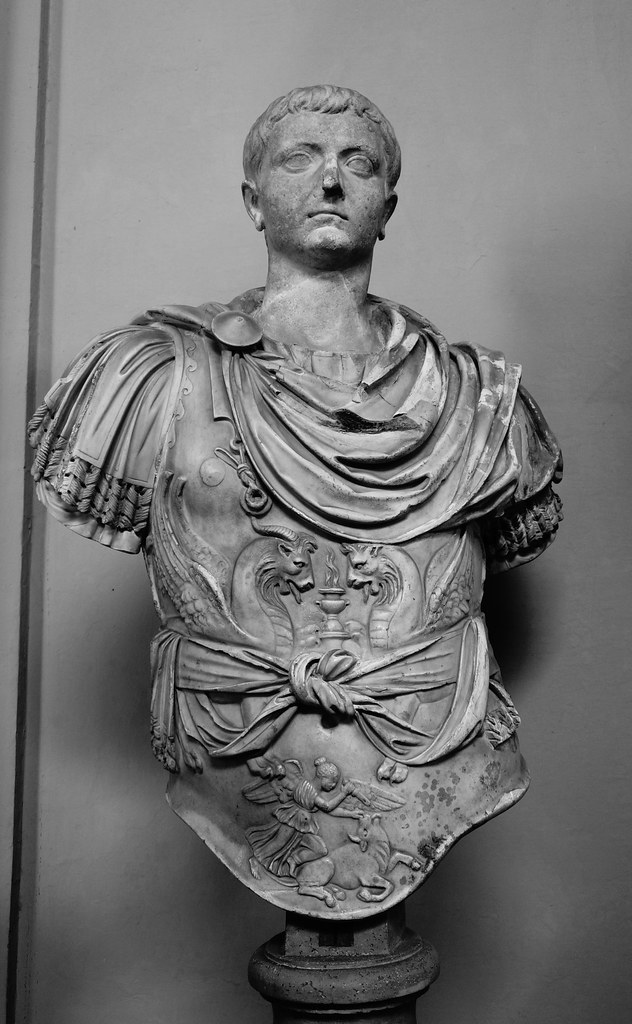
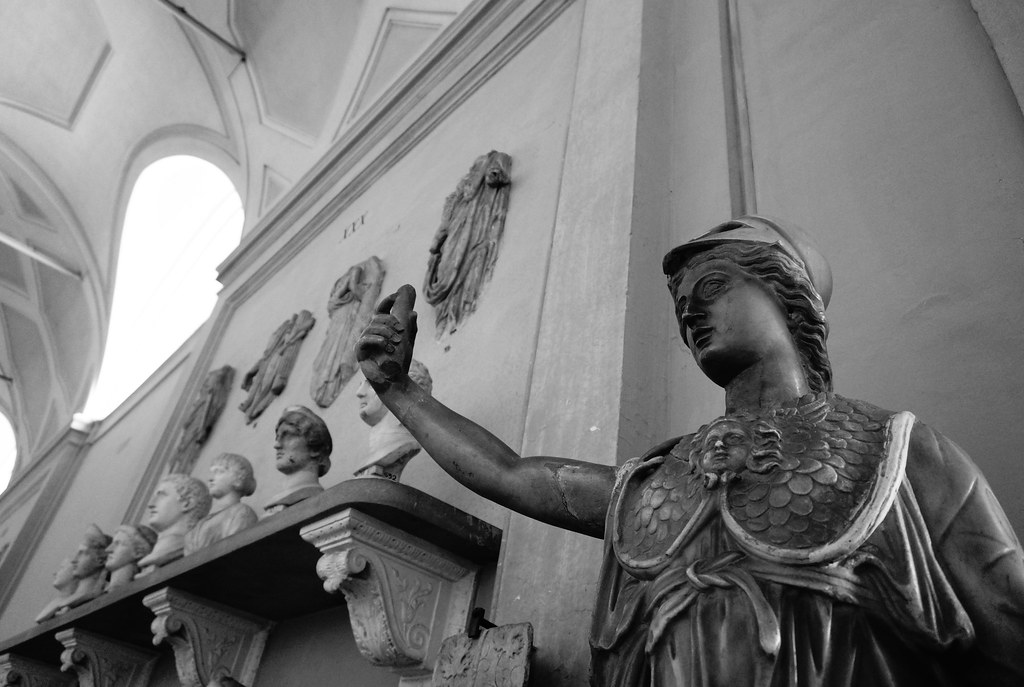
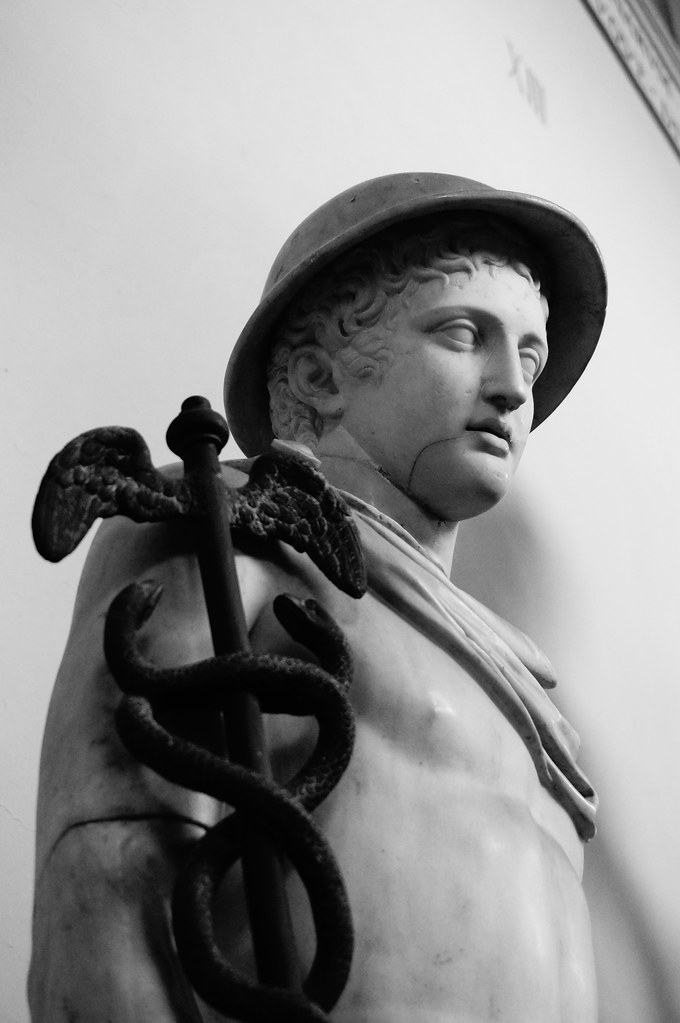
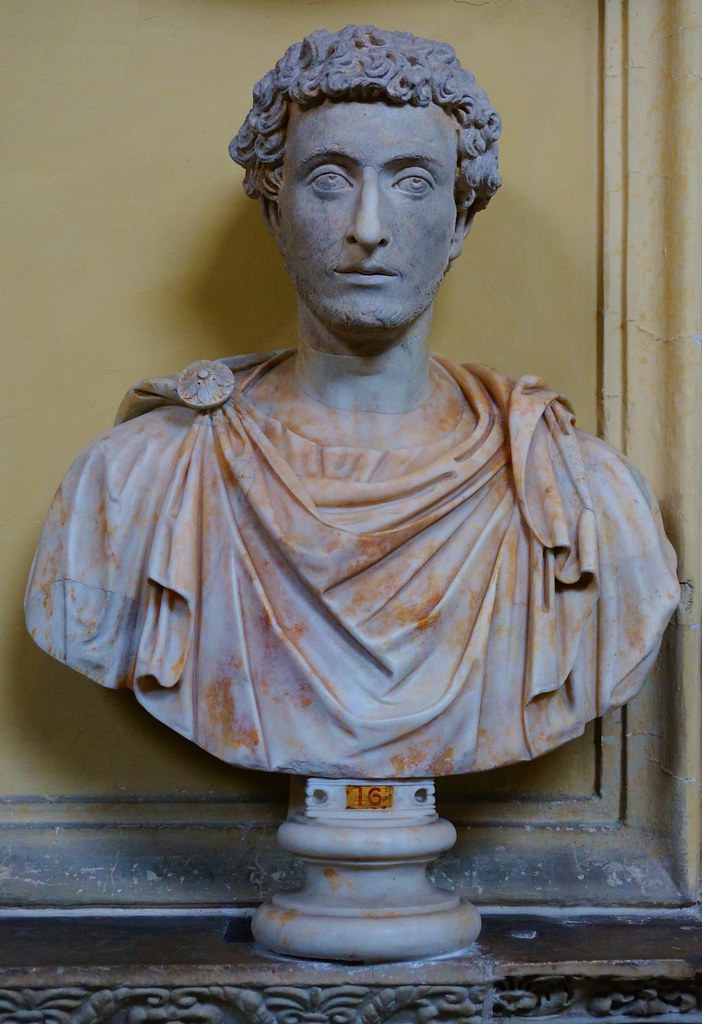
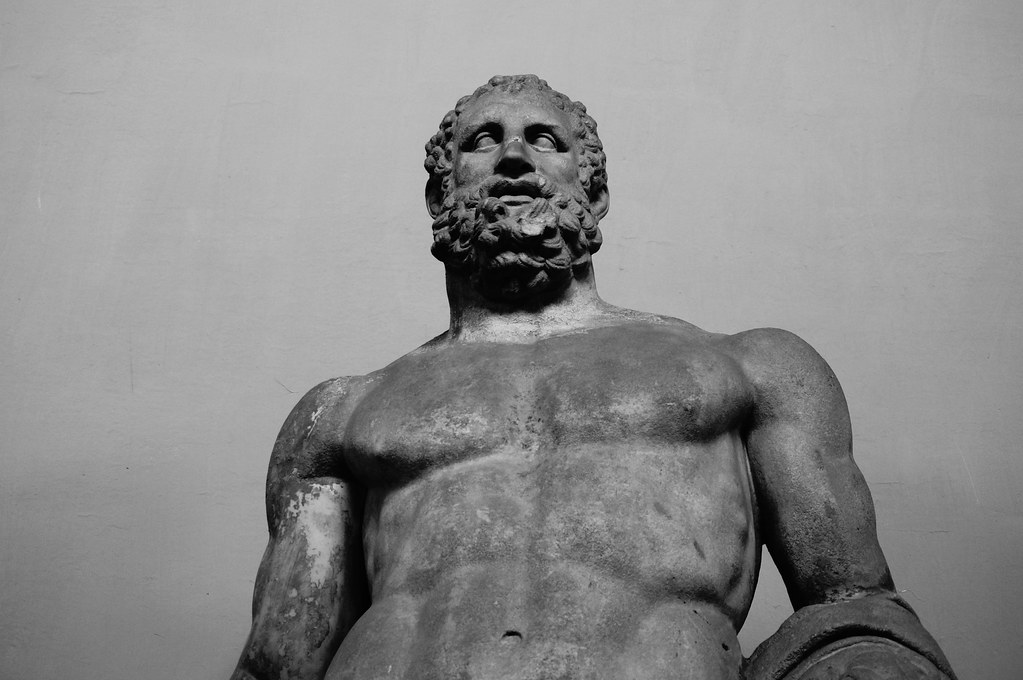
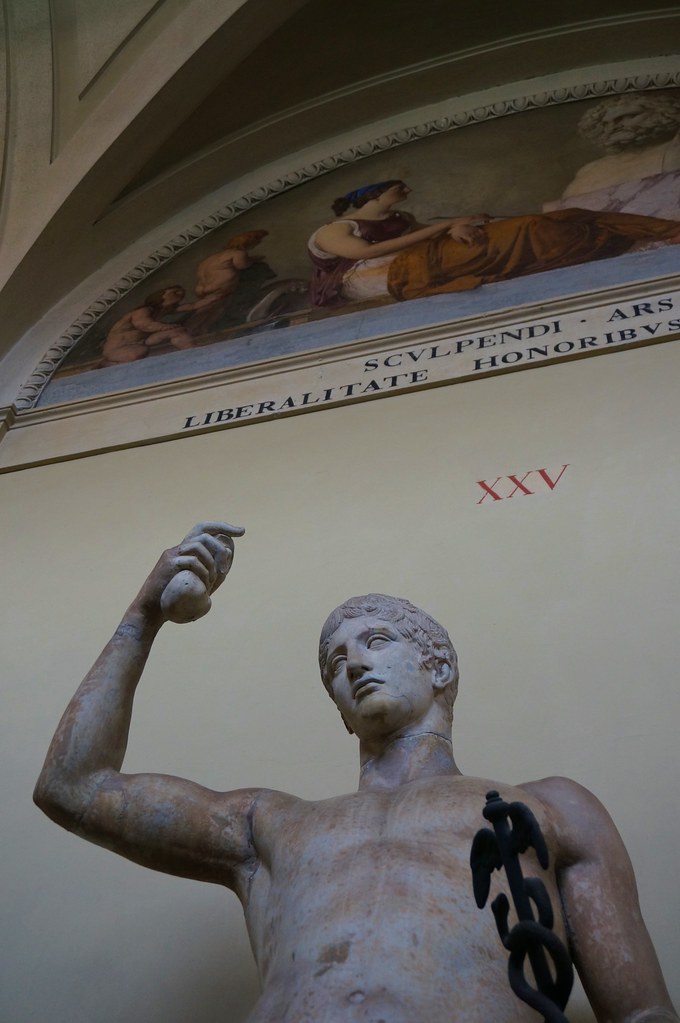
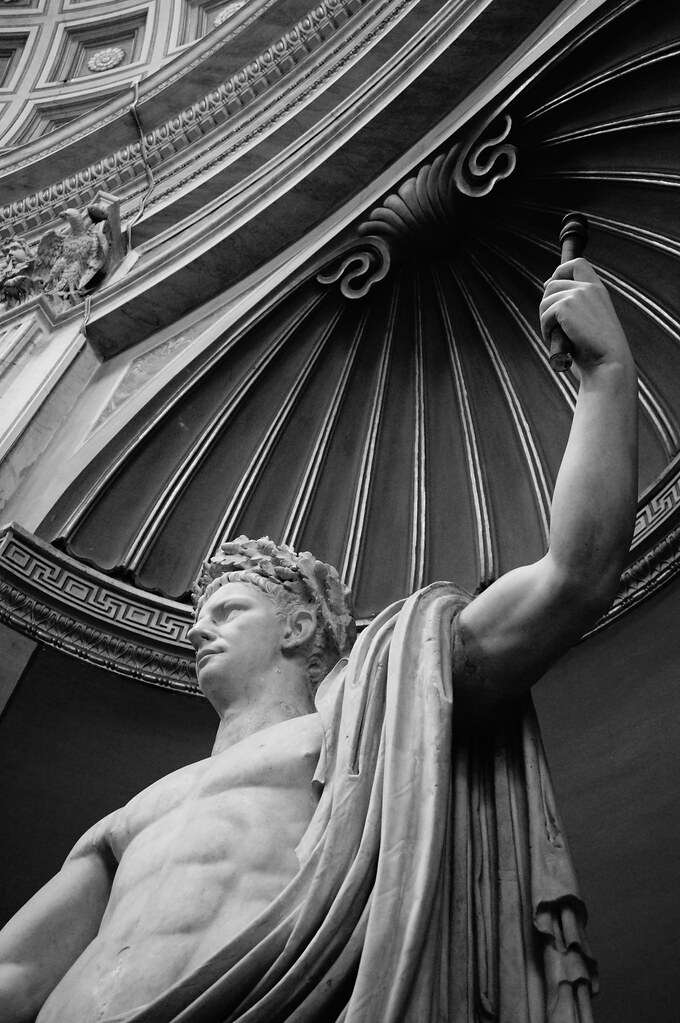
The hall of statues in Museo Chiaramonti was one of my favorite sections.  There is a beautiful courtyard outside with a nice fountain, a beautiful bronze globe, and a large bust, then you move inside on the "quick route" to the Sistine Chapel and find yourself near the Museo Chiaramonti.  It is basically a straight hallway of statues of Roman emperors, generals, queens, gods, goddesses, and other famous figures from Roman mythology.  Under the Treaty of Tolentino in 1797, Napoleon ordered the Papal States to cede the major part of the masterpieces from the Pio Clementino Museum to France.  Later on, the Congress of Vienna in 1815 and the diplomatic work of sculptor Antonio Canova resulted in the recovery of almost all of the sculptures that were taken by Napoleon.  The Museo Chiaramonti was designed to house these recovered pieces and it was designed, arranged, and painted by Canova himself.  The Chiaramonti museum is now one of the most important collections of Roman busts with over 1,000 sculptures on display in this little hallway.
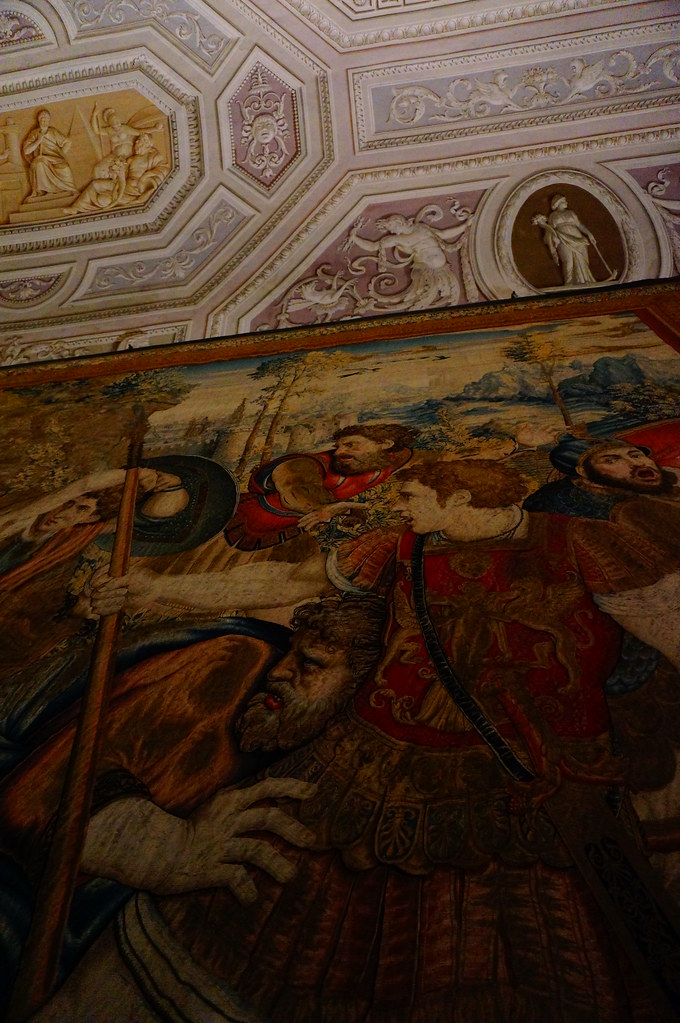
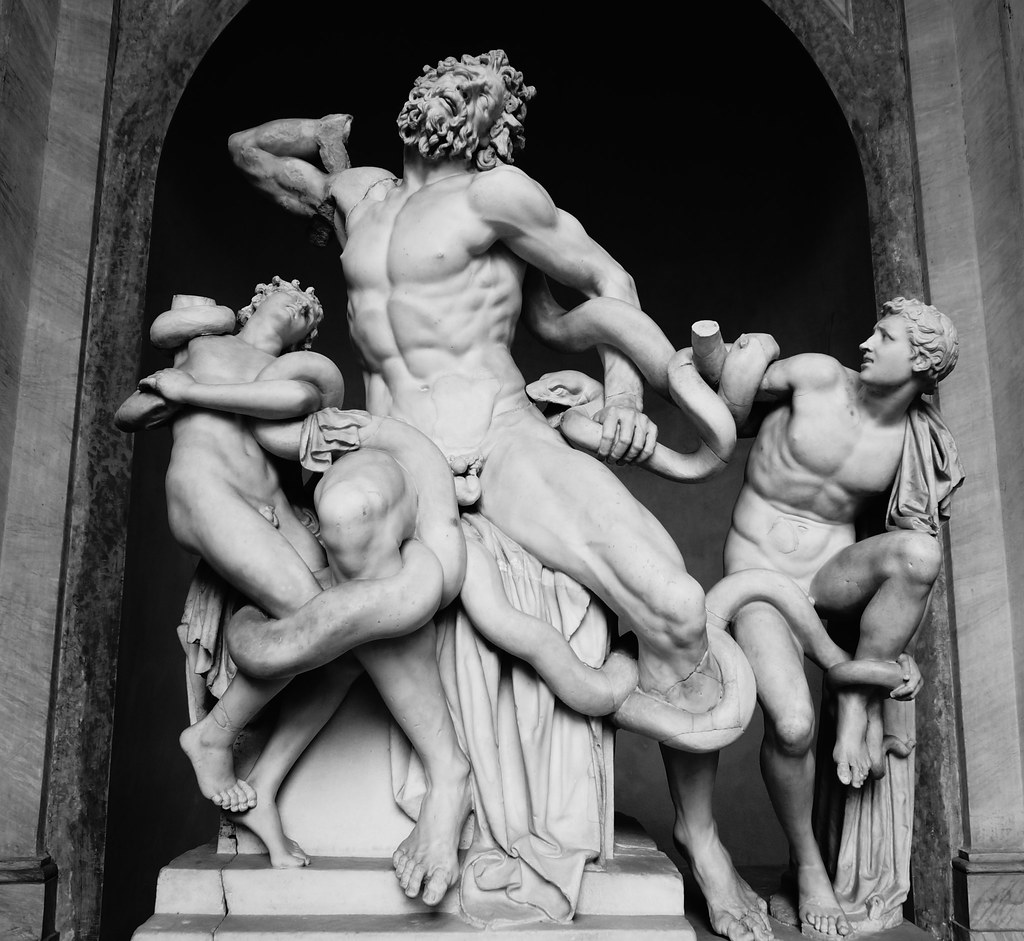
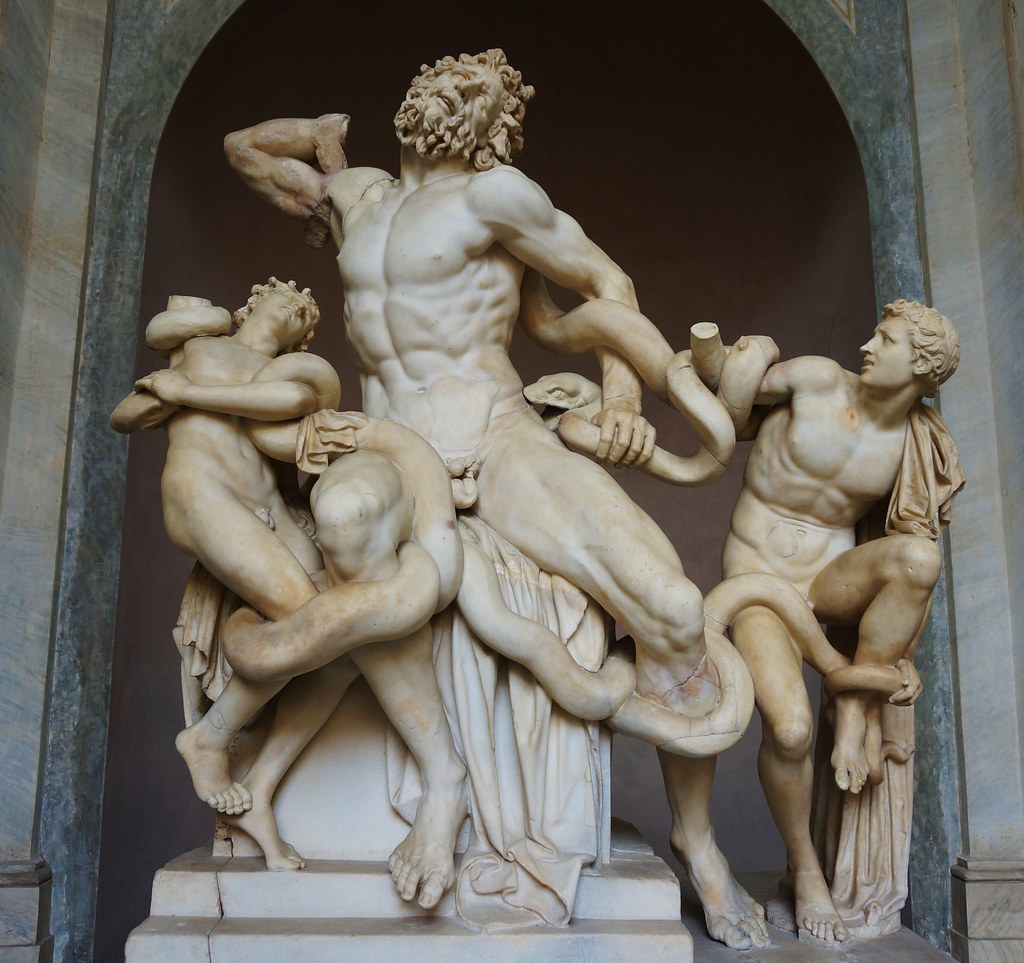
Before arriving at the Sistine Chapel, you will also pass through the Galleria degli Arazzi full of fine tapestries and a beautifully ornate ceiling, the Galleria delle Carte Geografiche with ancient maps, and then you arrive at the Museo Pio Clementino which houses my favorite statue in the Vatican Museums - Laocoön and his Sons.
The statue was found in 1506 on the Esquiline Hill in Rome and identified as Laocoön and his Sons by Pliny the Elder as a masterpiece by the sculptors of Rhodes.  During the Trojan War, Laocoön (a priest of Apollo in the city of Troy), warned his fellow Trojans against taking the wooden horse left by the Greeks outside the city gates.  Athena (Minerva) and Poseidon (Neptune), who favored the Greeks, sent two great sea serpents to kill Laocoön and his sons.  The statue depicts the snakes wrapping Laocoön and his sons in their coils and killing them.  From the Roman point of view, the death of the innocent Laocoön and his children was crucial to Aeneas' decision to flee Troy, heeding Laocoön's warning, which led to the eventual founding of Rome.  The statue seems to date from around 40-30 BCE.  
To me, this statue was so incredibly impressive and moving.  Just like the Lion of Luzern (Lowendenkmal), you can feel Laocoön's pain and anguish in the tragic events unfolding.  You feel the movement of the serpents as Laocoön and his sons struggle against their grip.  Even though it is solid stone, you feel Laocoön's silent screams.
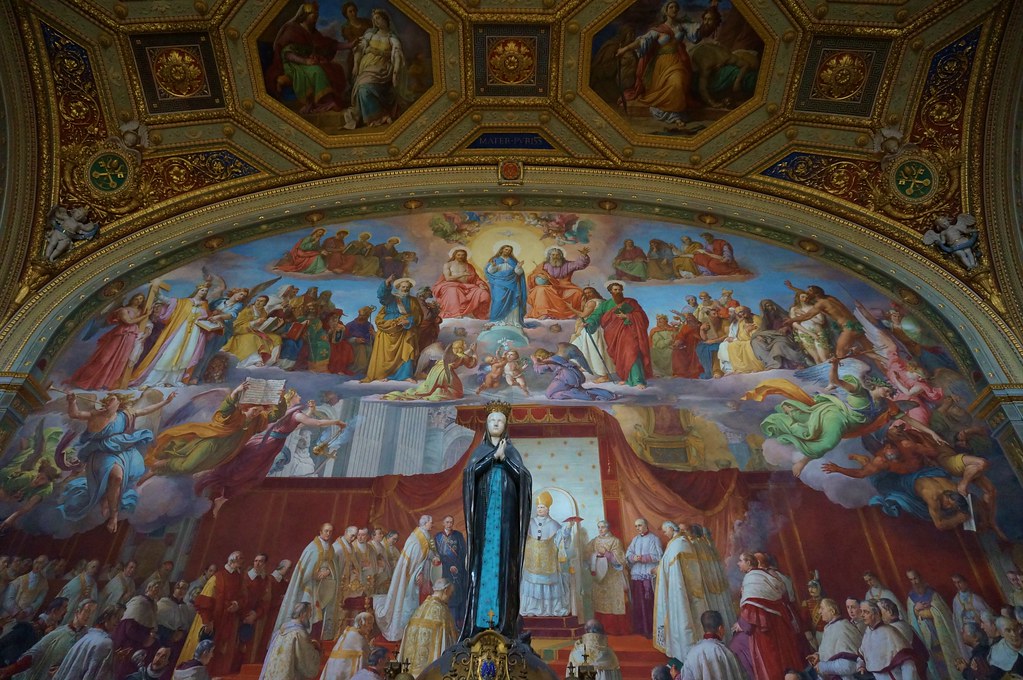
After spending some time at this statue, I moved on to the Sistine Chapel - the big money attraction of the Vatican Museums.  Along the way, there were several other great statues.


Unfortunately, like everywhere else in Rome, the Chapel was so packed full of people that it was hard to appreciate the majesty of Michelangelo's masterpiece.  I thought that the scene of God putting life into Adam with hands outstretched might have been larger, but in reality, it is only one piece of the entire ceiling, full of other impressive paintings and biblical illustrations.  Given all the detail and the height alone of the ceiling, it is amazing to me that it only took Michelangelo four years to paint it (from about 1508-1512, when he was in his early to mid 30's).  
An accurate portrait of the artist, I believe...
Michelangelo was originally commissioned to paint the Twelve Apostles on the triangular pendentives that support the ceiling and then cover the central part of the ceiling with ornament.  Michelangelo instead convinced Pope Julius to give him free reign in the project and this allowed him to create a more complex scheme representing Creation, the Fall of Man, Promise of Salvation through the Prophets, and the genealogy of Jesus.  This work is part of a larger decorative scheme within the Chapel that represents some of the most important doctrines of the Catholic Church.
Michelangelo's Sistine Chapel
After finishing in the Sistine Chapel (when I was tired of the pushing crowds, loud tour guides, and shouting security guards), I left the Vatican Museums and walked back to St. Peter's Square to catch a taxi to Termini station.  From Termini, I hopped on the Leonardo Express train to the airport to fly back to Geneva for the last time this trip.  

Arrivederci Roma!

Friday, May 2, 2014

Gladiating in Rome

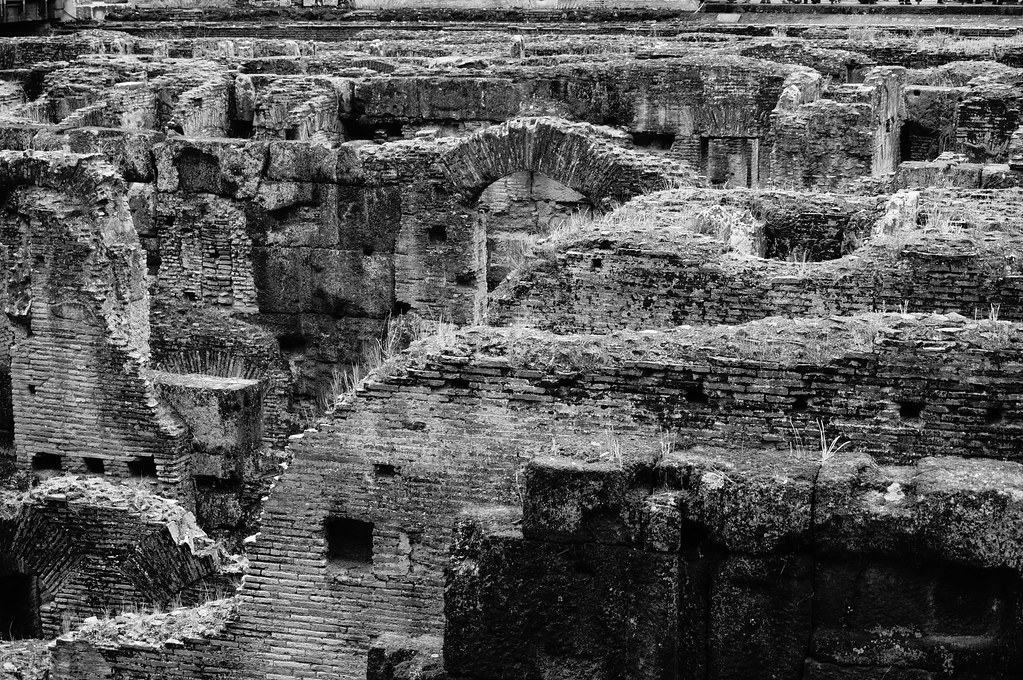
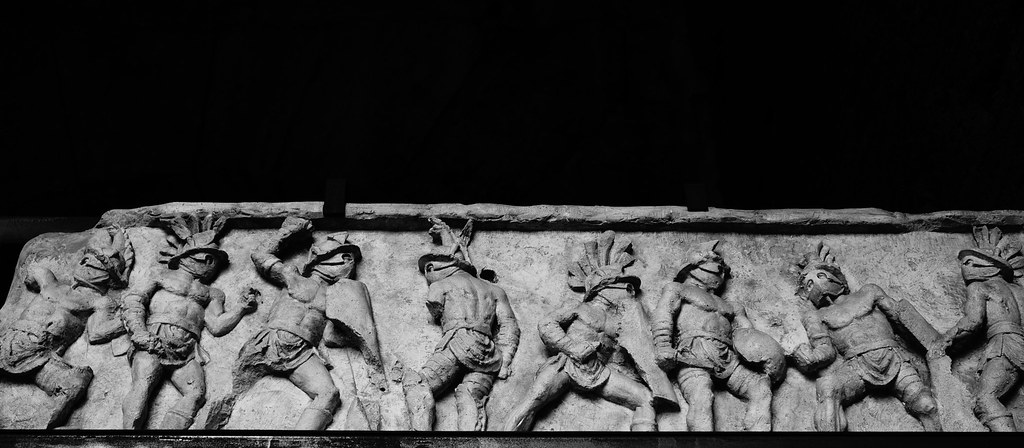
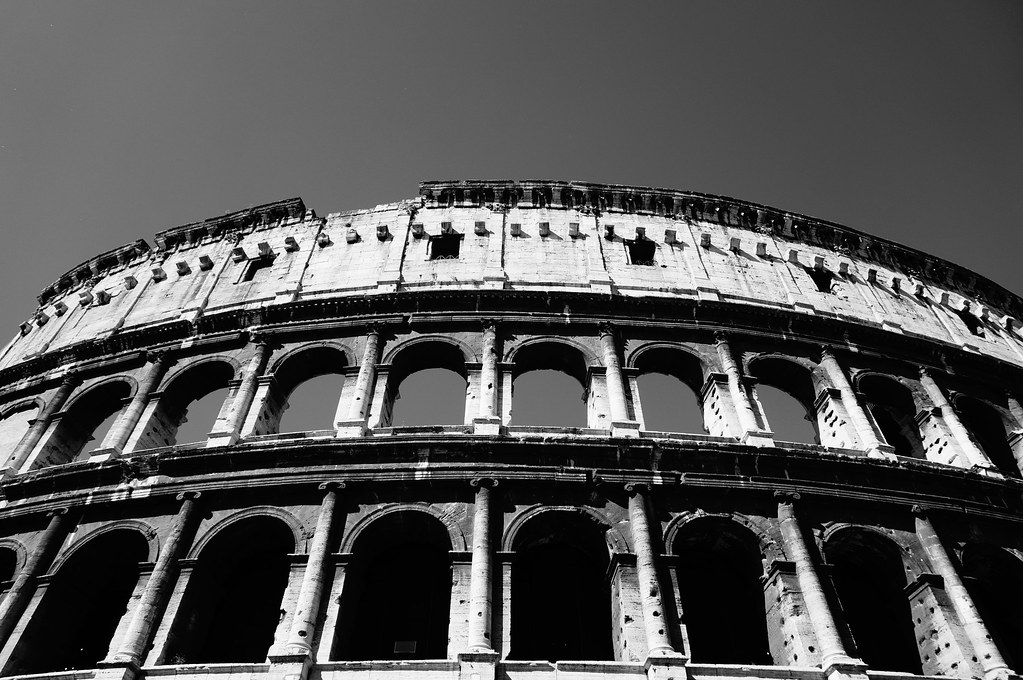
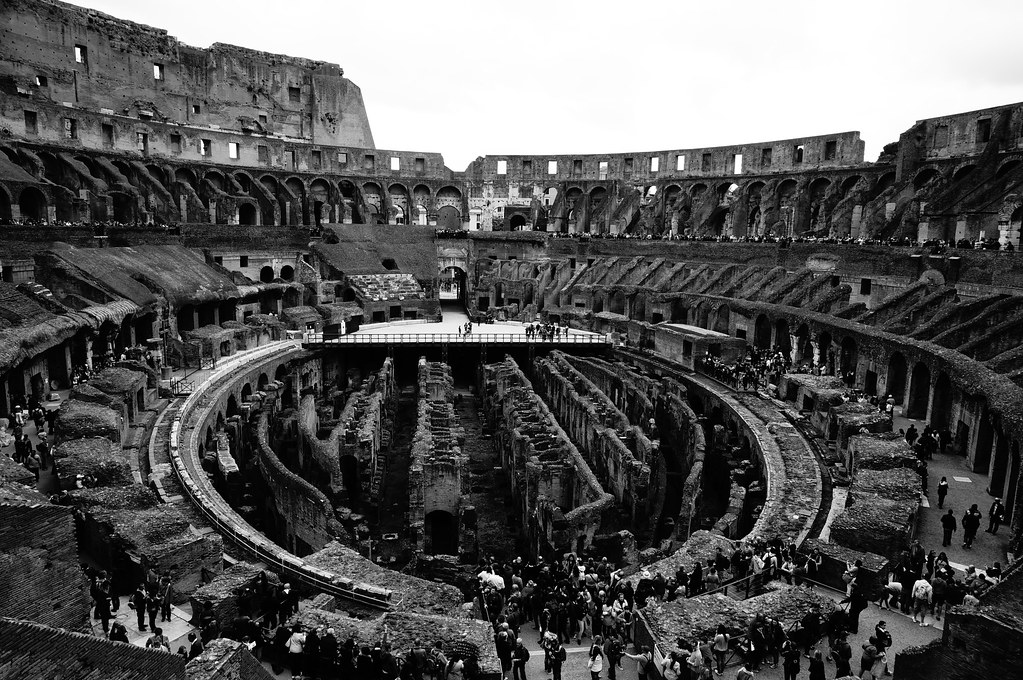
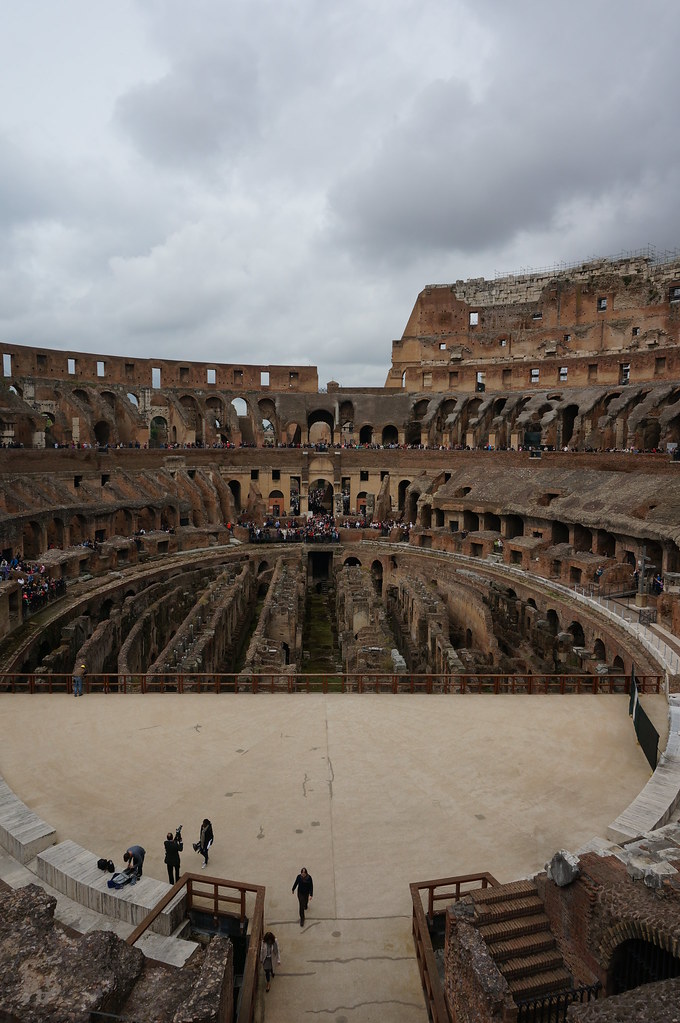
Of all the places I was able to see in Rome, the Colosseum was one of my favorites.  The building is massive and to imagine how it must have looked at the time it was built and used in Ancient Rome is pretty impressive.  Even despite its brutal history as "a powerful tool for controlling the masses, a showcase for proclaiming Rome's domination of the world," you cannot help but feel awe when stepping inside the Colosseum.
Even with the deadly matches and fierce competition, almost 90 percent of trained gladiators survived the matches (although you were basically a dead man walking if you were an untrained gladiator sent into the arena).  They also had access to some of the best medical care available in Ancient Rome.
A gladiator typically took on a distinct persona—and the weapons to go with it. For instance, during the second and third centuries theretiarius-and-secutor gladiator pairing was the most popular.  "The retiarius was the 'fisherman,' who fought with a net, a gladius, and a trident [and was] protected with just a small shoulder shield," Kanz said. "His opponent, the secutor, was the 'fish,' protected by a fishlike helmet with very narrow eye holes and a large shield, and fighting with a gladius," Kanz said.
If two gladiators both fought bravely and were equally matched, sometimes both would walk out of the arena alive.  Such an incident was recorded by the poet Martial about a fight between Priscus and Verus, who fought as Emperor Titus opened the amphitheater for the gladiatorial games.  Because of their fight, both were awarded their freedom that day.  You can see a reenactment of the fight in this BBC docudrama about the fight:

And here is an English translation of Martial's poem (Latin version here):
As Priscus and Verus each drew out the contest
And the struggle between the pair long stood equal,
Shouts loud and often sought discharge for the combatants. 
But Titus obeyed his own law 
(the law was that the bout go on without shield until a finger be raised). 
What he could do, he did, often giving dishes and presents. 
But an end to the even strife was found:equal they fought, equal they yielded. 
To both Titus sent wooden swords and to both palms. 
Thus valor and skill had their reward. 
This has happened under no prince but you, Caesar: 
Two fought and both won.
Gladiators were usually prisoners of war, slaves, or criminals condemned to death or forced labor.  Free men rarely chose to be gladiators in order to reach fame, and if they did so, it was only for brief periods.  Fighters were assembled in groups trained by entrepreneurs (called lanista).  Armor worn by gladiators in the Republican Period of Rome were inspired by enemies' armor.  Only during the Augustan Period were the types of gladiators defined according to their equipment.  Offensive and defensive weapons that fighters carried were meant to ensure a balanced encounter.  There were also equites, gladiators who were armed with a spear, sword, and small shield, and confronted one another on horseback.
A Day at at the Flavian Amphitheatre
The spectacle day began in the morning with the presentation of all the participants (pompa).  This was followed by the venationes, hunts in which hunters tackled wild animals lurking among sets replicating the geographical contexts from which they came.  
During the lunch interval, when executions ad bestias took place, the condemned, naked and unarmed, faced the wild beasts which would eventually tear them to pieces.  During the intervals, there were performances by jugglers, acrobats, and magicians, as well as parodies and re-enactments of ancient myths. 
Finally, gladiatorial combats (the munera) were held in the afternoon.  Their origin, perhaps Etruscan or Samnite, was linked to funerary celebrations in honor of eminent individuals.  The participants in these combats were usually prisoners of war or slaves, but some gladiators were free men seeking fame and fortune.  There were categories of gladiators distinguished by their weapons and techniques.  Those who were defeated in a duel could hope to be pardoned by the emperor or the audience, saving their life.   
Thanks to their popularity, the games (ludi) were often financed by politicians who hoped to curry favor with the public whereas intellectuals saw these spectacles as a means of swaying public opinion and as a cause of spiritual decadence.
From the first half of the 5th century AD, there was a widespread economic crisis that led to a decline and final end of the munera and venationes fights.  Between the end of the 5th century AD and the beginning of the 6th century AD, the underground structures in the Colosseum were filled in.  Lacking machinery for shifting scenery, the Colosseum served only to accommodate displays similar to modern-day circus performances, with acrobats replacing gladiators as the main attraction.  A popular spectacle during this period was the contomonobolon, executed by acrobats who performed spectacular jumps among animals with the aid of a pole (the contus).  The last games in the Flavian Amphitheatre (aka Colosseum) took place in 523 AD.

Before heading over to the Palatino and the Foro Romano, I stopped at the Pasqualino al Colosseo (map) for a pizza margarita and a glass of vino bianco for lunch.  The food was okay, and even though the initial waiter was good, the one who actually took our food tried to give me trouble about asking for a glass of tap water (it escalated to him telling me that they do not have water at all and me saying, "oh really?  do you wash the dishes?  what do you use to wash the dishes?" until he acquiesced).
After spending Friday morning wandering around the different levels of the Colosseum, I headed over to the Palatino and Foro Romano.  The Palatino is the hill where Romulus and Remus are said to have been nursed by the wolf.  It is also the site of the imperial Roman palace that overlooks the Colosseum and Foro Romano, the main commercial center of Ancient Rome.  The church of St. Sebastian also sits at the old vinyards on the Palatino.  On the southwest side below the hill lies the Circo Maximo, where chariot races took place.
Foro Romano
The Roman Forum (Foro Romano) lies in the valley surrounded by the Palatine, Capitoline, and Esquiline hills.  In the Republican period (5th-1st centuries BCE), this was the political, economic, religious, and commercial heart of ancient Rome.  In the 9th and 8th centuries BCE when the city was made up of independent villages, the area was occupied by the cemeteries of the various settlements.  Later, the villages began to merge and the Forum valley naturally became the place where their inhabitants met for economic transactions and social activities.
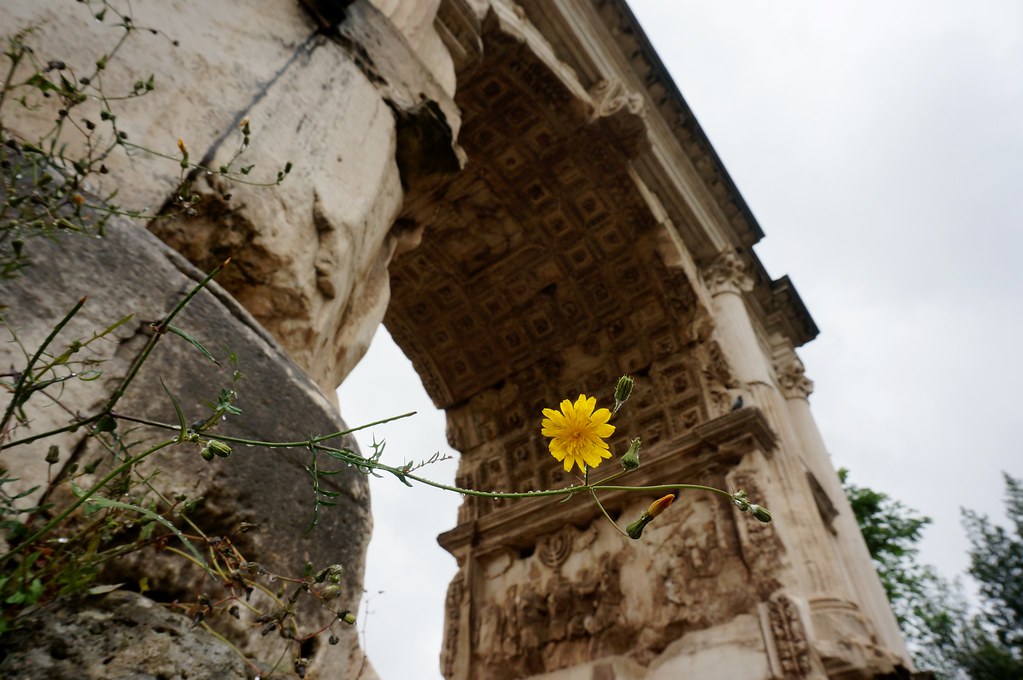
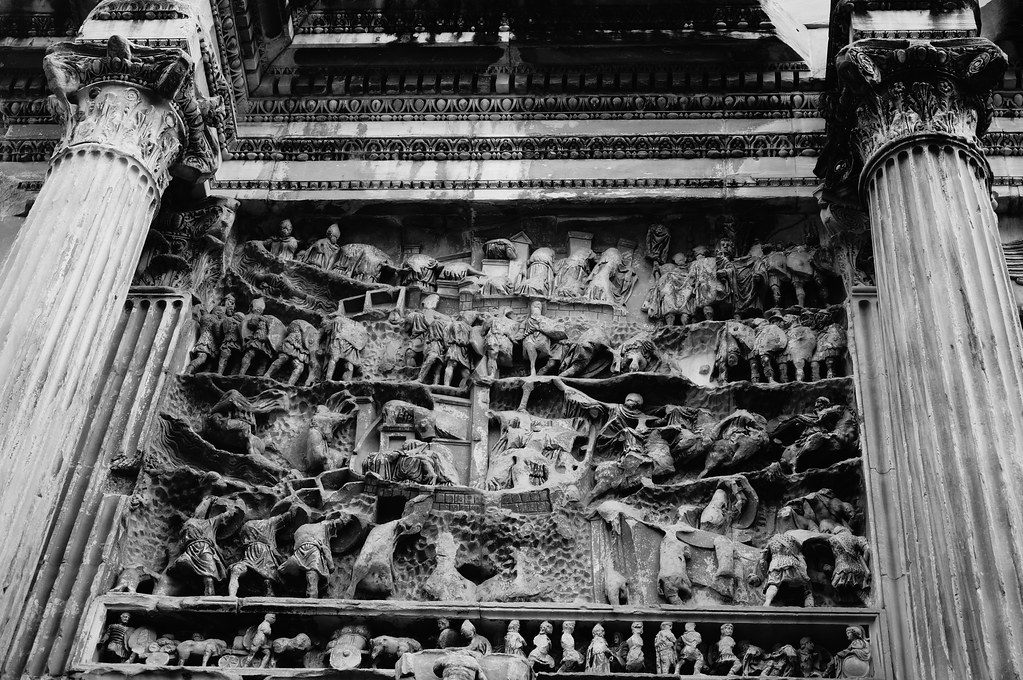
Arco di Tito
Broad and flat, it gradually became the center of the ancient city's social life.  Originally, this was a marshy and unhealthy area, especially at its lowest point near the Capitoline hill.  This made it necessary to carry out works here to drain the marshy swamp.  This was one of the first land reclamation acts of ancient Italy and was ascribed to the Tarquins who built the Cloaca Maxima to channel the waters into the Tiber River.  This was when the area took on a specific social and political function within the community.  The Forum hosted games, political meetings, and assemblies.  It is described by legend as the setting for some of the most important events in early Roman history, including the Rape of the Sabine Women.  Particularly, between the 3rd and 1st centuries BCE, the intense activities carried out here led to the construction of the first buildings with specific sacred and public functions.  An initial road network also began to take shape between the temples and basilicas: the Via Sacra, the Vicus Tuscus, the Clivus Argentarius, etc.
Statue of Apollo, Palatine Hill Museum
The Roman Forum retained its importance especially during the Republican period when the valley gradually filled with public buildings whose remains are still preserved here today.  These buildings, which almost always had a timber frame and brick facing, were reconstructed on various occasions, in part because they were frequently destroyed by fire or civil strife.  It was this unplanned continuity of its buildings over time which gave the Roman Forum its typically disorderly appearance without a unitary plan.

The area's development peaked with the victorious end of the Punic Wars in the 2nd century BCE when four basilicas were built: the Porcia, Opimia, Aemilia, and Sempronia.  Later, first under Julius Caesar and then Augustus and the early emperors (1st century BCE to 1st century AD), the Forum gradually took on a different role - that of monumental center and place of religious memory while public life moved to the nearby Imperial Forums.  As a consequence, building activities were interrupted, with one last moment of glory in the late empire with the construction of the honorary columns and equestrian statues.

True decline began with the imperial court's move to Ravenna and the edicts of the 4th century AD decreeing the closure of the temples, some of which were turned into churches.  This was followed in the 5th century by the Visigoth and Vandal invasions.  The abandoned buildings fell into ruin while the ground level of the Forum rose to cover what remained.  Buried in vegetation and now on the edge of the city, the square became a pasture with the name Campo Vaccino ("Cow's Field").
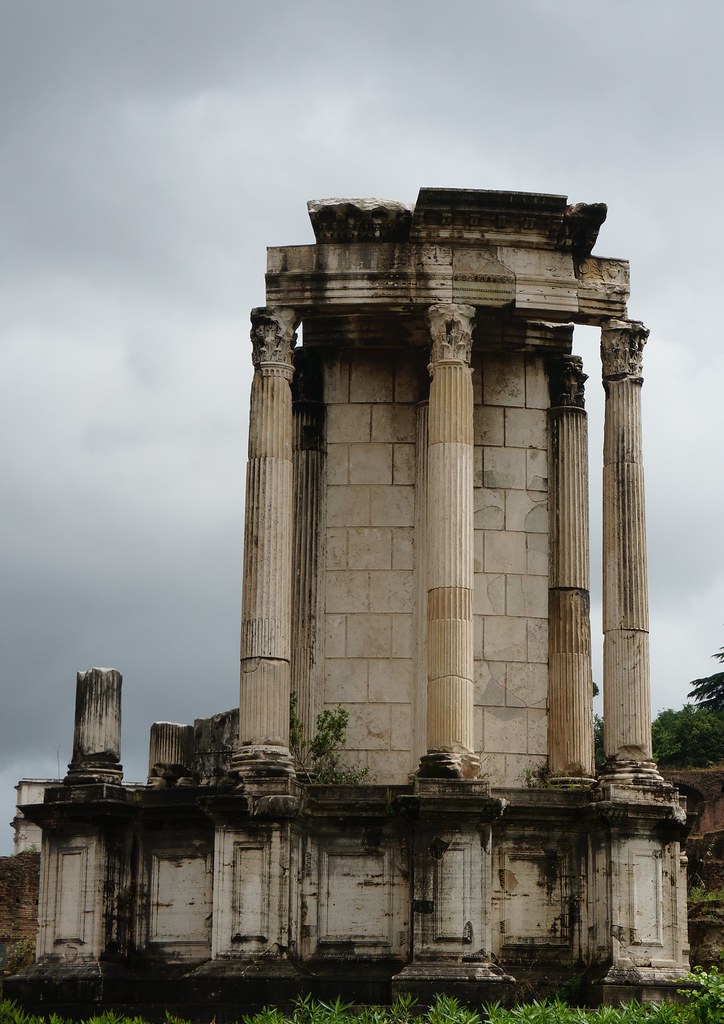
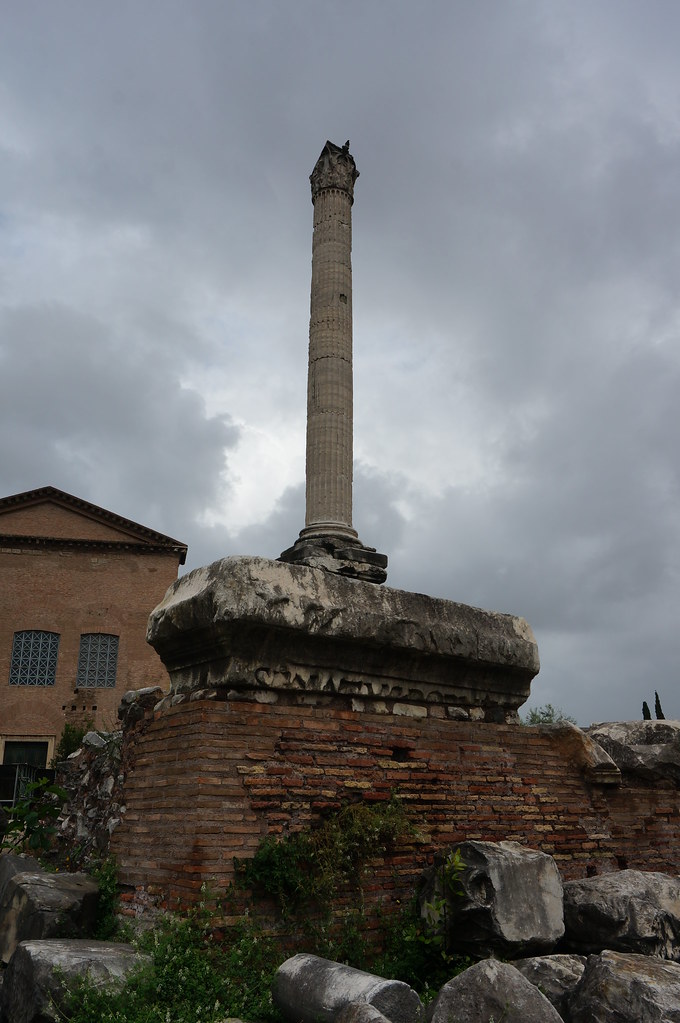
Temple of Romulus
One of the main attractions at the Foro Romano is the Temple of Romulus.  The temple's round shape was unusual for Roman architecture and was built by emperor Maxentius in 307 AD in honor of his son who died during childhood.  The circular building is flanked by two halls opening onto the front with little porticoes decorated with columns.  The bronze door on the temple is the original door and the lock still works.  Pope Felix V turned the monument into the vestibule of the Church of Saints Cosmas and Damian.
Temple of Antoninus and Faustina
The Temple of Antoninus and Faustina was dedicated by the Senate to Faustina in 141 AD and, when he died, to her husband the emperor Antoninus Pius (138-161 AD).  The long walls of the cella, in square peperino blocks, were originally covered in marble.  At the center of the staircase, added later, are the remains of an altar.  The statue visible behind the six columns of the facade probably belonged to the temple, which in the Middle Ages was turned into the Church of San Lorenzo in Miranda.  Later, Pope Urban V reused construction materials from inside the church to restore the Lateran Palace.
Temple of Castor & Pollux
According to legend, two brothers Castor and Pollux, sons of Jupiter (Zeus), were seen watering their horses at the Spring of Juturna in the Forum after helping the Romans against the Latins and Etruscans at the Battle of Lake Regillus (496 BCE).  In their honor, the dictator Aulus Postumius Albinus built a temple - dedicated in 484 BCE - which was transformed several times over the centuries.  The high podium dates to its reconstruction by Metellus in 117 BCE.  Another important reconstruction took place under Tiberius, to whom the three Corinthian columns can be attributed.
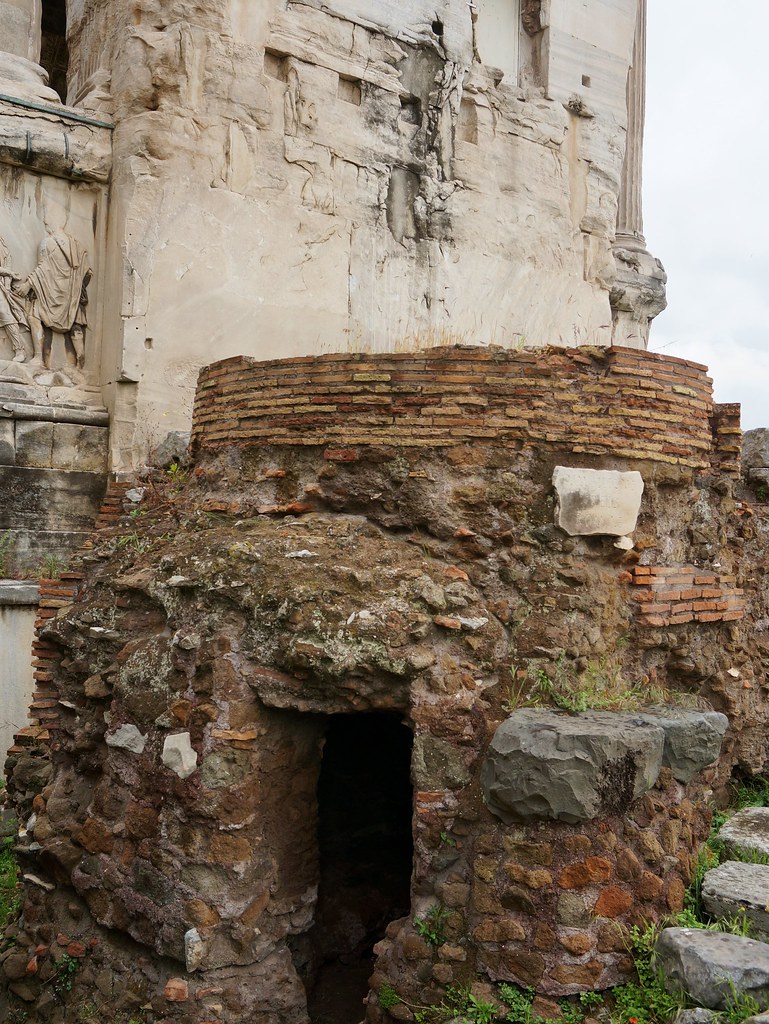
Vulcan's Temple
There are also temples to more famous gods that are part of the Forum.  Partly cut into the rock and partly built from tufa blocks, the Vulcanal monument (about 3 x 4 meters) was believed to be the sacred space hosting the altar dedicated to Vulcan by Titus Tatius (the mythical king of the Sabines), in existence from the city's origins.  It has recently been suggested that the remains belonged to the altar of Saturn, which Latin authors describe as standing in front of the Temple of Saturn at the bottom of the slope leading up to the Capitoline Hill.
Rostra
Finally, the Forum also has the Rostra, the podium from which orators addressed the people.  The name comes from the rostra (rames) of the Latin ships, captured by the Romans at the Battle of Antium in 338 BCE with which the monument was decorated.  Caesar had the Rostra moved here from the nearby Comitium and it was later enlarged by Augustus.  The monument has a curved part made of tuff blocks, clad in marble panels.  The holes which supported the rostra can be seen on the front.  The monument had a platform accessed from a staircase on the side facing the Capitoline hill.
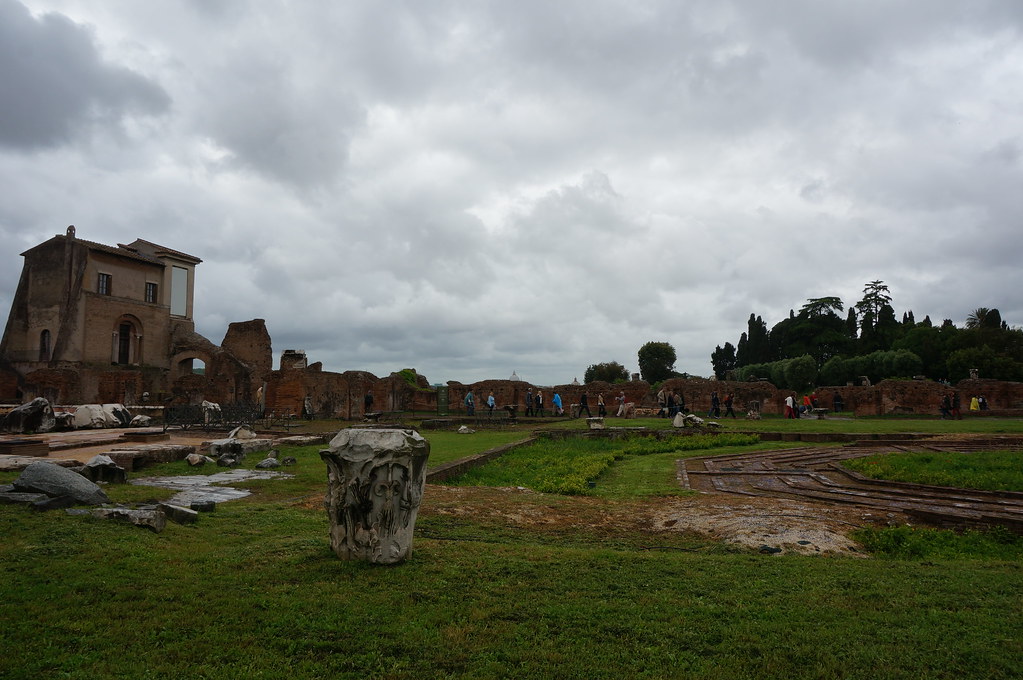
Palatino, Imperial Palace
On top of the Palatine hill stands the Imperial Palace.  The palace occupies much of the hill and its slopes.  It was built by the architect Rabirius on the orders of Domitian (81-96 AD) and inaugurated in 92 AD.  It was the official residence of all later emperors.  The palace was divided into three sectors: an official or "public" area (the so-called Domus Flavia), a sector hosting private apartments (Domus Augustana), and a large garden in the form of a stadium with its annexes (called the Stadium).
Palatino, Imperial Palace
The palace was made of brick and its massive foundations were superimposed on earlier buildings, some of which can be visited underneath the Domitianic structures.  Conserved to almost its original extent, the palace represented a turning point in the history of Roman architecture, codifying the typology of the dynastic palace in Rome.  Its importance is evident from the fact that the word "palace" itself comes from the Latin palatium or palatine because this is where the first imperial residence was built, a model for all later palaces.  Its construction made a deep impression on Domitian's contemporaries.  Statius and Martial, his court poets, composed admiring descriptions of it, praising its extraordinary size, the beauty of its decorations, and the luxury of its furnishings.  "The palace was so vast," Martial wrote, "that one's eyes became tired looking at it, and so tall that in comparison the pyramids of Egypt seemed laughable." (That seems like a wee biiiiit of an exaggeration there, Martial.  Tsk tsk).
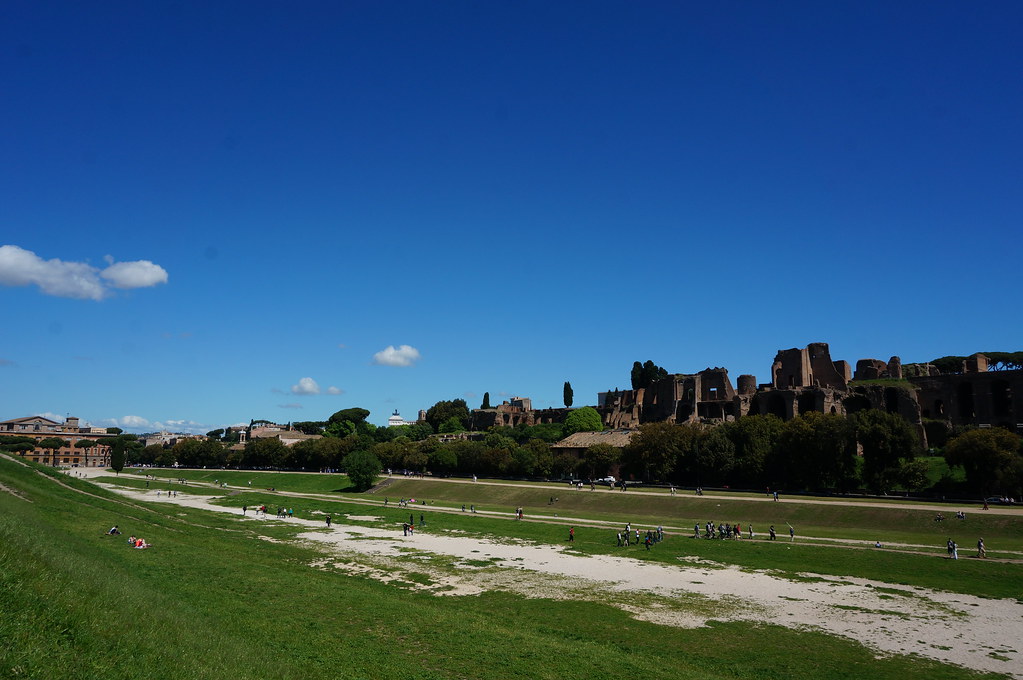
Circo Massimo with Palatino Hill above
In the afternoon, I walked back to the Vittorio Emanuele II monument for a while.  After hanging out there until the guards began chasing people off of the steps, I wandered over to Dante's Bar for some gelato (I tried chocolate, strawberry, and tiramisu).  Then, when the person I had met at the hostel who had been accompanying me sight-seeing needed to charge her phone, we wandered over to the Theatre Cafe to find an outlet.  Since apparently we were doing dessert before dinner, I kept up with the trend and ordered a delicious, authentic Italian canoli.
Delicious canoli with Grapefruit juice.
For dinner, my friend from the Geneva program had recommended a restaurant called Trattoria Da Lucia (map) for amazing pasta.  Unfortunately, by the time I found it that night wandering through some beautiful streets and hidden plazas, it was full and the restaurant only takes reservations.  So, if you are going to Rome any time soon, call ahead for good restaurants to make your reservations.
Since that place was full and it was raining hard by this point, I found a different restaurant that was full but did have some room called Taverna della Scala (Italian; English; map), where I had some pretty delicious penne all'arrabbiata.
Like a real midwestern American, I added the Parmesan cheese.
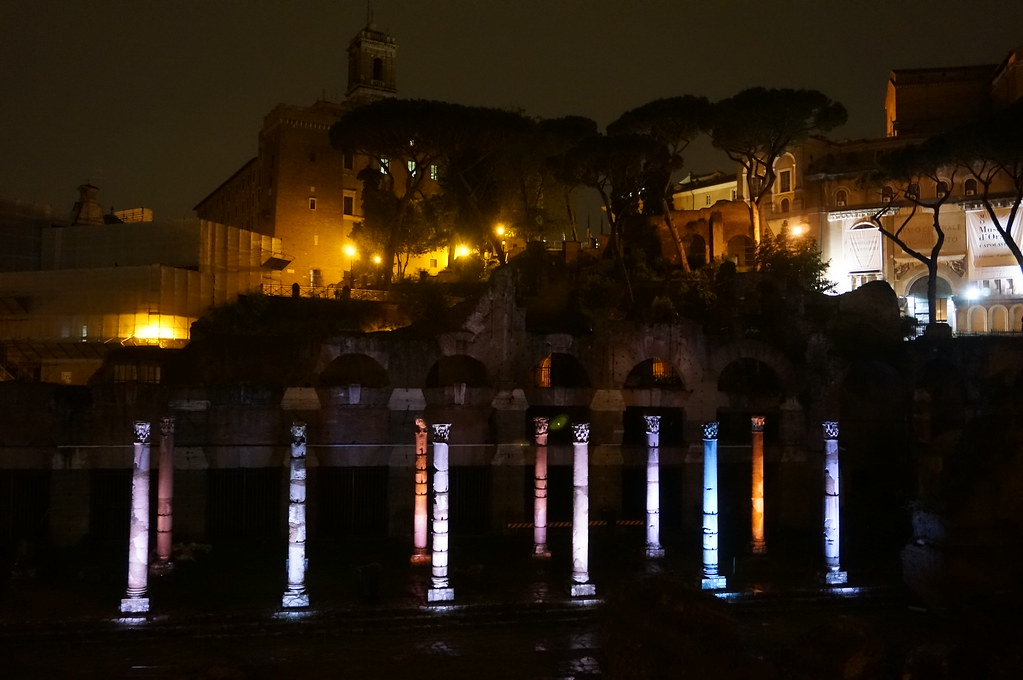
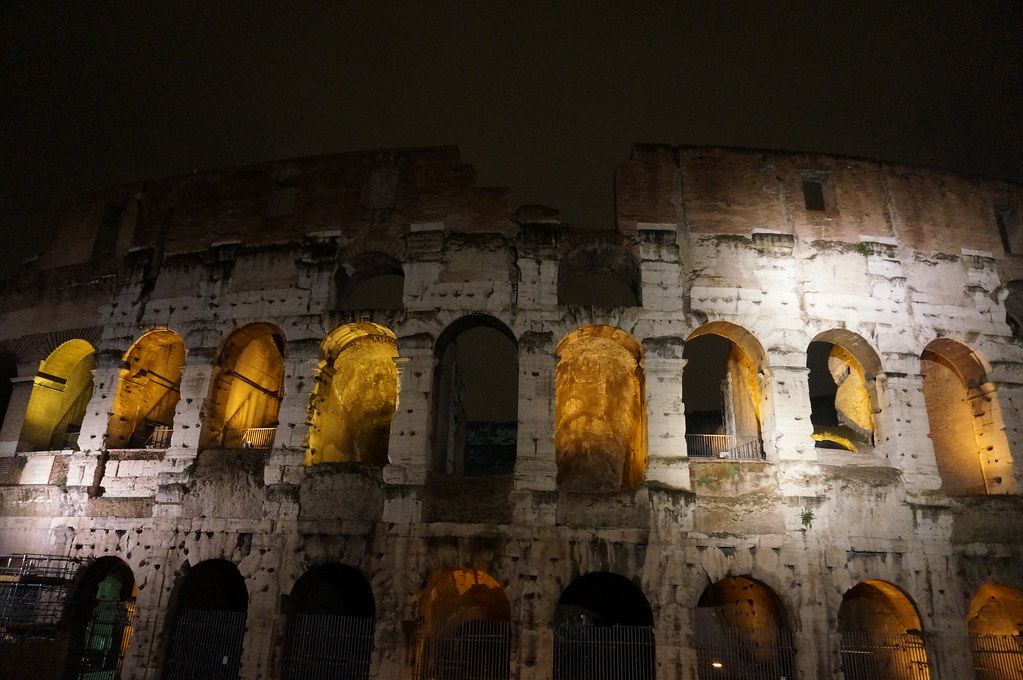
Friday night, I was able to come back to the Colosseum to see it lit up.  Along the way, we passed part of Foro Romano illuminated as well as a couple bridges on the Tiber River.  It was raining on and off all day and the rain had started again at night.  While this meant fumbling between umbrella and camera, the bonus was that the Colosseum was beautiful illuminated and no one was there because of the rain.  It was really nice to be able to walk around it and admire the structure without having to push through lines of tourists.  Definitely one of the major highlights of my trip to Rome.
Roman Forum at Night
Colosseum at Night


Thursday, May 1, 2014

First Two Days in Rome

I arrived in Rome from Geneva on Wednesday, April 30th, 2014.  I landed pretty early in the morning and hopped the Leonardo Express train to the hostel (Freedom Traveller Hostel at Via Gaeta 23).  The hostel was old and did not have the greatest facilities, but I was able to book a small room and the hostel was about a 5 minute walk from the Termini Train Station.  

Wednesday, April 30th, 2014: Day One in Rome

I went to the hostel, dropped my things off, then went back to the train station to buy a ticket for the hop-on, hop-off double-decker buses to see the city.  I was still tired so I figured that the bus would be a fast way to see the whole city and get to and from the major attractions.  There are also audio guides that you can listen to with headphones while on the bus so you can learn about some of the sites while riding.  I happened to take the Ciao Roma bus company, but there are a lot of different companies that all go to the same places, so I don't think it matters so much which bus you take.  The customer service for Ciao Roma was kind of hit and miss, too.  
Ciao Roma bus route
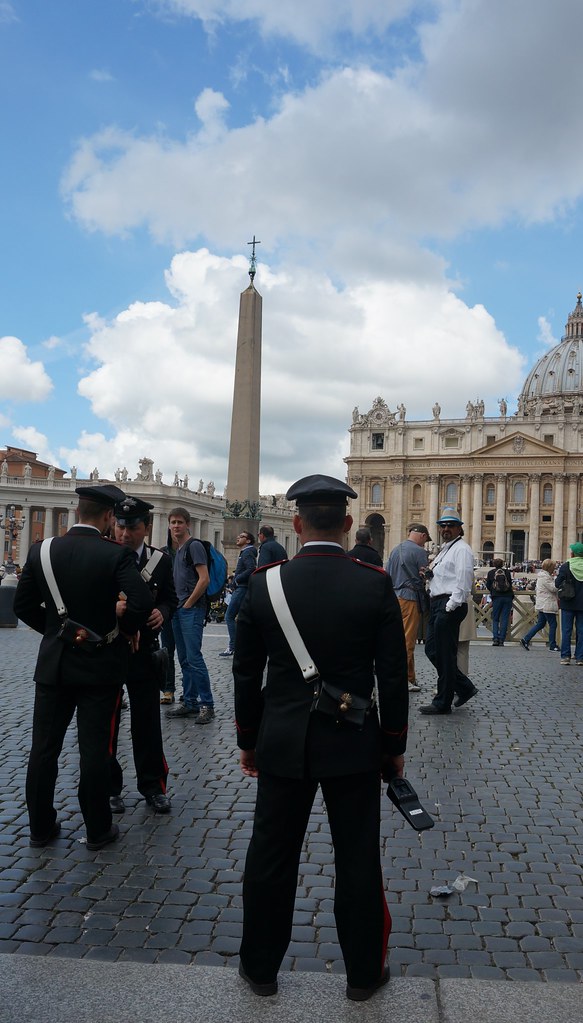
I decided to first take a ride around the city until reaching the Vatican City.  I hopped off here and walked up Via della Conciliazione until I reached Piazza Pio XII, just outside the Vatican City.  I don't know if I have ever been to a place with so many people packed together. It just so happened that at the time I wanted to go inside the Basilica San Pietro (St. Peter's Basilica), the Pope was doing an audiencia.  An audiencia is where the Pope is in the main square in front of the Basilica and addresses the people and they can last anywhere from ten minutes to a couple hours, depending on what the Pope has to say and how many people he will personally address.  
The Vatican City and Rome police forces who were trying to manage the crowd flows were not letting more people inside the Vatican City until the Pope finished the audiencia.  It was hot that day though and there were over a thousand people crammed against the gates waiting for a couple hours to get past the barrier from Rome into the Vatican.  I thought it was strange that they police kept telling us that we could not enter the plaza because we had to wait for people to leave, but as people left, more people were not allowed to enter.  Finally, we watched the Pope hop into the Pope-mobile and drive off, ending the audiencia.  The Rome police finally got the signal from the Vatican police to let people in past the barriers and when they unblocked the gate, there was this huge mob of people that all started running to be the first to enter the Basilica.  It was pretty insane.  The mob clustered in the plaza, forming a "line."  When I saw that it would be at least another hour or so of just standing in the plaza on a really hot day without any water, I decided to leave and try to use the rest of my day to see something else.
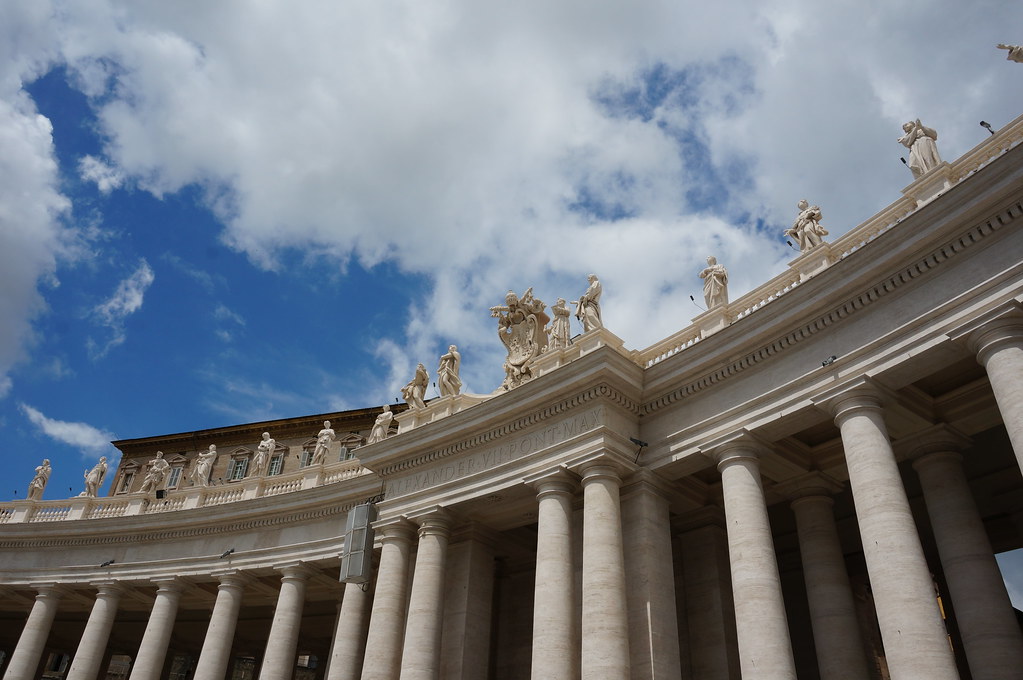
I thought that since the Vatican Museums were nearby, that I would give them a try.  However, the line for this too was insanely long - it stretched around for about three blocks before even getting to the entrance (on Saturday morning, right before my flight, I would finally make it inside the Vatican Museums and Sistine Chapel).  Once I saw that the line was so long, I decided to leave the Vatican area altogether and do something different.  First stop: gelato.
After the gelato break, I decided that I would just hop back onto the Ciao Roma bus and ride around the entire city at least once to see it and get my bearings for when I'll walk around for the next couple days.  Since many people exit at the Vatican City and Colosseum stops, I thought I was in a good location to hop back on and get a good seat on the upper deck.  I was right, and managed to find a good place.  I listened to some of the new audio and got off the bus once we arrived at Termini.  I was pretty tired from the early morning start, so I went back to the hostel, officially checked in, then took about an hour nap.
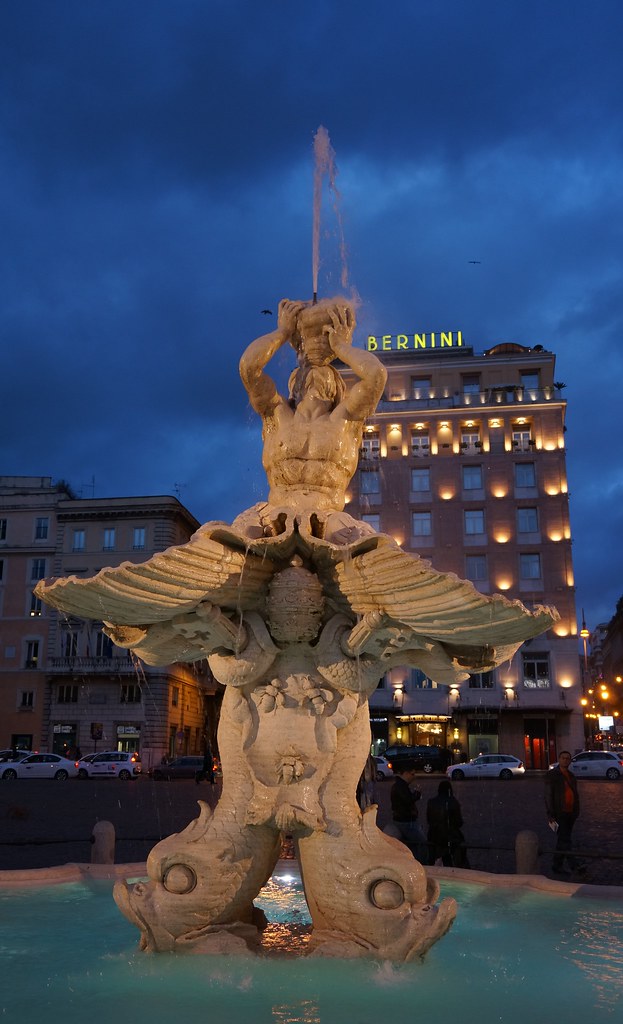
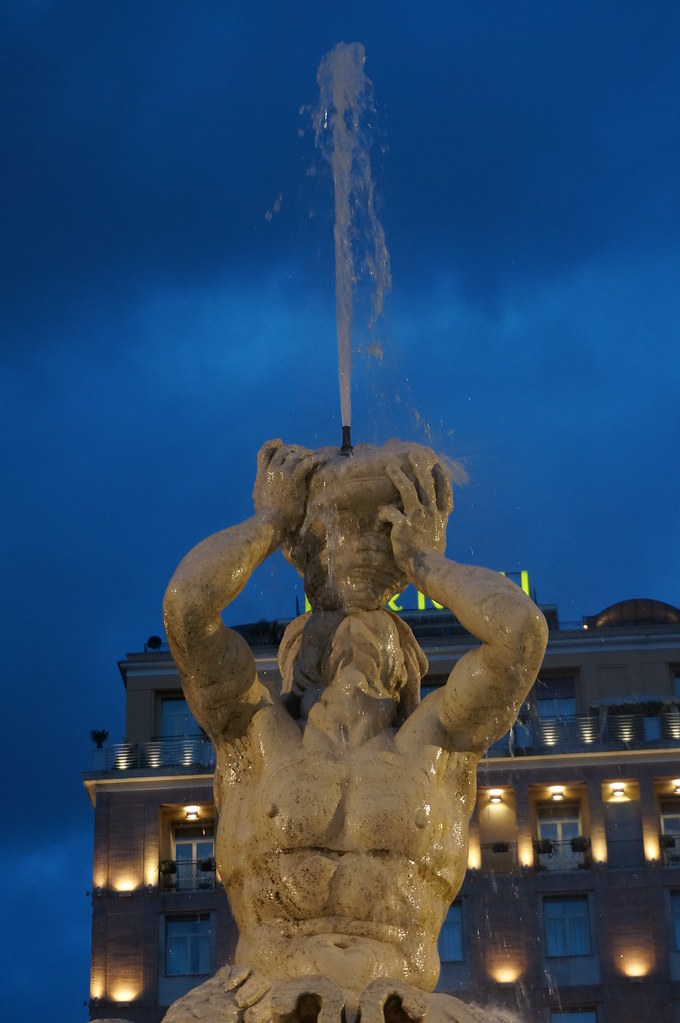
That afternoon, I got back on the bus and rode to Fontana del Tritone, a fountain by Gian Lorenzo Bernini.  Bernini's fountain, located in Piazza Barberini, has four dolphins with upturned tails that support an open scallop shell where Triton sits, blowing into a conch shell.  The fountain was designed by Bernini in 1643 and was his first of many fountains he made.  Up until the end of the 1700s, apparently the bodies of unidentified people were laid out in front of the fountain and the town crier would call the public to come to identify and claim the bodies.  Weird.  Luckily, there are no dead bodies in front of the fountain any more and it can be enjoyed sans zombies.  Actually, the Fontana del Tritone is my favorite fountain because of its design and how great it looks at night, although the fountains in Piazza Navona are pretty cool too.
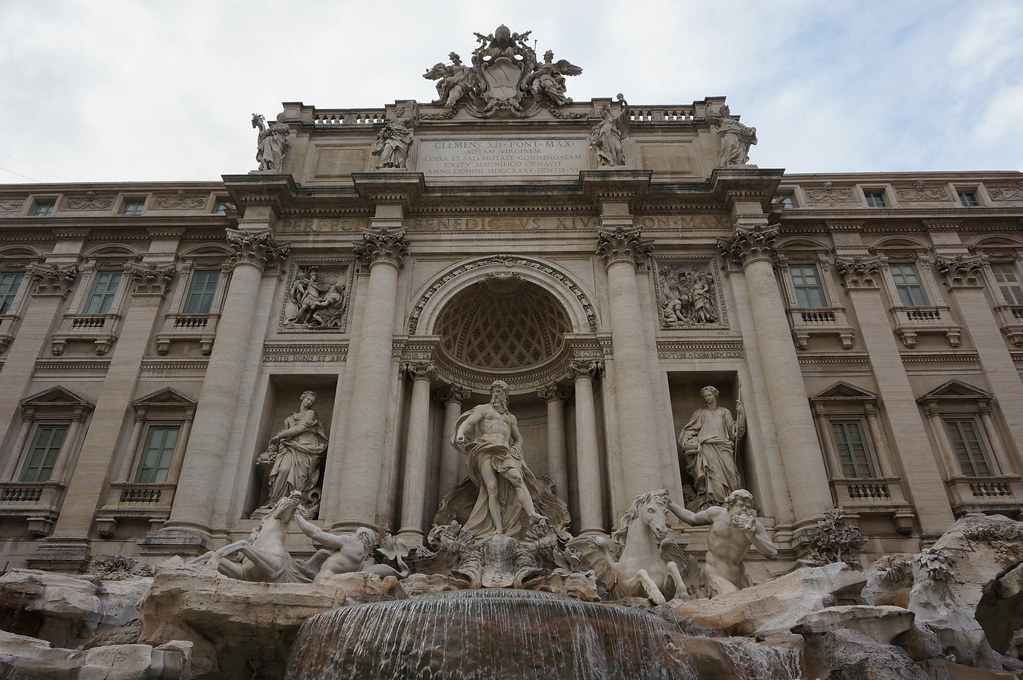
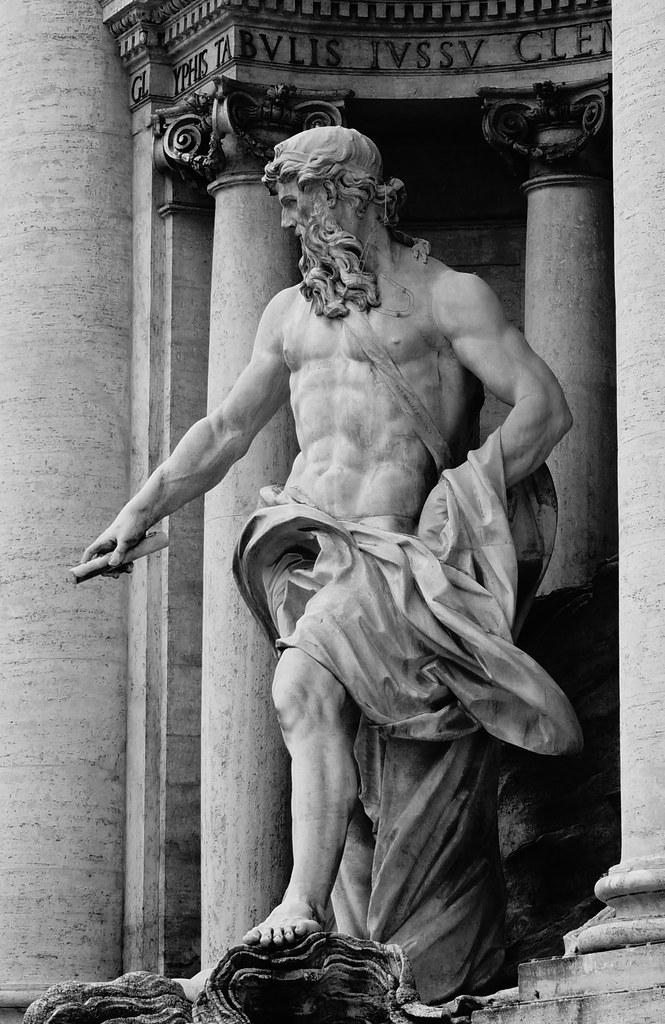
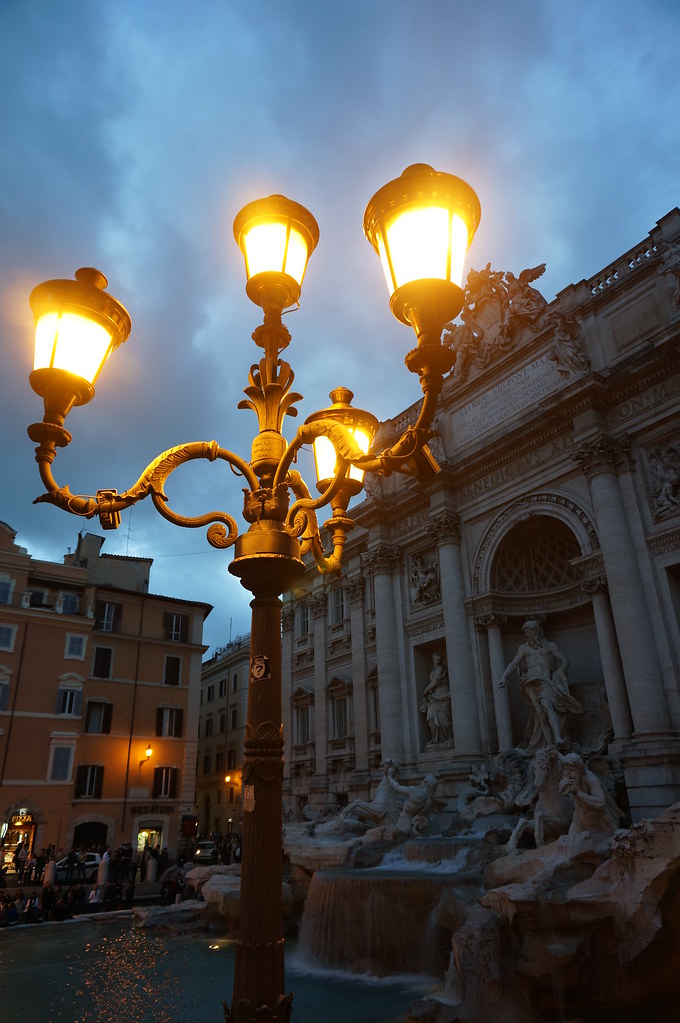
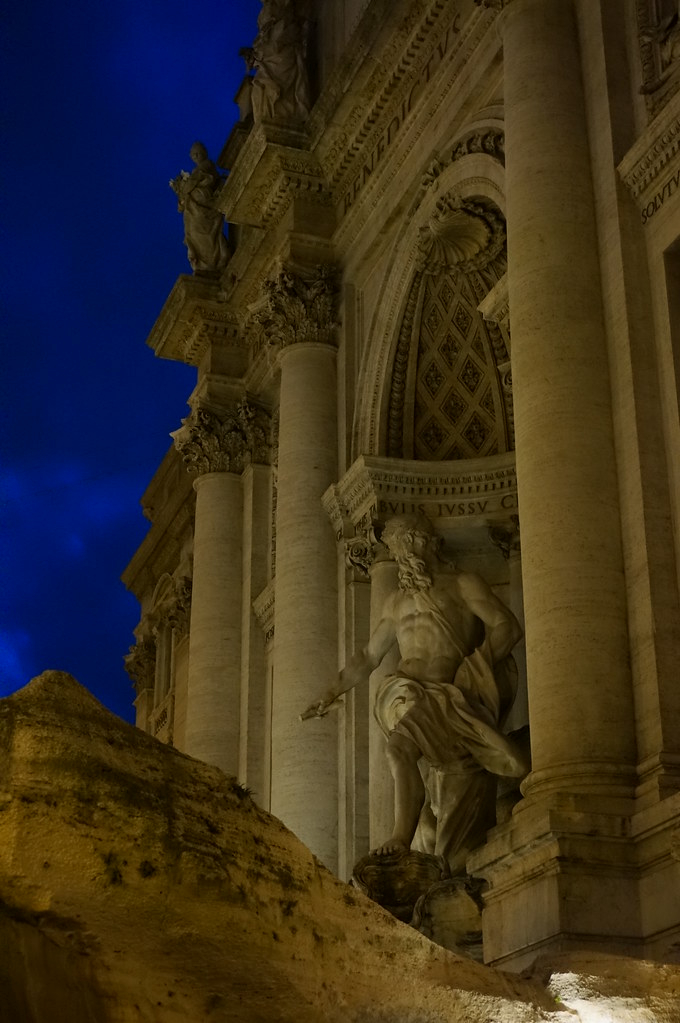
From Fontana del Tritone, I walked down Via del Tritone to the famous Fontana di Trevi.  The Fontana di Trevi has a magical quality to it, captured by Frederico Fellini in La Dolce Vita (although I don't image that it would ever be as empty or as clean as it appears in this scene).

The fountain was designed to be a celebration of Acqua Vergine, the water conveyed to Rome by an aqueduct constructed by Agrippa in 19 BC.  The fountain itself has been remodeled and replaced throughout the centuries.  The fountain is so large that it seems to fill the entire plaza/piazza and you can hear the thundering of the water from about a block or so away, despite the crowds of people.
Here at Fontana di Trevi, legend has it that if you stand with your back to the fountain and throw a coin over your shoulder into the water, you will return to Rome someday.  Apparently, the city gets some good use out of this tradition.
Apparently, there are so many tourists that visit the Trevi fountain that a charity for the poor and needy in Rome called Caritas began collecting the coins from the fountain each day.  The daily amount is about 3,000 Euros (or about $4,109 USD).  Recently, Caritas opened a supermarket to distribute essential items at free or low costs for those in need.
After making a wish and throwing my coin into the fountain like so many others before, I wandered around the streets nearby the piazza and grabbed a caprese sandwich and bottle of water to go.  I walked back to the fountain and found a place to sit along the fountain's left side where I could watch the crowds of people in the plaza as well as appreciate the fountain's beauty and rushing water from up close.  Sitting on a high part of the fountain, I ate my dinner and watched the sun set and the lights slowly turn on, one by one, to illuminate the little piazza and make the fountain come to life.
Making my way back to Fontana del Tritone, I realized that I had waited until after the bus' last time to take me to the Termini stop.  I had the hostel's business card with me and there were tons of taxis around the piazza, so I was in no rush.  I crossed the busy streets back to the piazza to admire Tritone at night before catching a cab back to the hostel.


Thursday, May 1st, 2014: Day Two in Rome

Since I had been up so early the day before, I decided that I could afford to sleep in a bit today.  The weather forecast predicted a beautiful day, so I decided I would try to go to the Colosseum.  Unfortunately, I did not realize that May 1st was a national holiday in Italy, so everything was closed.  The only tourist attractions that were open were those that were outside (like the fountains and piazzas) and things associated with churches.
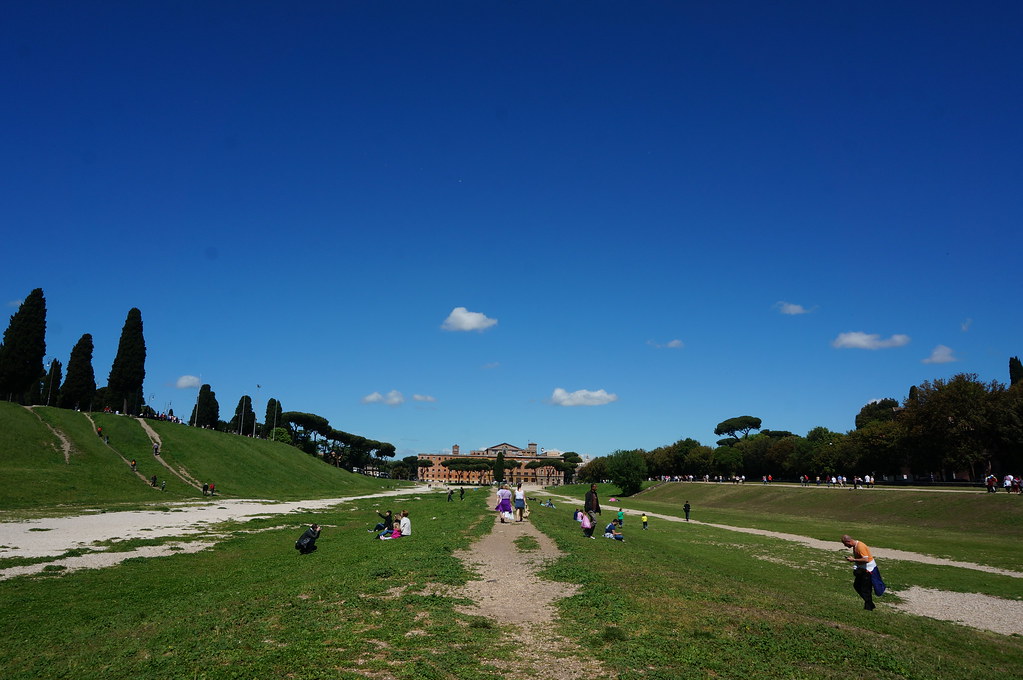
I still decided to walk around the Colosseum and take some great pictures of it and the Palatino today to take advantage of the beautiful weather.  I continued walking along Via di San Gregorio until I arrived at Circo Massimo (Circus Maximus, in English/Latin), the old chariot racing grounds of the emperors.

Apparently, this is what it looked like in its glory years, after being built around 530 BCE.  It must have been pretty incredible to see something like this constructed and then to be there in the stands watching the thundering chariots fly by (or better yet, in the chariot itself!).
There are not a whole lot of ruins left of Circo Massimo and today, the racing grounds now serve as a public park.  I decided to take a break and enjoy the sun, so I walked to the center of the old racing grounds and laid down in the grass.
After lounging in the early afternoon sun on the grounds of Circo Massimo, I headed over to the Sant'Maria in Cosmedin church, famous for the Bocca della Verita, the Mouth of Truth.  Legend has it that if you place your hand in the mouth while telling a lie, your hand would be bitten off.  You can see Gregory Peck playing the old prank on Audrey Hepburn in Roman Holiday.


Just like Peck does in the movie, there was a security guard working at the Bocca della Verita who would tease some tourists by shouting AAAAH! when they cautiously place their hands in the mouth.  The lips are actually pretty smooth - either chapstick for statues or the result of thousands of tourists throughout the years placing their hands in the mouth.  Luckily, despite telling a little lie, I left with both hands and all ten fingers.  ;)
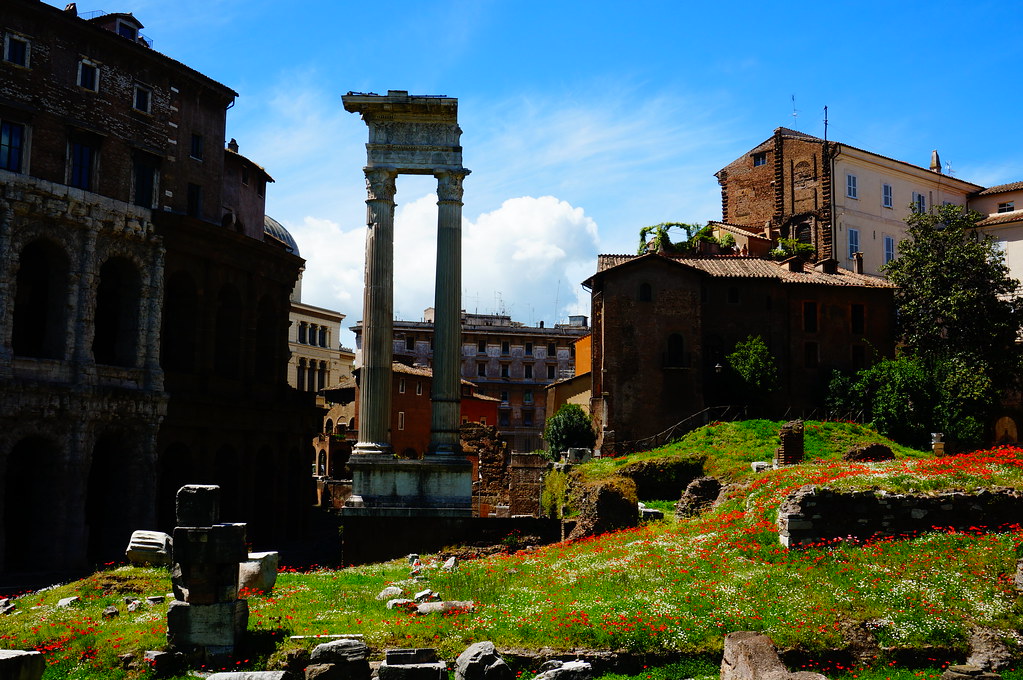
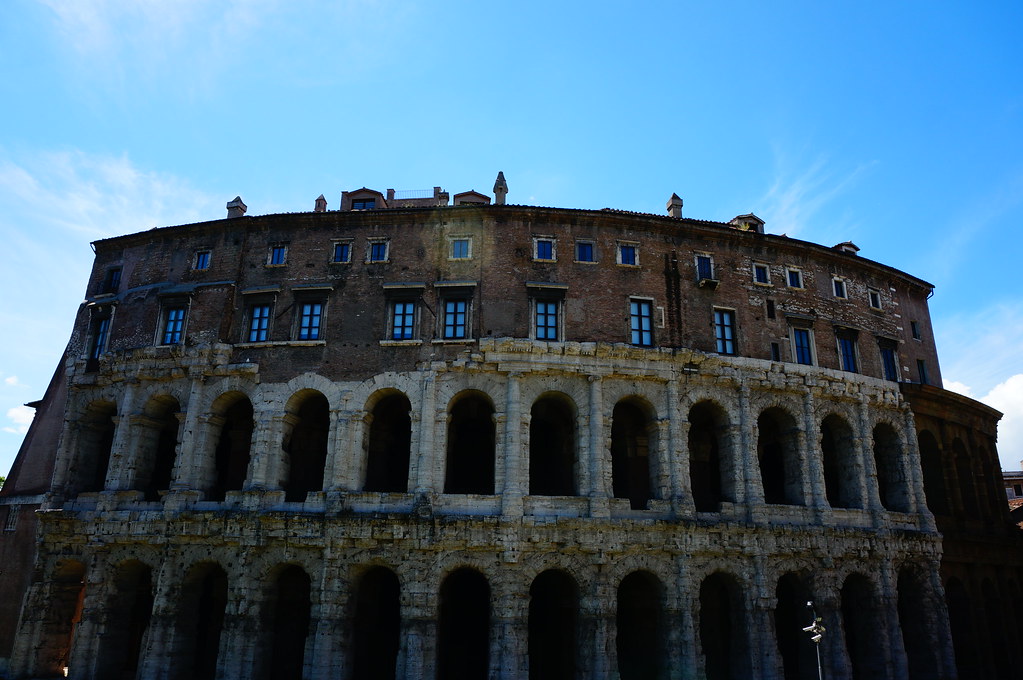
The old theatre, Teatro Marcello, is just up the road.  The theatre's architecture with its arches served as an inspiration for the design of the Flavian Amphitheatre (better known as the Colosseum) when it was built some years later.
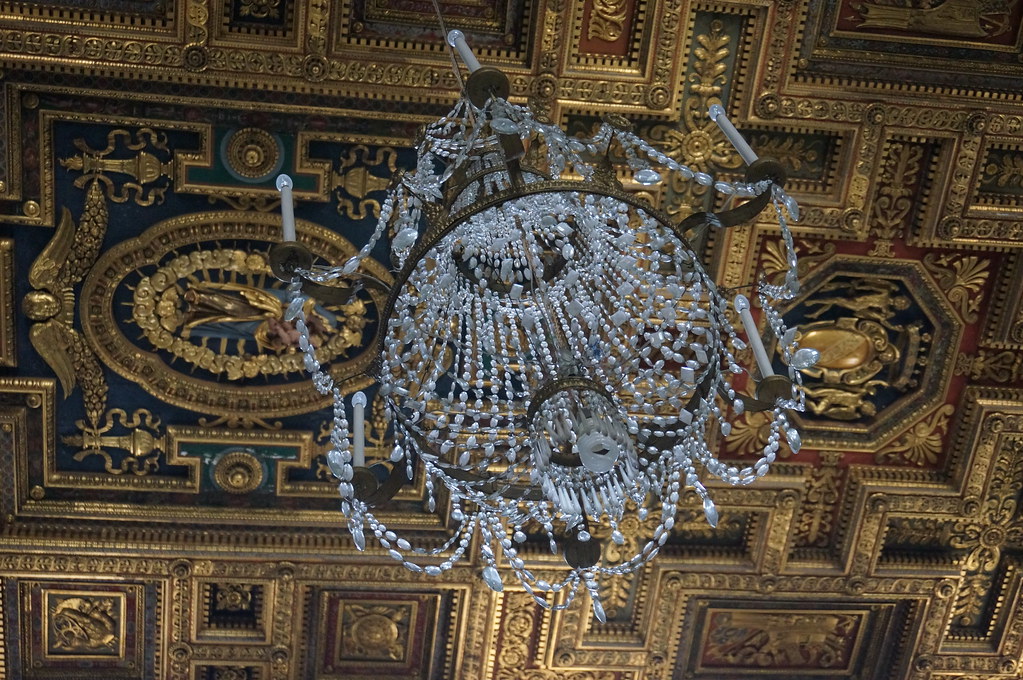
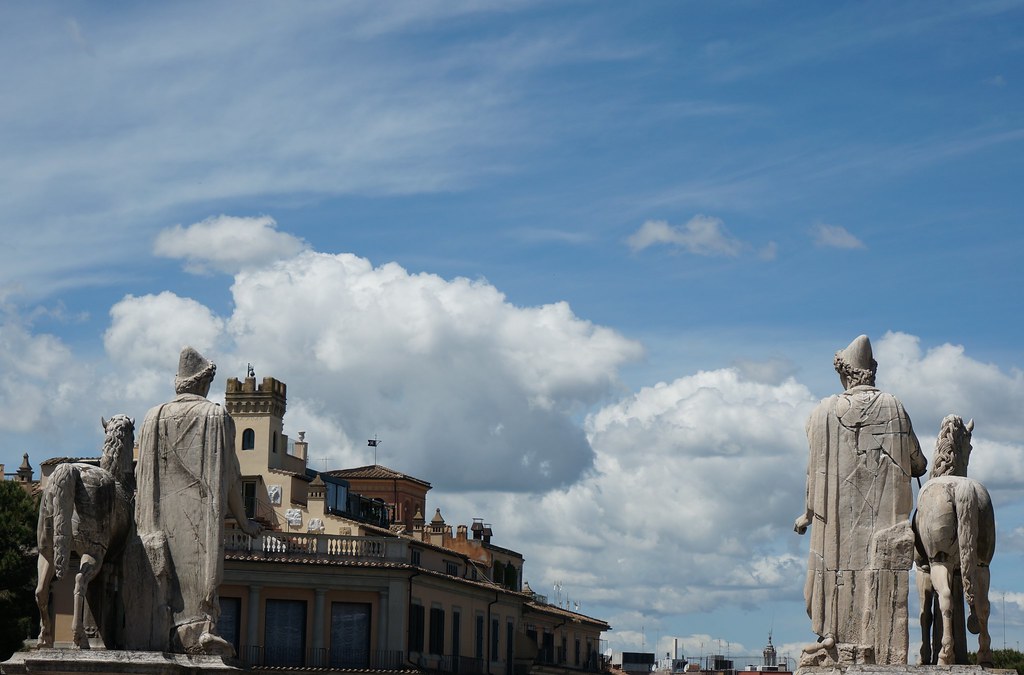
My next stop was the Campidoglio, and the church next to it, designed by Michelangelo when he was only 25 years old.  The church was gorgeous, especially with its beautiful chandeliers.  The Campidoglio was also pretty cool.  You climb up several stairs to reach the plaza at the top, with a huge statue of Marcus Aurelius riding a horse.  Castor and Pollux (twins and brothers to Helen of Troy), each hold a horse and wait at the top of the stairs to the Campidoglio. From behind the government buildings (with a fountain of the River God Tiber in the front), you can see a statue of Romulus and Remus with the wolf, as well as a great view of the Palatino and Foro Romano.
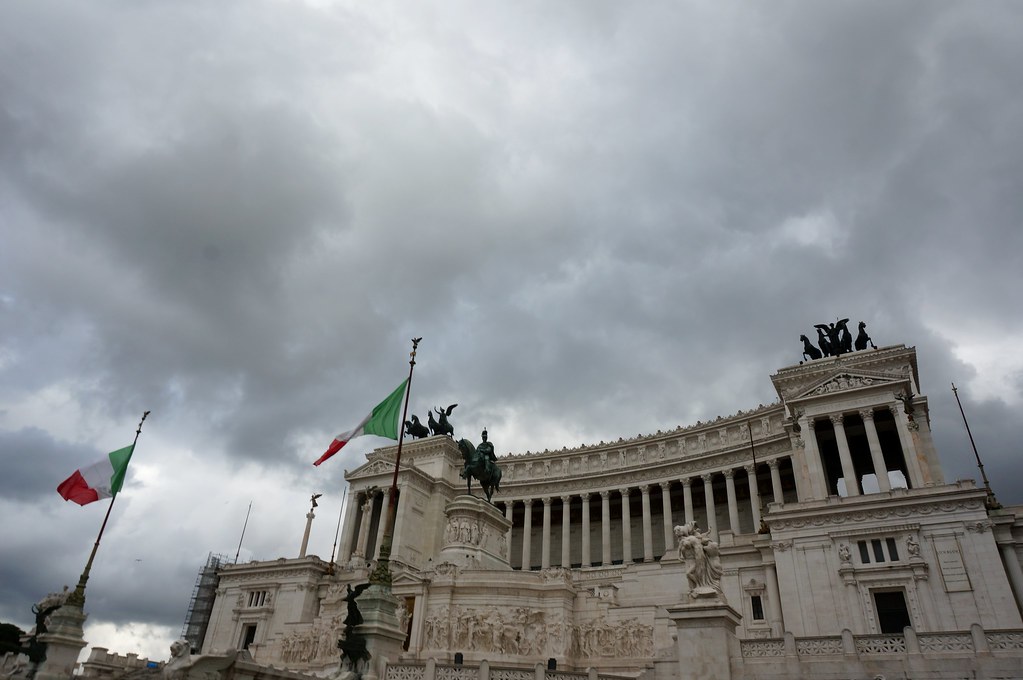
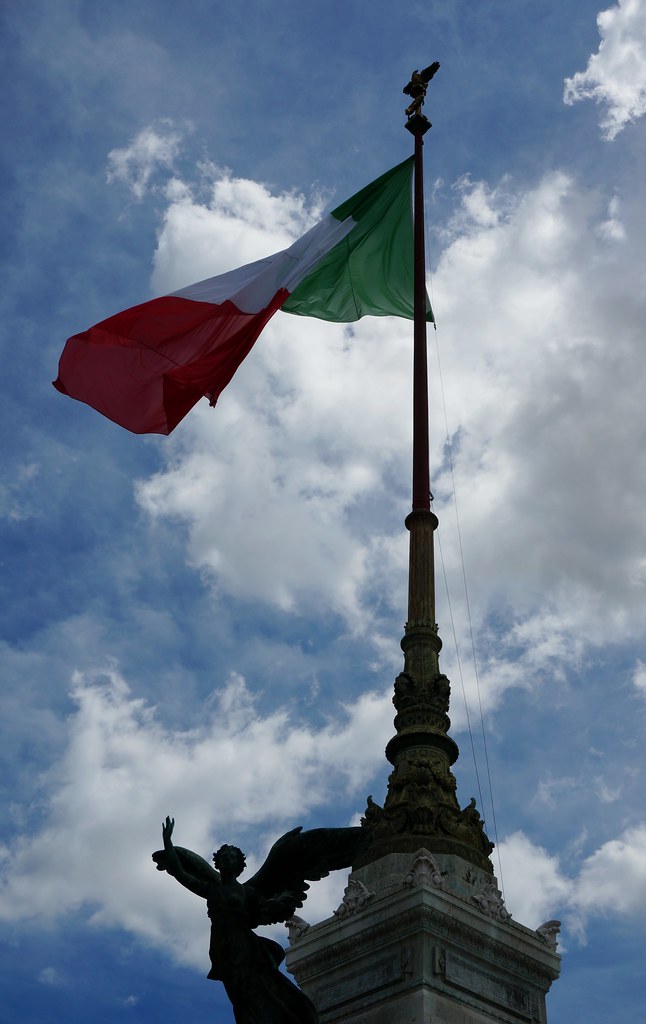
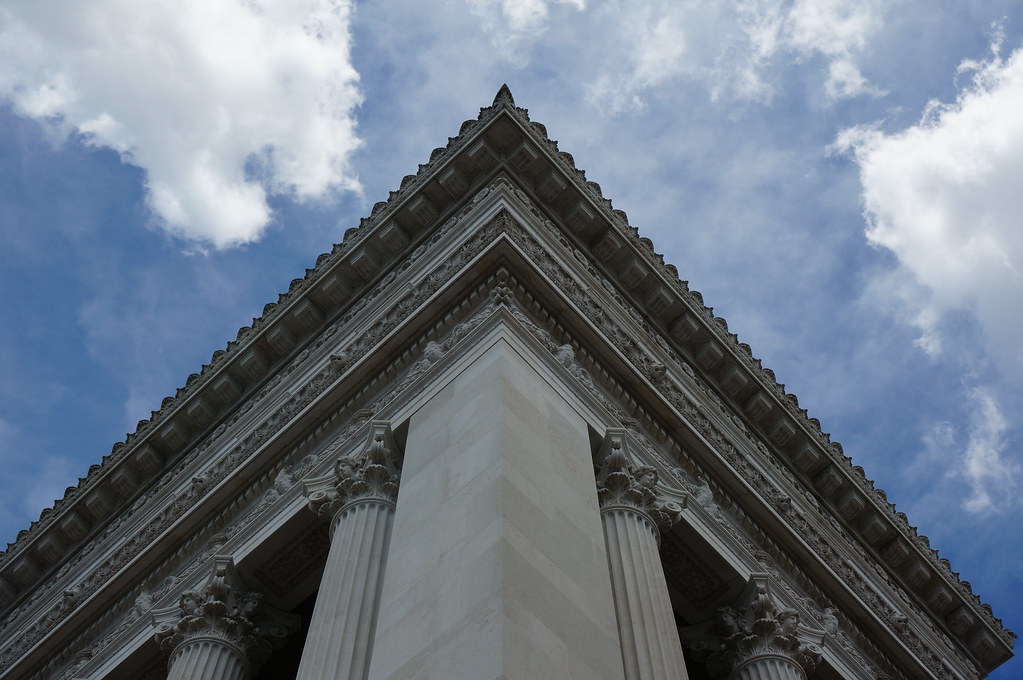
Right next to the Campidoglio, there is a huge white marble building, the Monumento Vittorio Emanuele II.  Vittorio Emanuele II became king of Italy in 1878 and was the first king of a united Italy since the 6th century.  He is pretty famous in Italy and there are streets named after him in many Italian cities.  The front of the white marble building has a monument for the Tomb of the Unknown Soldier, guarded around the clock by Italian soldiers.  Just like at Arlington National Cemetery, this Tomb of the Unknown Soldier has a changing of the guard that occurs periodically.  I did not film it, but YouTube exists, so this is pretty much what the changing of the guards looked like.
After watching the ceremony and visiting the monument, I walked over to Ristorante Il Miraggio (map), a restaurant nearby for a quick pizza lunch (pizza all'ananas).
I then began to make my way over to the Pantheon.  Unfortunately, the Pantheon was also closed for the May 1st holiday and the piazza was, like everything else in Rome I was soon discovering, insanely packed with more people in one place than I've ever seen before.
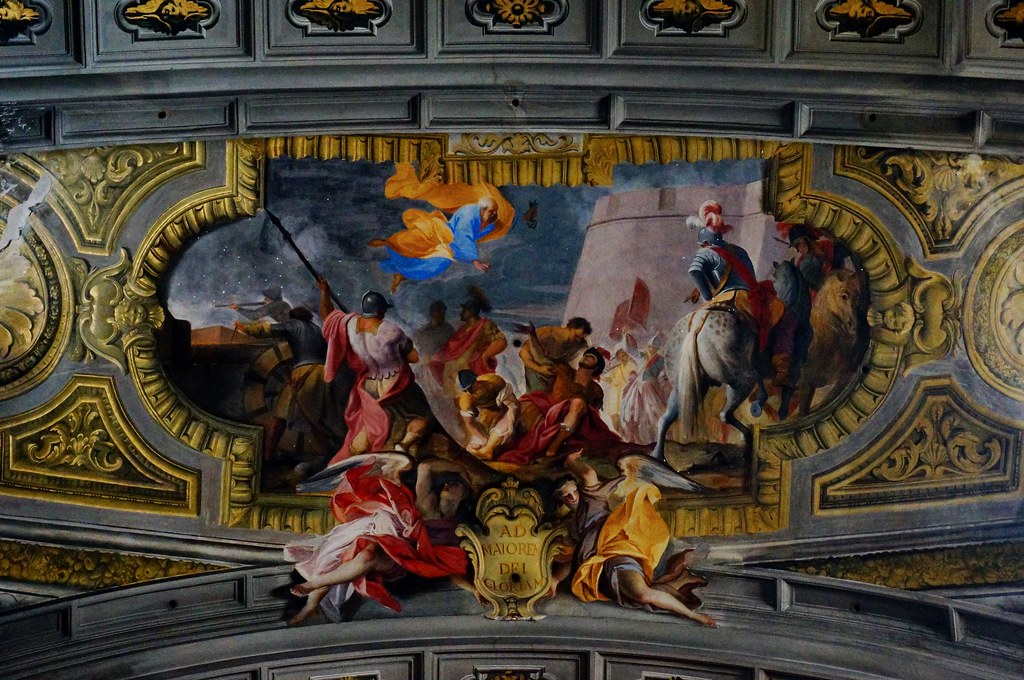
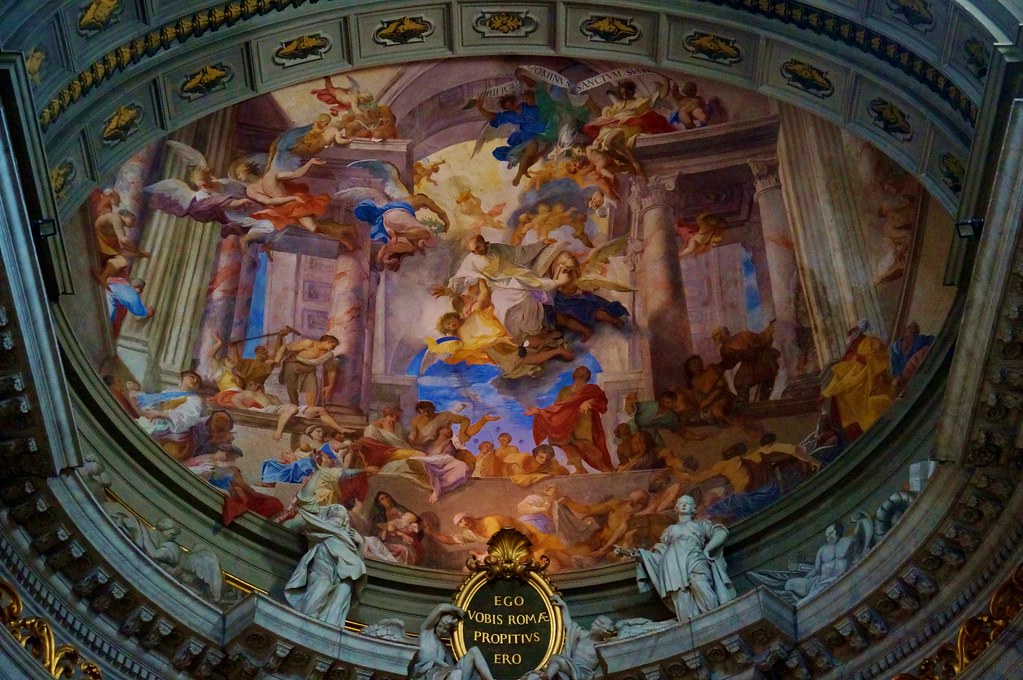
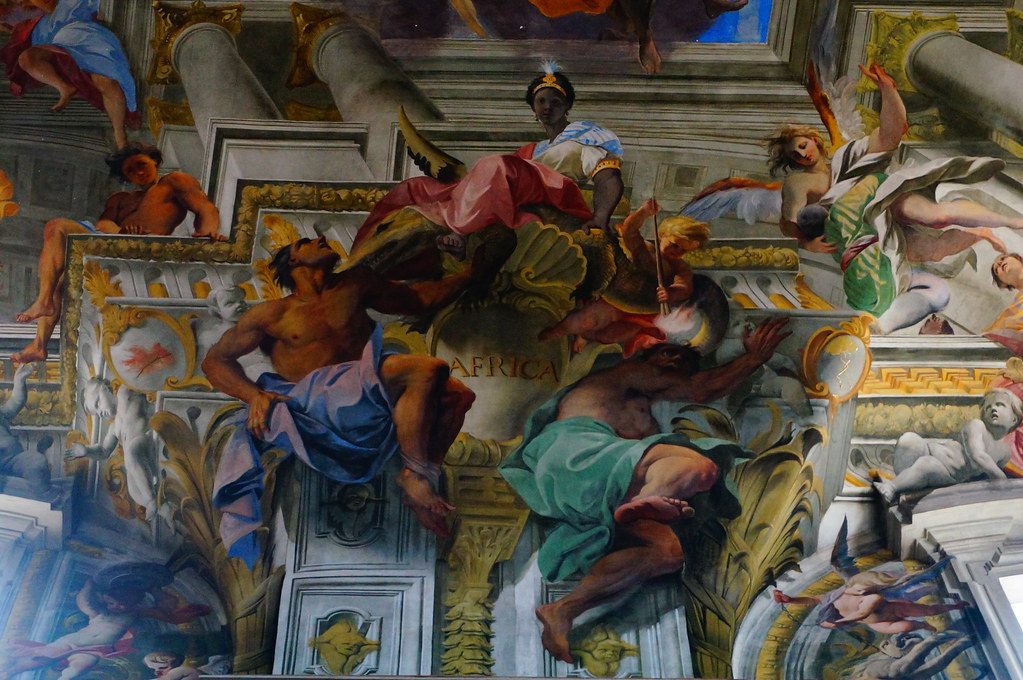
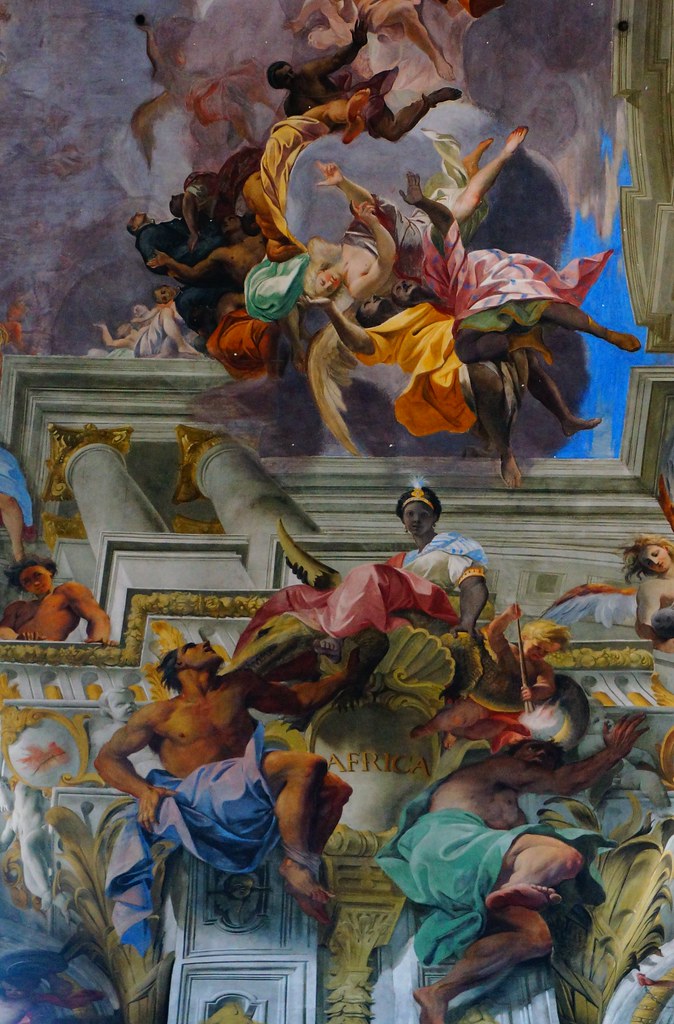
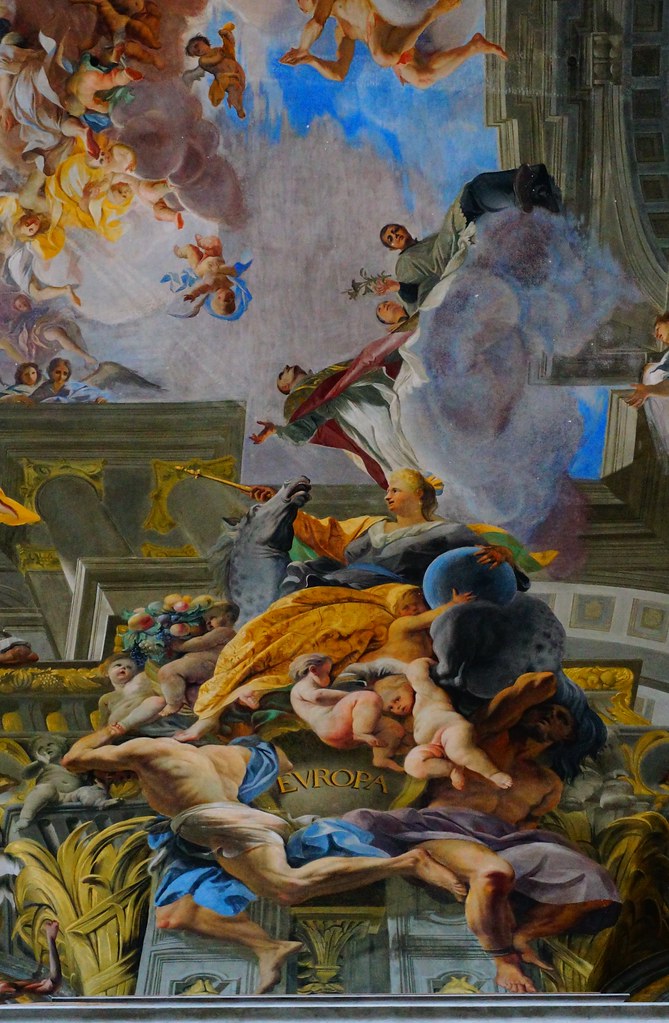
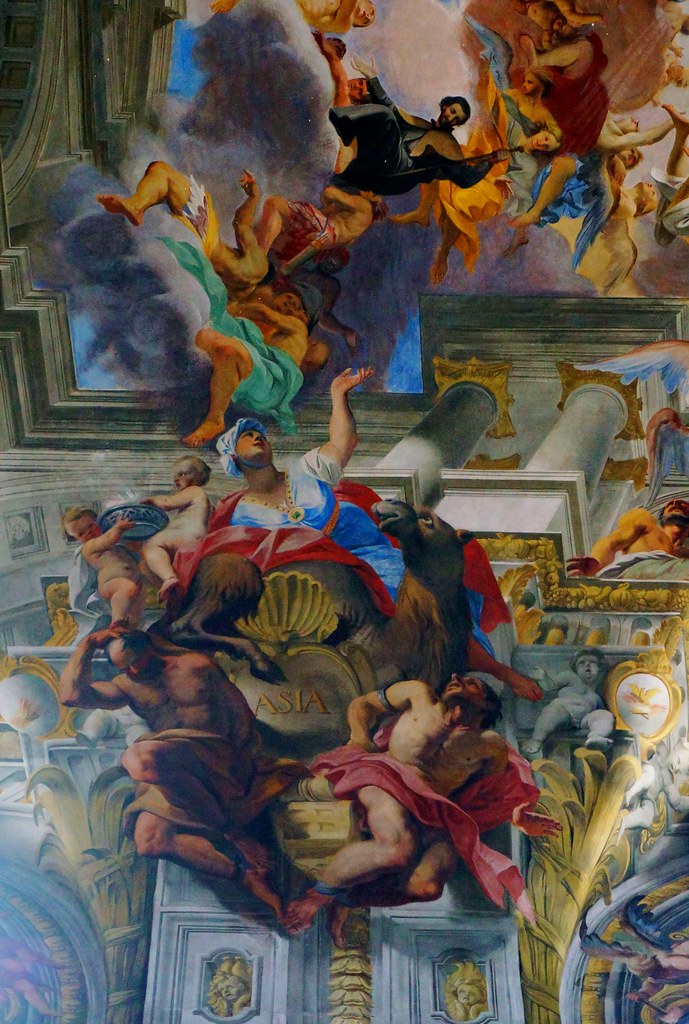
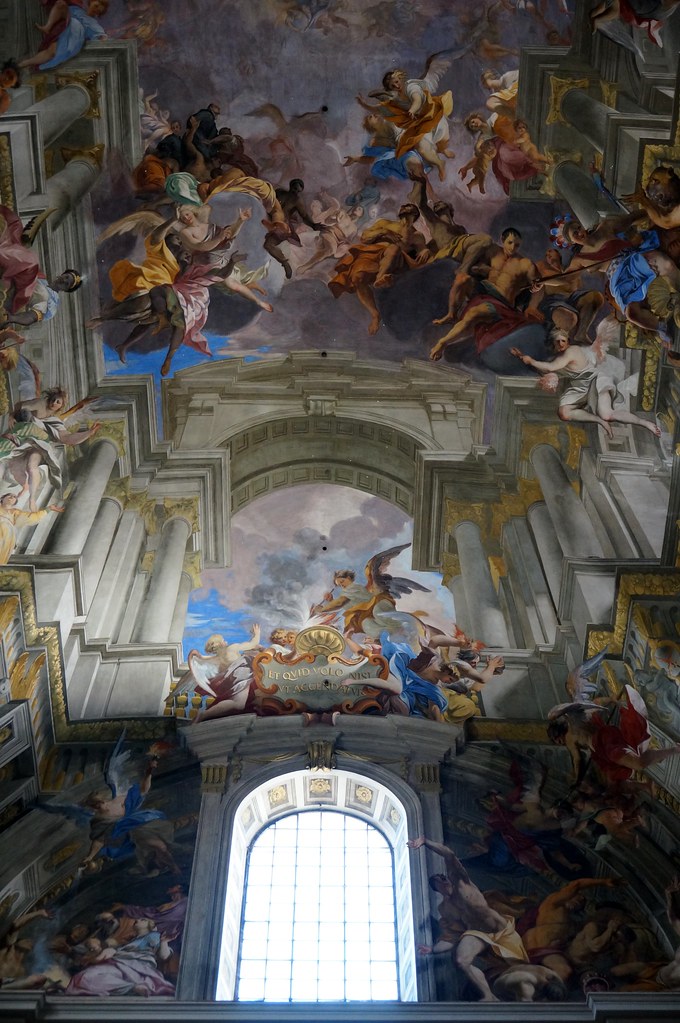
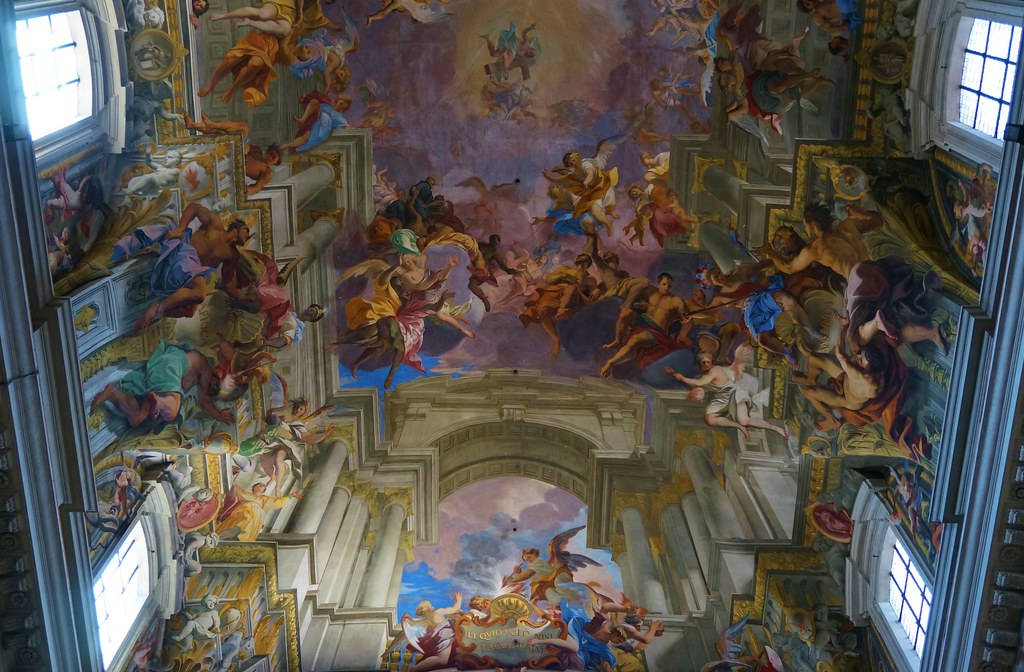
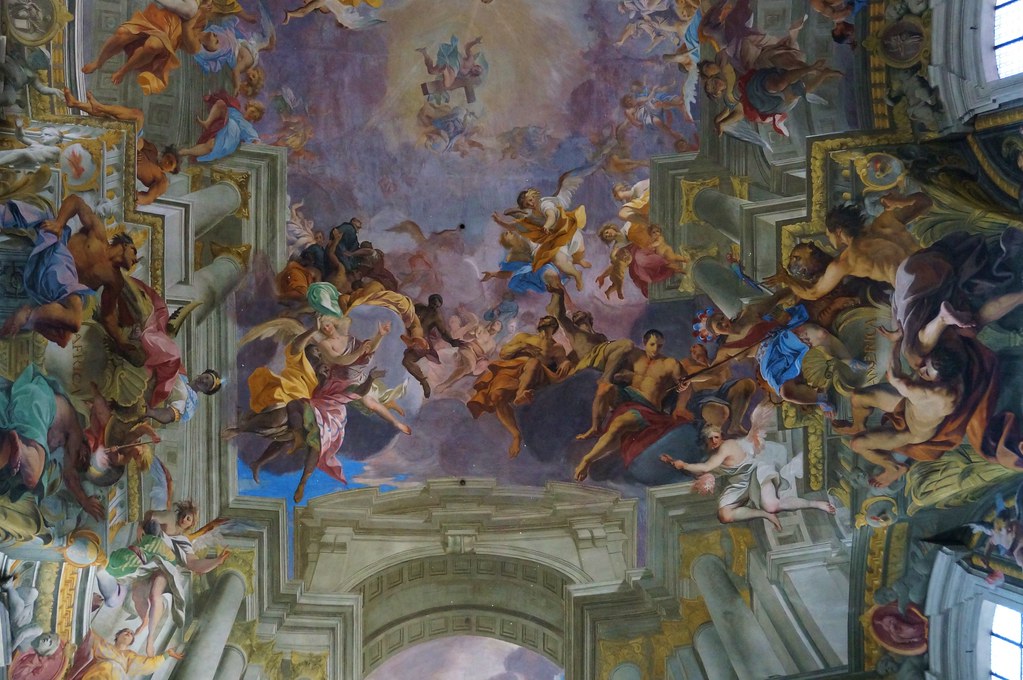
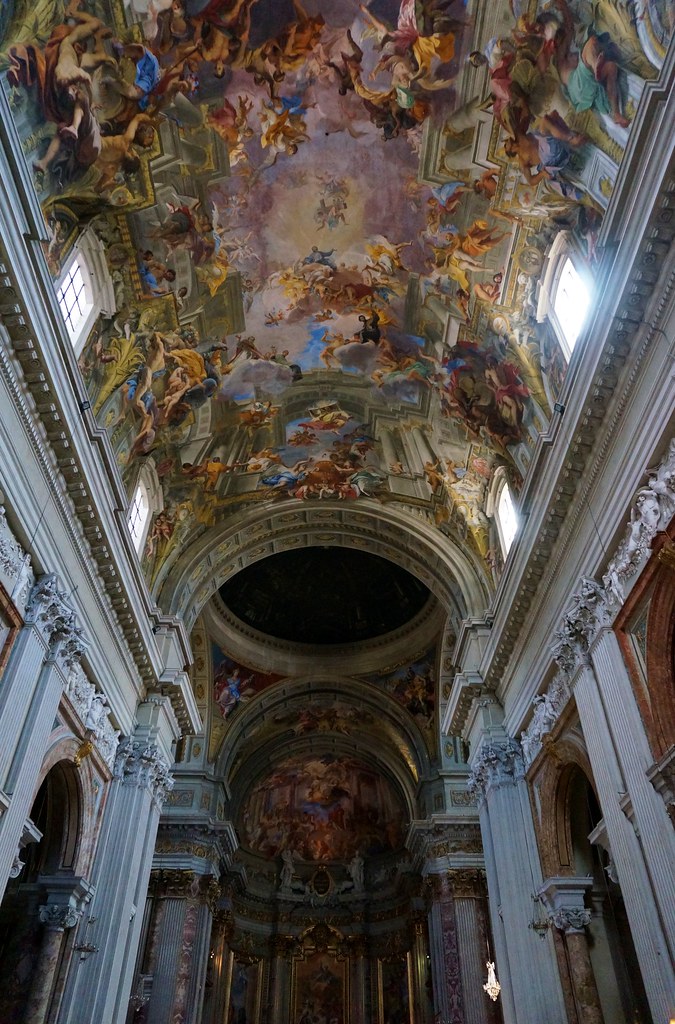
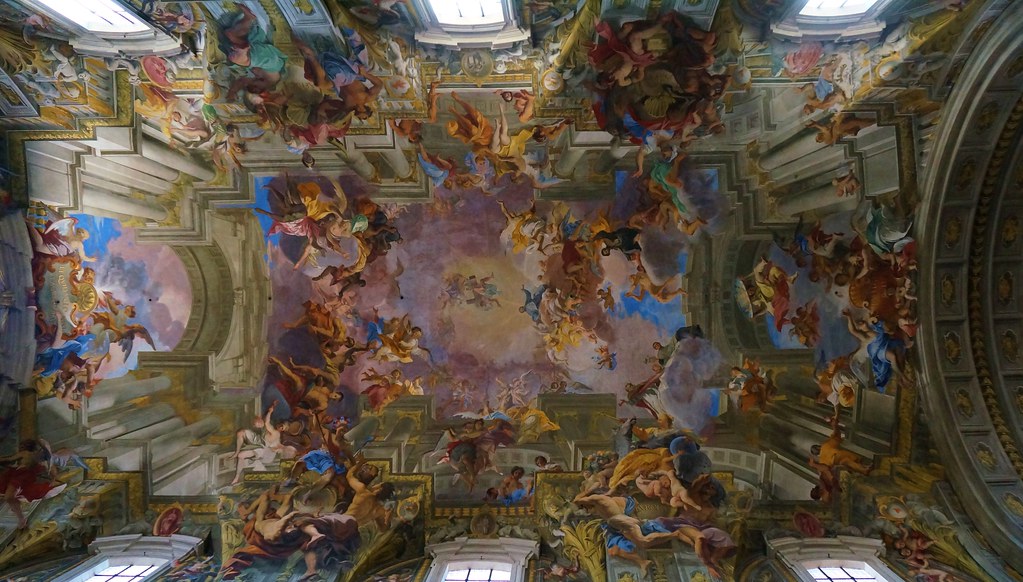
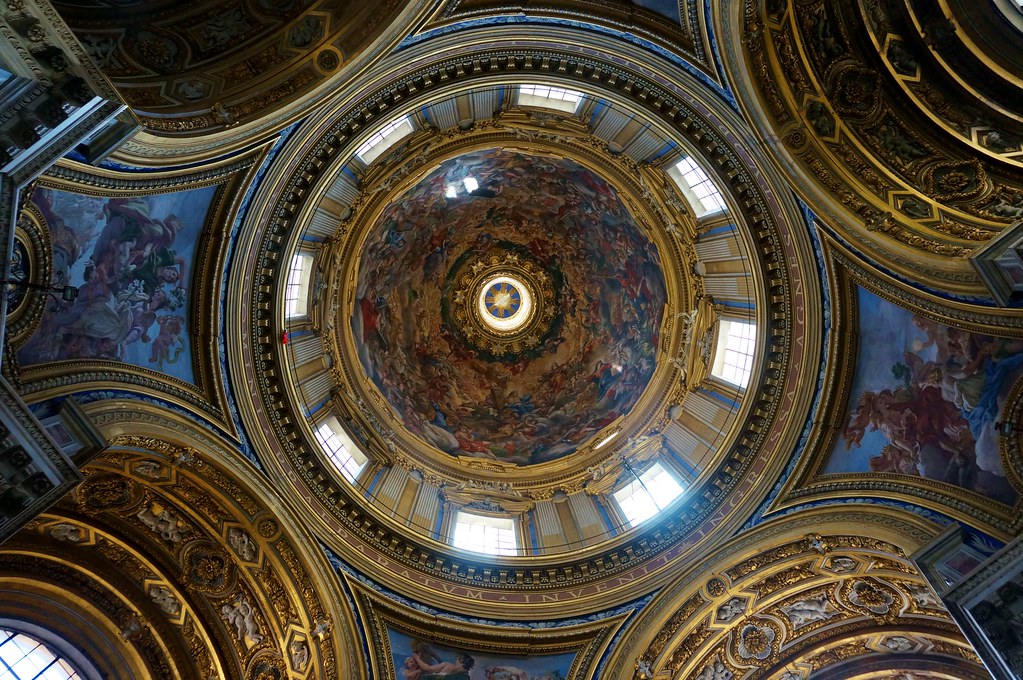
As I moved from the Pantheon to Piazza Navona, I stumbled across the church of San Ignacio (San Ignazio in Italian, Saint Ignatius in English).  Apparently, San Ignacio was a Basque knight and thus is one of the patron saints for the Basque people in Pais Basco in Spain.  The church is incredible though.  The architecture inside is actually quite simple and the ceiling is a simple, smooth arched roof.  It is the awe-inspiring frescos that make the church come to life.  Painted by a lay Jesuit brother, Andrea Pozzo, in the last decades of the 1600s, the frescos are so stunning that you'll never want to look back down.  It seems as though the figures are in three dimensions and that the angels are falling from the ceiling down toward you.  There is no picture that I could possibly take that can capture how absolutely stunning this place is, but with the beauty of its art and the fact that there were not a whole of of people inside, since it's not a major or well-known tourist destination, it is definitely one of my favorite places in Rome.
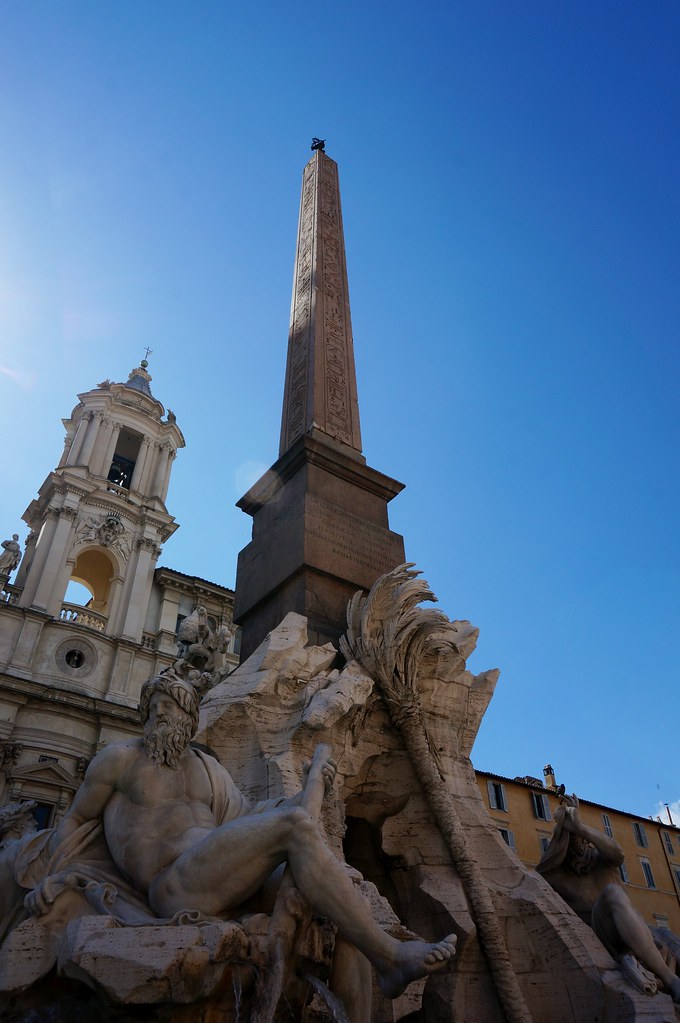
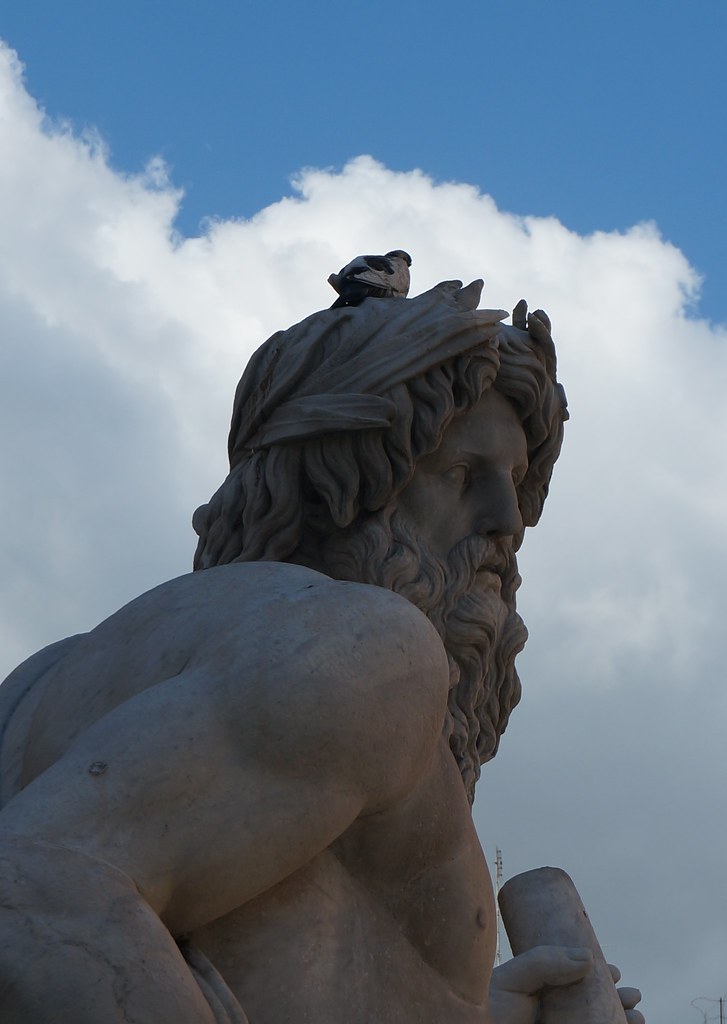
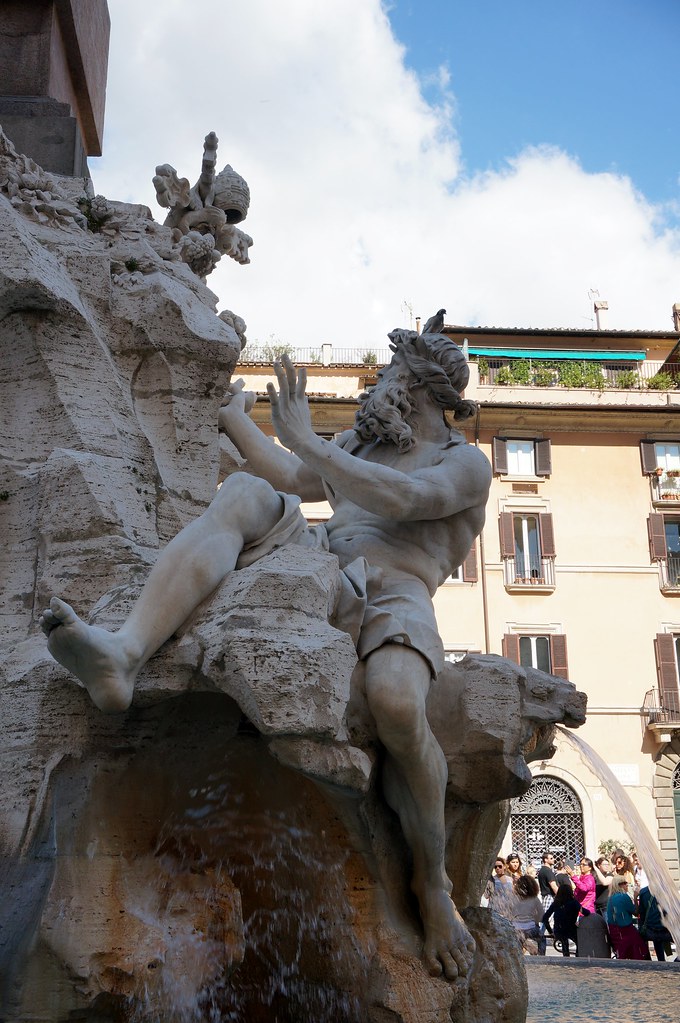
After spending a long time admiring the beauty of this hidden gem, I continued along the way until I reached Piazza Navona.  The fountain in the center of Piazza Navona is also by Bernini and is called Fontana dei Quattro Fiumi, or The Fountain of Four Rivers.  The statues alongside the central column represent the Danube, Ganges, Rio de la Plata, and the Nile rivers.
According to popular tales, the poses of the statues for the Nile and Rio de la Plata are also that of the statue of Saint Agnes in the church directly behind the fountain.  This is said to be because of the rivalry between Bernini and Borromini.  Apparently, Rio de la Plata's hand is raised to ward off the collapse of the church's facade while the Nile has its face covered in its refusal to look at Borromini's work (as opposed to the fact that the source of the Nile at this point was not yet known in Europe).
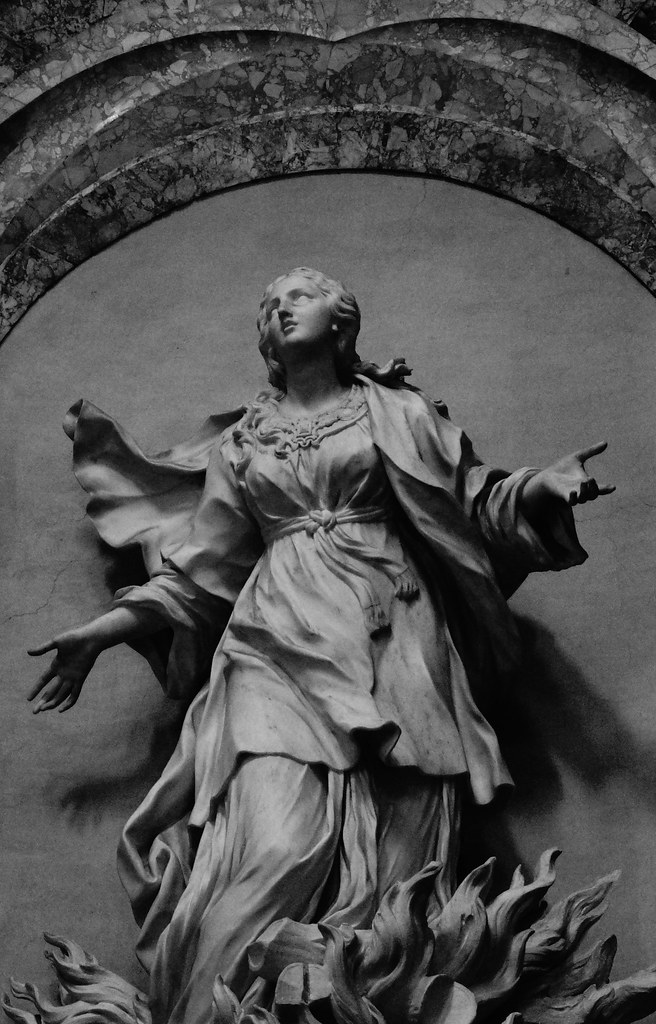

In this same vein, Saint Agnes' statue is touching her chest in a gesture by Borromini to assure the people of Rome that the church would not collapse.
The story of Saint Agnes itself though is actually pretty interesting and definitely gives you a different impression when entering the church.  I ended up picking up a brochure from the church that explains it in detail.

There is little known about the life of St. Agnes, but the scarce information we have is enough to throw light on a figure who has been dear to the hear of the faithful through the centuries.
We know nothing about her family, or why this young girl became a Christian.  What is certain is that her name was Agnes (in Greek: pure, chaste) and that when she died, she was 12 or 13 years olf, according to the examination of her skull which is preserved in the reliquary in the Chapel of the Holy Head, in the Church of Sant'Agnese in Agone at Piazza Navona.
She was martyred under the Emperor Siocletian who unleashed a ferocious persecution of the Christian community around the years 303-304 AD.   
The responsibility for her martyrdom is attributed to the son of the Prefect of Rome who became infatuated with her.  When she rejected his advances - she had made a vow of chastity to mark her total consecration to God - she was put on display under the arches of the Circus Agonale, the present day Piazza Navona, where the prostitutes of the time paraded. 
Tradition says that her nakedness was covered by flowing locks of hair which grew miraculously to protect her.  A man who intended to buy her favors died before he could touch her.  When the prefect questioned her about this mysterious death, Agnes replied that an angel dressed in white protected her and, to prove the truth of her statement, she brought the unfortunate man back to life with a prayer. 
She was next thrown onto the fire, but once again prayer came to her aid, extinguishing the flames. 
In the cad, like a lamb taken to slaughter, her throat was pierced with a sword.  This is why the image of St. Agnes always shows her with a lamb at her feet or in her arms.
Constance, the daughter of Emperor Constantine, erected a basilica in her honor on the Via Nomentana, where to these days, the nuns raise two lambs each year which are offered to the Pope.  Their wool is used to weave the pallium which the Pope, in turn, gives the archbishops. 
Throughout the centuries the name of St. Agnes has been commemorated in Roman Catholic liturgy and her cult has always occupied an important place in the life of the Church. 
The Basilica of Saint Agnes in Agone is a magnificent evidence of the consideration in which this saint has been held by the Popes and by the many illustrious artists who have conferred so much splendor on her in their works. 
St. Agnes is the patron saint of young women and of gardeners.  St. Agnes' saint's day is on the 21st of January, the date of her martyrdom.
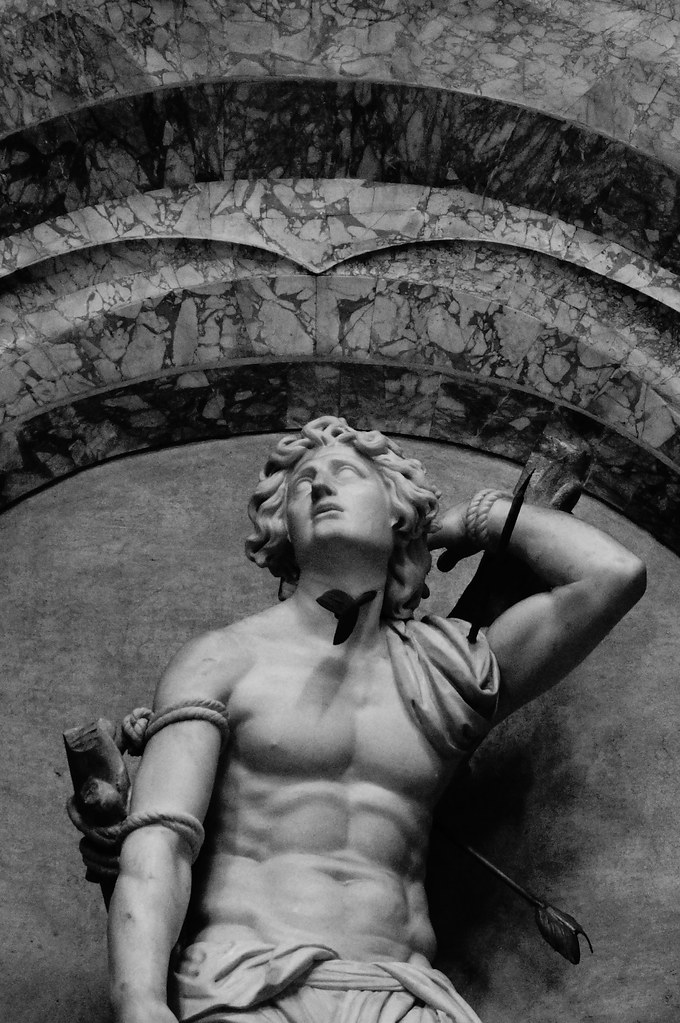
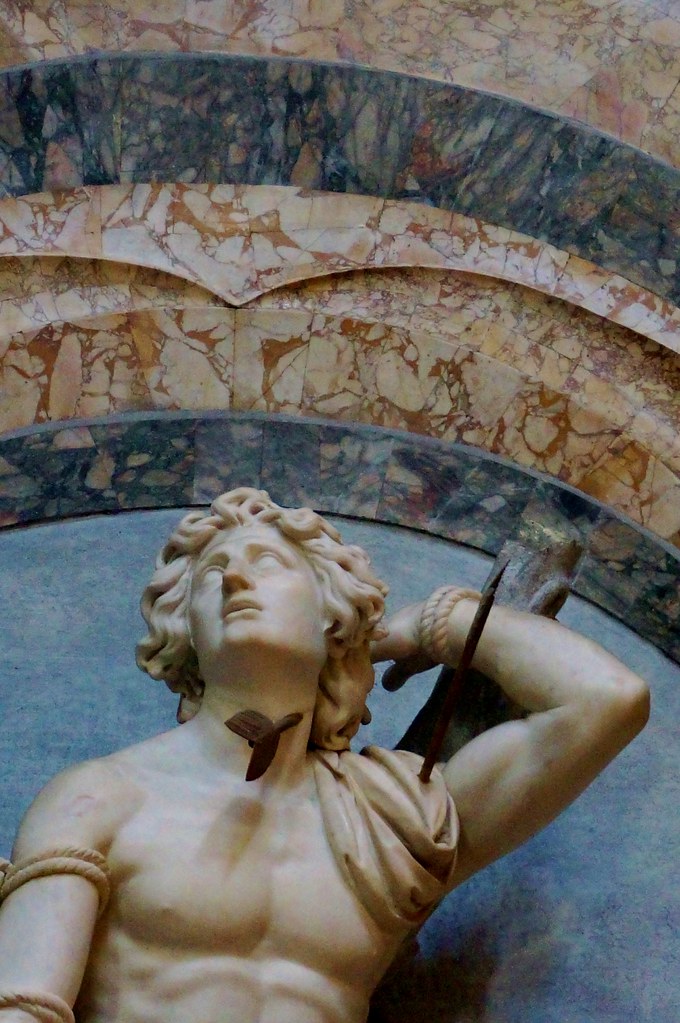
The church of St. Agnes also has a chapel dedicated to Saint Sebastian, another famous Catholic saint and early martyr who was also killed in Diocletian's persecution of the early Christians.  His saint's day is on January 20th, and he is a patron saint for soldiers and athletes.

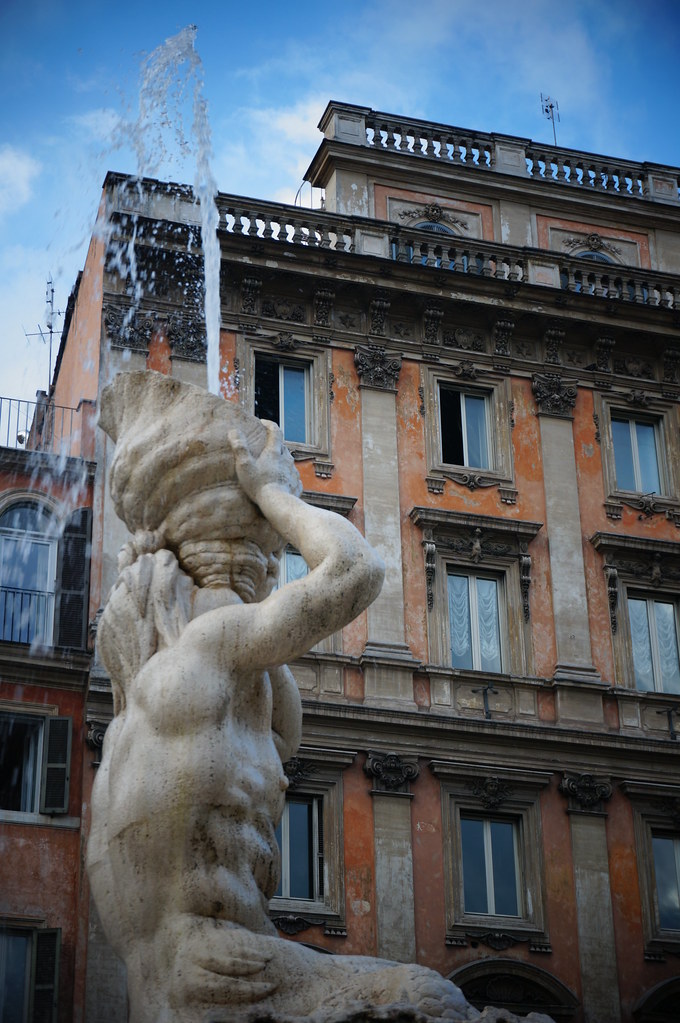
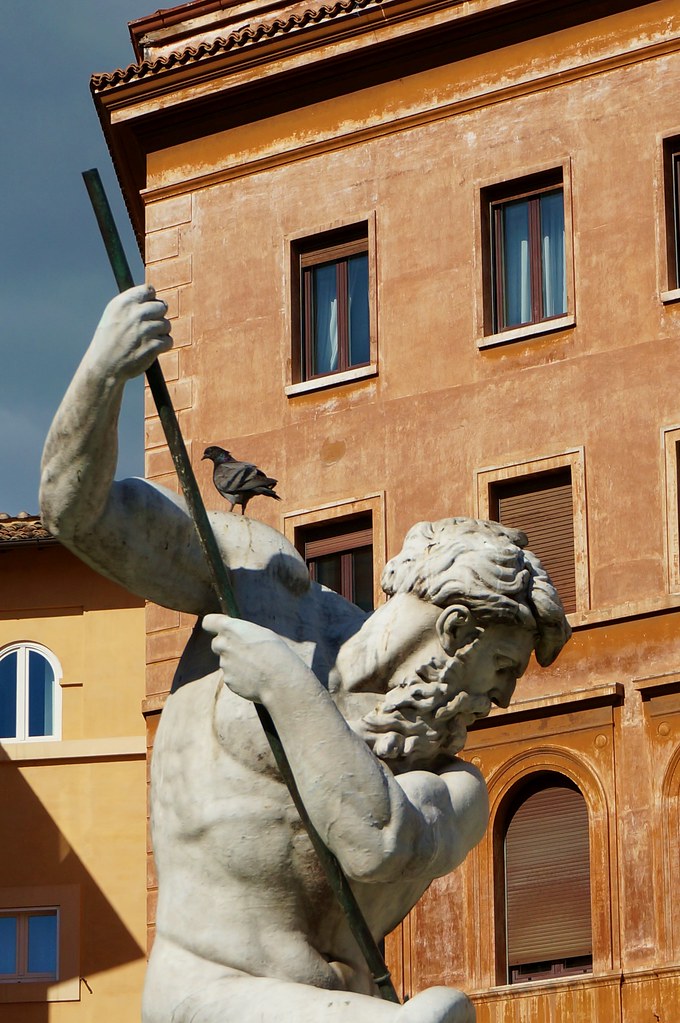
Just north of Bernini's Four Rivers fountain, you can find a delicious gelato shop and the fountain of Neptune in the plaza.  I really liked this fountain and the way that Neptune stood in the water in front of the buildings surrounding the piazza.  I took a break from the hot sun and bought a gelato, eating it and relaxing along the edge of this fountain before continuing on.

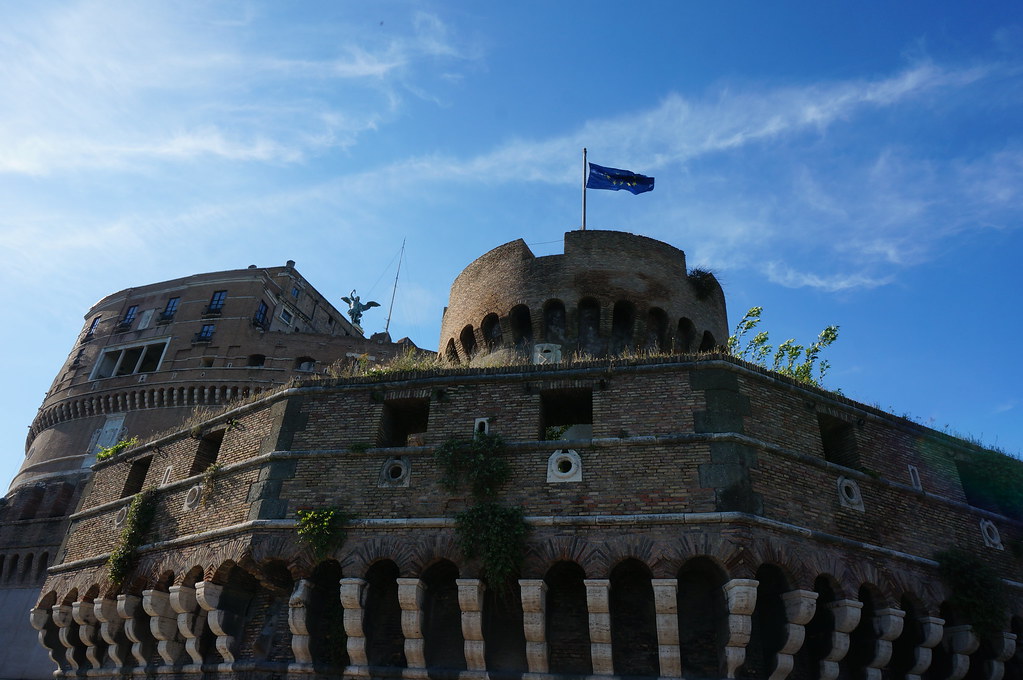
I now crossed the Tiber River and made it to the Castel Sant'Angelo.  The castle was originally built by Hadrian to be a mausoleum for himself but then was later used as a fortress by the popes.  It is now a museum (that was also closed for the holiday).  I walked around the front facing the river and then through the park along Lungotevere Castello, making my way north.
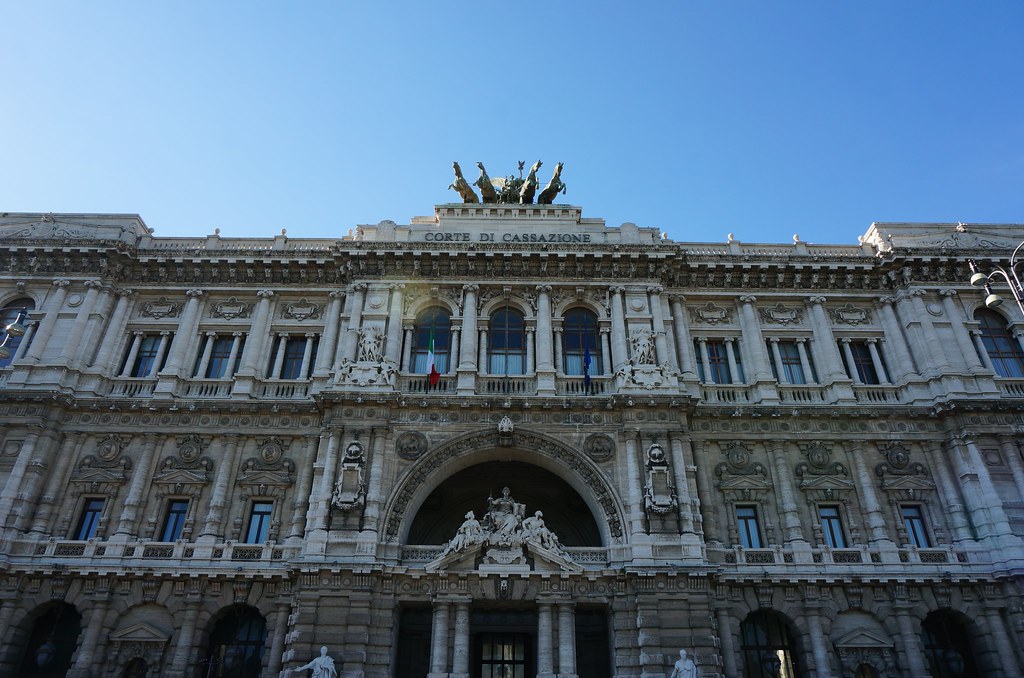
I continued along until I reached the Piazza dei Tribunali/Piazza Giustizia and the Corte di Cassazione, the highest court of appeal in Italy (sort of like the U.S. Supreme Court).  It is such a huge building and it would have been so cool to be able to go inside.  Instead, I took advantage of the fact that I was the only one on this grand building's steps and had an "international lawyer nerd moment" chilling on the steps of the Italian Supreme Court by a statue of the great lawyer, politician, and orator Cicero.
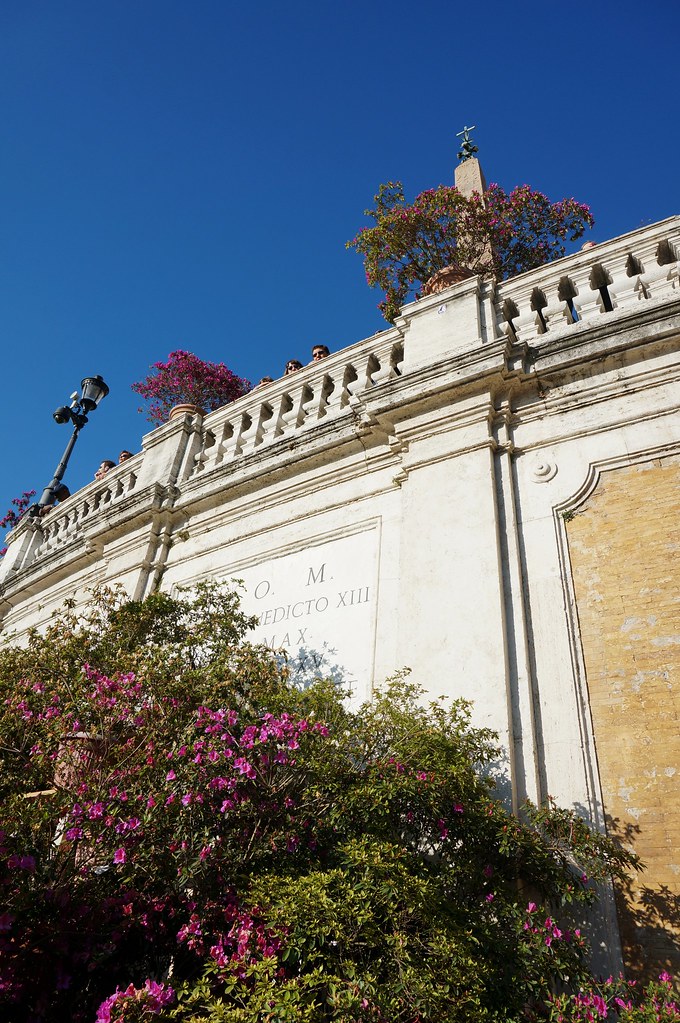
From the Supreme Court, I finally walked back to a Ciao Roma bus stop by Castel Sant'Angelo and rode the bus back through the city until I got close to the Spanish Steps.  I thought it might be cool to see the boat-shaped fountain there and eat by the steps but once I arrived, I found out that the fountain was closed and completely blocked off for repairs and the steps were covered by people.  I walked to the top to enjoy the view of the city and write a bit in my journal.  Then, due to the sheer numbers of people packed on the steps and the lack of restaurants in the immediate area, I decided to make an alternative plan for dinner that evening.

I made my way back down the steps and walked over back toward Fontana del Tritone and from there, to Fontana di Trevi.  I stopped at a restaurant just around the corner from Trevi called Sora Lucia (map).  It is just far away enough to avoid the crowds, but close enough to people watch and listen to the rushing waters of the fountain.  I had some delicious gnocchi al pomodoro and tiramisu here before making my way back to Tritone to take the bus back to Termini and my hostel for the night.
Once I got back to the hostel, I had one more thing to do for the day: reserve my ticket for the Vatican Museums.  I quickly took care of this and printed out my voucher to be all set to go for Saturday morning.  I also met two other people staying in my room who were also travelling alone - a girl from Brazil who was working as an au pair in Antwerp and a girl from Thailand on her way back from a business trip in Europe.  Since both had just arrived to the hostel and were hungry, we went across the street to a restaurant called La Famiglia (map) for them to get something to eat.


Tomorrow inside the Colosseum and Foro Romano should be another great day!
Onward!

Twitter Delicious Facebook Digg Stumbleupon Favorites More

 
Design by Free WordPress Themes | Bloggerized by Lasantha - Premium Blogger Themes | Walgreens Printable Coupons