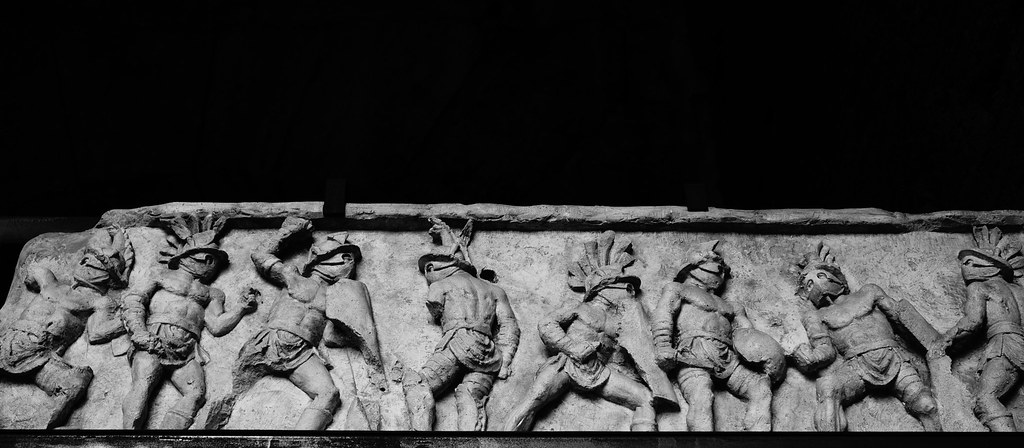
If two gladiators both fought bravely and were equally matched, sometimes both would walk out of the arena alive. Such an incident was recorded by the poet Martial about a fight between Priscus and Verus, who fought as Emperor Titus opened the amphitheater for the gladiatorial games. Because of their fight, both were awarded their freedom that day. You can see a reenactment of the fight in this BBC docudrama about the fight:
Gladiators were usually prisoners of war, slaves, or criminals condemned to death or forced labor. Free men rarely chose to be gladiators in order to reach fame, and if they did so, it was only for brief periods. Fighters were assembled in groups trained by entrepreneurs (called
lanista). Armor worn by gladiators in the Republican Period of Rome were inspired by enemies' armor. Only during the Augustan Period were the types of gladiators defined according to their equipment. Offensive and defensive weapons that fighters carried were meant to ensure a balanced encounter. There were also
equites, gladiators who were armed with a spear, sword, and small shield, and confronted one another on horseback.
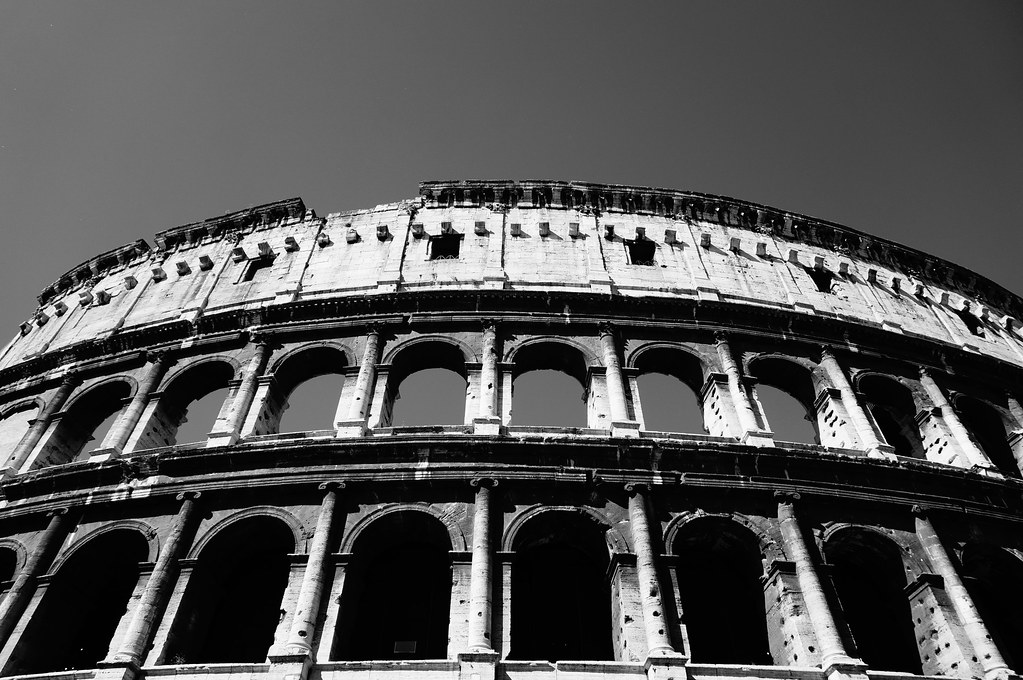
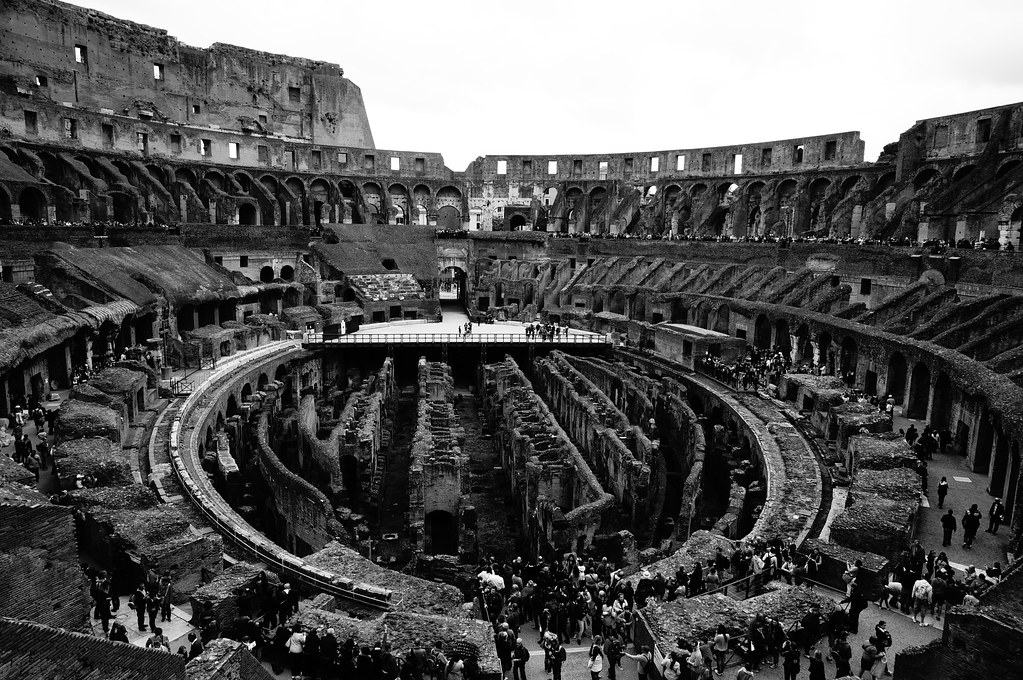
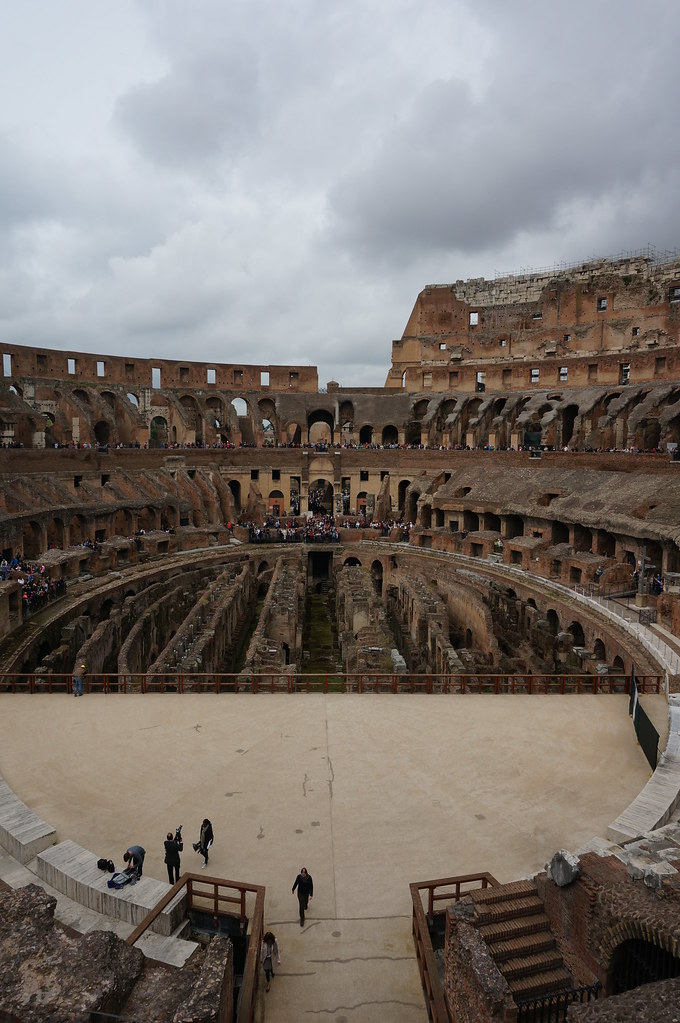
A Day at at the Flavian Amphitheatre
The spectacle day began in the morning with the presentation of all the participants (pompa). This was followed by the venationes, hunts in which hunters tackled wild animals lurking among sets replicating the geographical contexts from which they came.
During the lunch interval, when executions ad bestias took place, the condemned, naked and unarmed, faced the wild beasts which would eventually tear them to pieces. During the intervals, there were performances by jugglers, acrobats, and magicians, as well as parodies and re-enactments of ancient myths.
Finally, gladiatorial combats (the munera) were held in the afternoon. Their origin, perhaps Etruscan or Samnite, was linked to funerary celebrations in honor of eminent individuals. The participants in these combats were usually prisoners of war or slaves, but some gladiators were free men seeking fame and fortune. There were categories of gladiators distinguished by their weapons and techniques. Those who were defeated in a duel could hope to be pardoned by the emperor or the audience, saving their life.
Thanks to their popularity, the games (ludi) were often financed by politicians who hoped to curry favor with the public whereas intellectuals saw these spectacles as a means of swaying public opinion and as a cause of spiritual decadence.
From the first half of the 5th century AD, there was a widespread economic crisis that led to a decline and final end of the
munera and
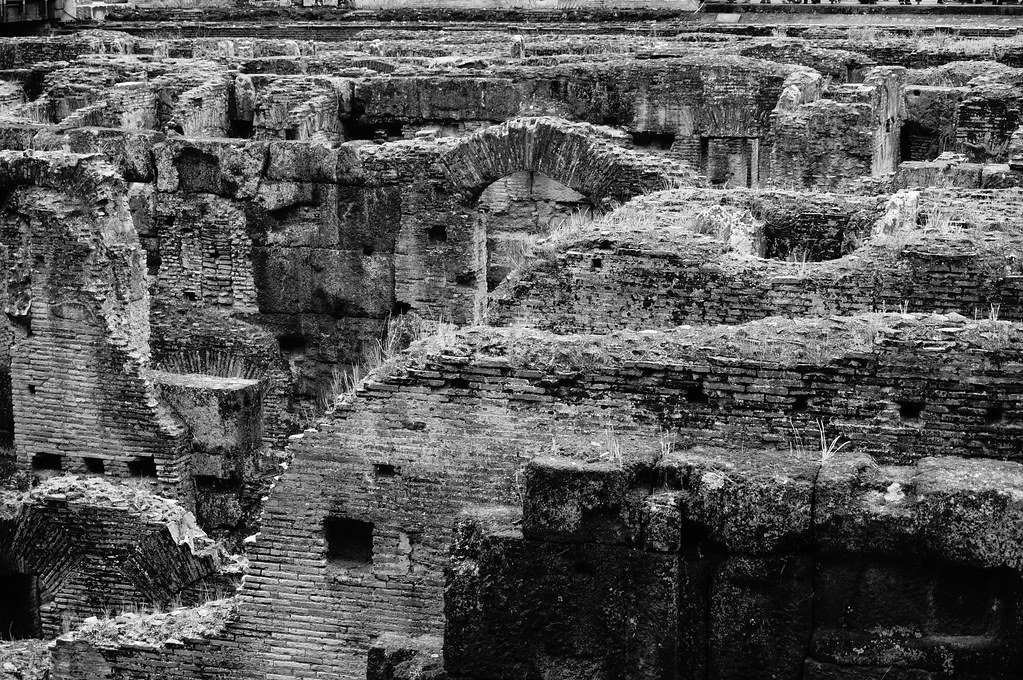
venationes fights. Between the end of the 5th century AD and the beginning of the 6th century AD, the underground structures in the Colosseum were filled in. Lacking machinery for shifting scenery, the Colosseum served only to accommodate displays similar to modern-day circus performances, with acrobats replacing gladiators as the main attraction. A popular spectacle during this period was the
contomonobolon, executed by acrobats who performed spectacular jumps among animals with the aid of a pole (the
contus). The last games in the Flavian Amphitheatre (aka Colosseum) took place in 523 AD.
Before heading over to the Palatino and the Foro Romano, I stopped at the
Pasqualino al Colosseo (
map) for a pizza margarita and a glass of vino bianco for lunch. The food was okay, and even though the initial waiter was good, the one who actually took our food tried to give me trouble about asking for a glass of tap water (it escalated to him telling me that they do not have water at all and me saying, "oh really? do you wash the dishes? what do you use to wash the dishes?" until he acquiesced).
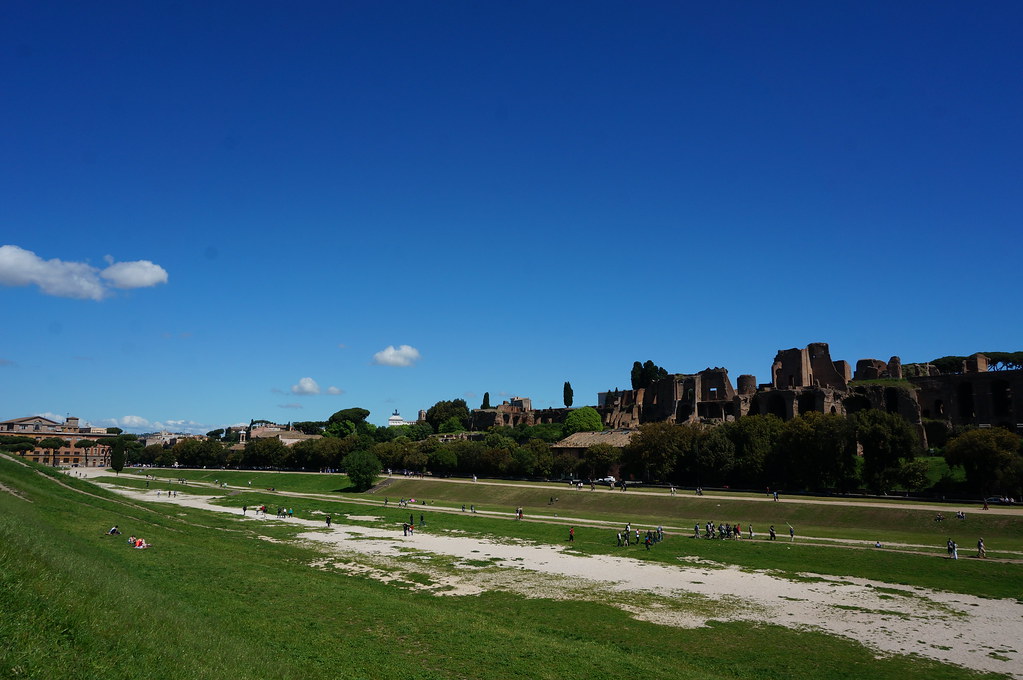
After spending Friday morning wandering around the different levels of the Colosseum, I headed over to the Palatino and Foro Romano. The Palatino is the hill where Romulus and Remus are said to have been nursed by the wolf. It is also the site of the imperial Roman palace that overlooks the Colosseum and Foro Romano, the main commercial center of Ancient Rome. The church of St. Sebastian also sits at the old vinyards on the Palatino. On the southwest side below the hill lies the Circo Maximo, where chariot races took place.
 |
| Foro Romano |
The Roman Forum (Foro Romano) lies in the valley surrounded by the Palatine, Capitoline, and Esquiline hills. In the Republican period (5th-1st centuries BCE), this was the political, economic, religious, and commercial heart of ancient Rome. In the 9th and 8th centuries BCE when the city was made up of independent villages, the area was occupied by the cemeteries of the various settlements. Later, the villages began to merge and the Forum valley naturally became the place where their inhabitants met for economic transactions and social activities.
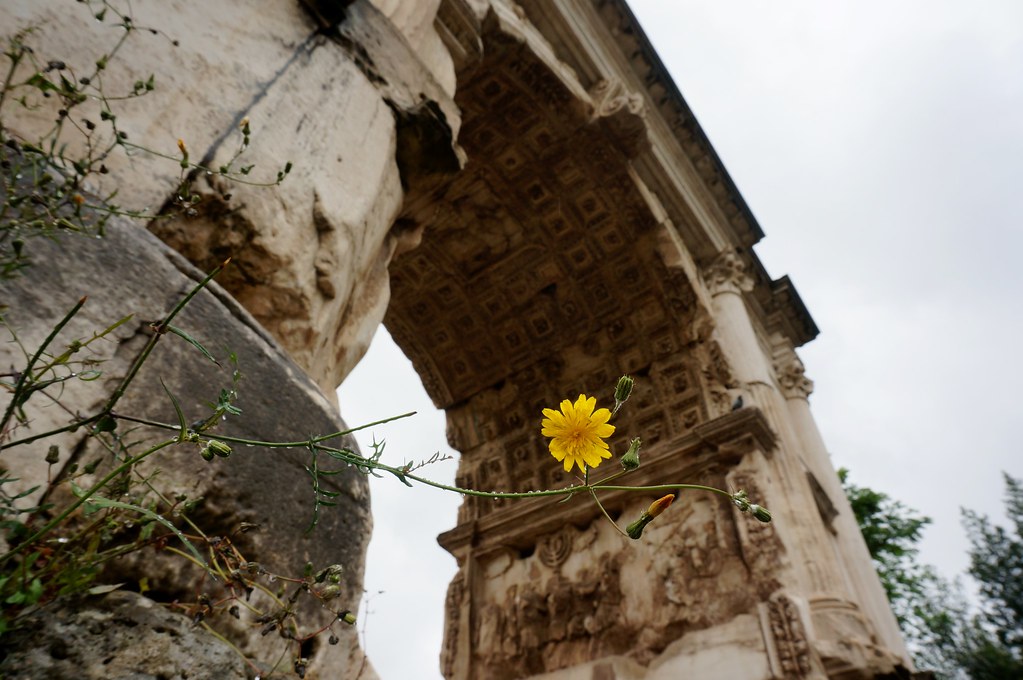 |
| Arco di Tito |
Broad and flat, it gradually became the center of the ancient city's social life. Originally, this was a marshy and unhealthy area, especially at its lowest point near the Capitoline hill. This made it necessary to carry out works here to drain the marshy swamp. This was one of the first land reclamation acts of ancient Italy and was ascribed to the Tarquins who built the Cloaca Maxima to channel the waters into the Tiber River. This was when the area took on a specific social and political function within the community. The Forum hosted games, political meetings, and assemblies. It is described by legend as the setting for some of the most important events in early Roman history, including the
Rape of the Sabine Women. Particularly, between the 3rd and 1st centuries BCE, the intense activities carried out here led to the construction of the first buildings with specific sacred and public functions. An initial road network also began to take shape between the temples and basilicas: the Via Sacra, the Vicus Tuscus, the Clivus Argentarius, etc.
 |
| Statue of Apollo, Palatine Hill Museum |
The Roman Forum retained its importance especially during the Republican period when the valley gradually filled with public buildings whose remains are still preserved here today. These buildings, which almost always had a timber frame and brick facing, were reconstructed on various occasions, in part because they were frequently destroyed by fire or civil strife. It was this unplanned continuity of its buildings over time which gave the Roman Forum its typically disorderly appearance without a unitary plan.
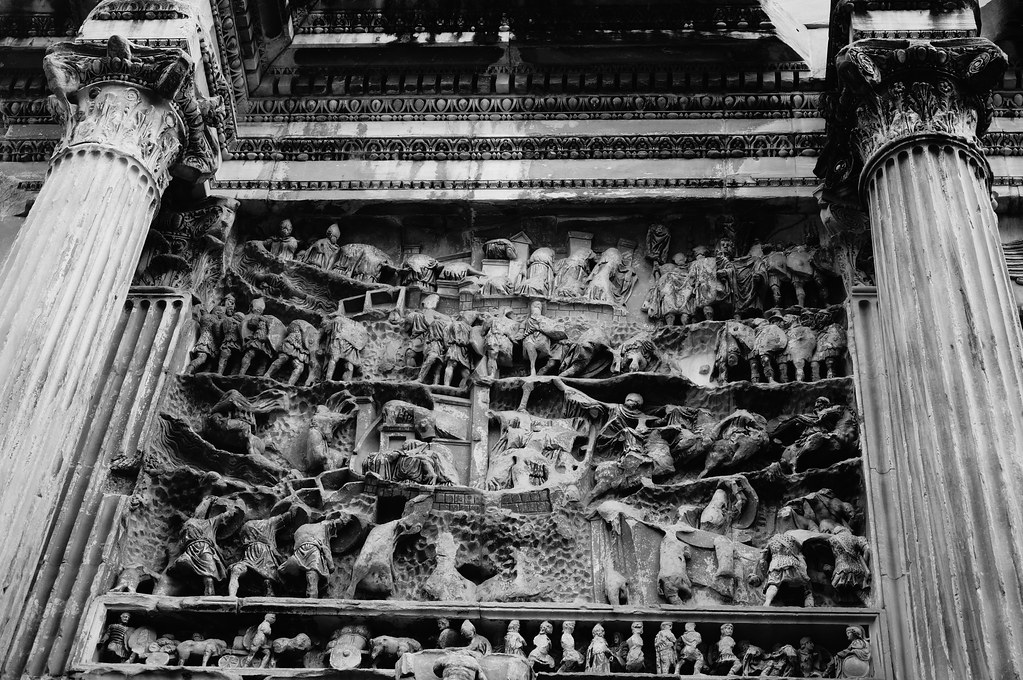
The area's development peaked with the victorious end of the Punic Wars in the 2nd century BCE when four basilicas were built: the Porcia, Opimia, Aemilia, and Sempronia. Later, first under Julius Caesar and then Augustus and the early emperors (1st century BCE to 1st century AD), the Forum gradually took on a different role - that of monumental center and place of religious memory while public life moved to the nearby Imperial Forums. As a consequence, building activities were interrupted, with one last moment of glory in the late empire with the construction of the honorary columns and equestrian statues.
True decline began with the imperial court's move to Ravenna and the edicts of the 4th century AD decreeing the closure of the temples, some of which were turned into churches. This was followed in the 5th century by the Visigoth and Vandal invasions. The abandoned buildings fell into ruin while the ground level of the Forum rose to cover what remained. Buried in vegetation and now on the edge of the city, the square became a pasture with the name
Campo Vaccino ("Cow's Field").
 |
| Temple of Romulus |
One of the main attractions at the Foro Romano is the Temple of Romulus. The temple's round shape was unusual for Roman architecture and was built by emperor Maxentius in 307 AD in honor of his son who died during childhood. The circular building is flanked by two halls opening onto the front with little porticoes decorated with columns. The bronze door on the temple is the original door and the lock still works. Pope Felix V turned the monument into the vestibule of the Church of Saints Cosmas and Damian.
 |
| Temple of Antoninus and Faustina |
The Temple of Antoninus and Faustina was dedicated by the Senate to Faustina in 141 AD and, when he died, to her husband the emperor Antoninus Pius (138-161 AD). The long walls of the
cella, in square peperino blocks, were originally covered in marble. At the center of the staircase, added later, are the remains of an altar. The statue visible behind the six columns of the facade probably belonged to the temple, which in the Middle Ages was turned into the Church of San Lorenzo in Miranda. Later, Pope Urban V reused construction materials from inside the church to restore the Lateran Palace.
 |
| Temple of Castor & Pollux |
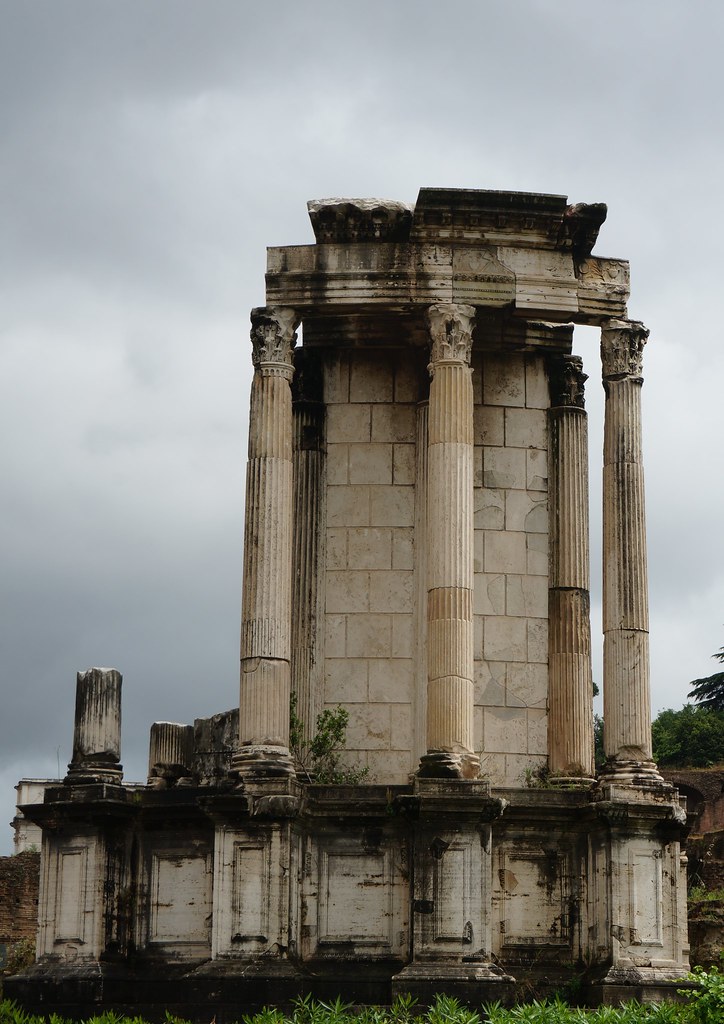
According to legend, two brothers Castor and Pollux, sons of Jupiter (Zeus), were seen watering their horses at the Spring of Juturna in the Forum after helping the Romans against the Latins and Etruscans at the Battle of Lake Regillus (496 BCE). In their honor, the dictator Aulus Postumius Albinus built a temple - dedicated in 484 BCE - which was transformed several times over the centuries. The high podium dates to its reconstruction by Metellus in 117 BCE. Another important reconstruction took place under Tiberius, to whom the three Corinthian columns can be attributed.
 |
| Vulcan's Temple |
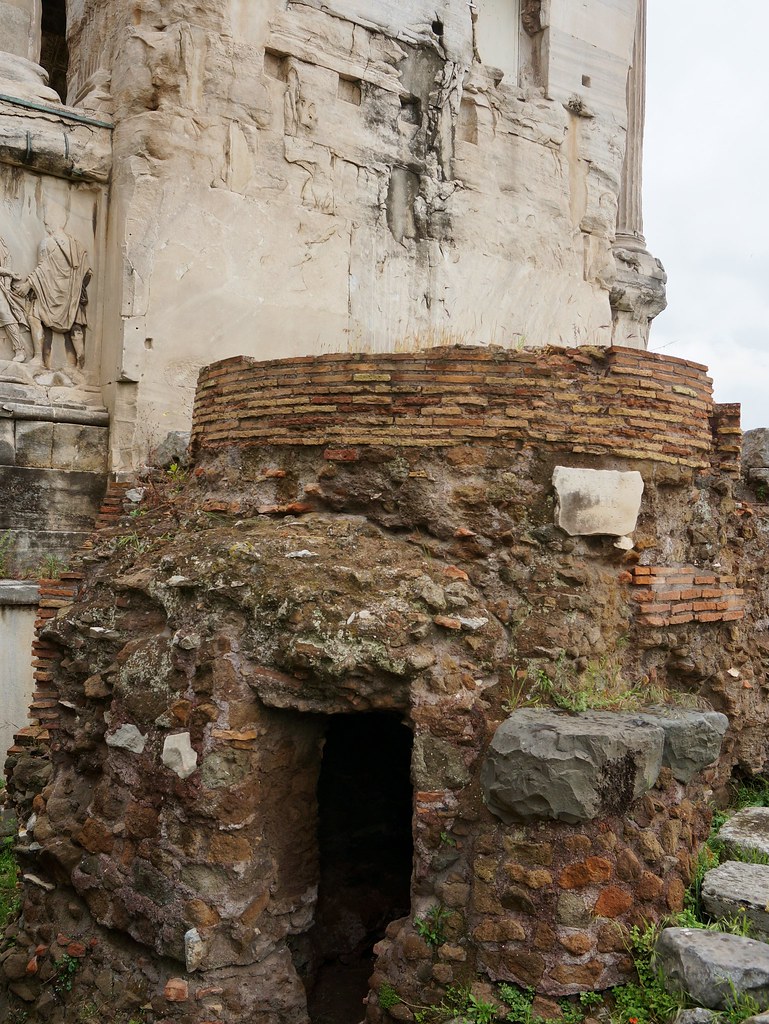
There are also temples to more famous gods that are part of the Forum. Partly cut into the rock and partly built from tufa blocks, the Vulcanal monument (about 3 x 4 meters) was believed to be the sacred space hosting the altar dedicated to Vulcan by Titus Tatius (the mythical king of the Sabines), in existence from the city's origins. It has recently been suggested that the remains belonged to the altar of Saturn, which Latin authors describe as standing in front of the Temple of Saturn at the bottom of the slope leading up to the Capitoline Hill.
 |
| Rostra |
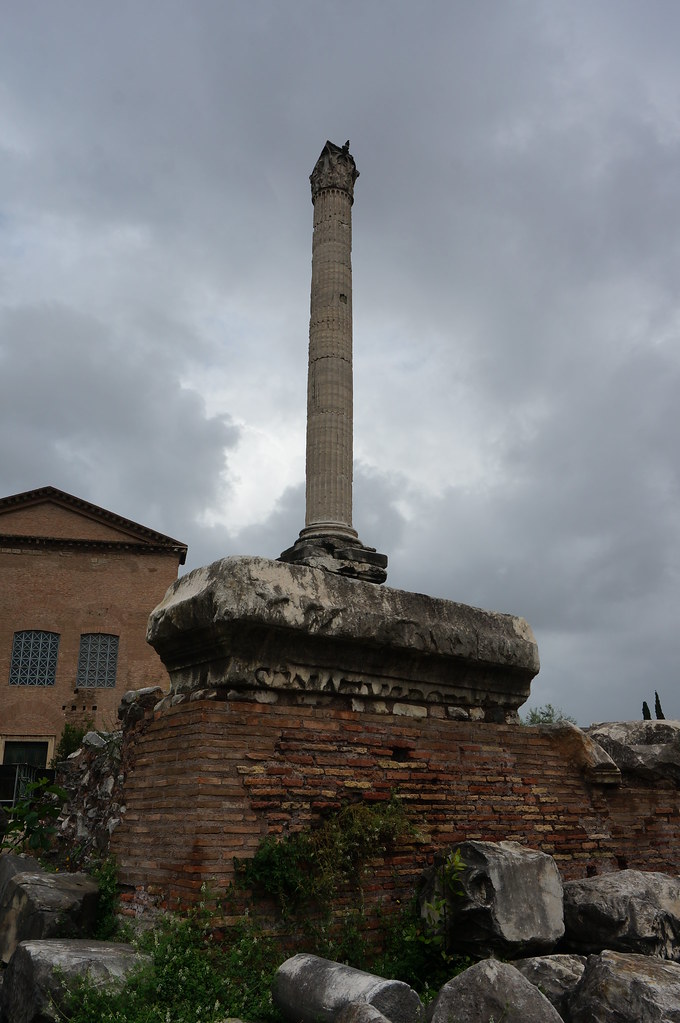
Finally, the Forum also has the Rostra, the podium from which orators addressed the people. The name comes from the
rostra (rames) of the Latin ships, captured by the Romans at the Battle of Antium in 338 BCE with which the monument was decorated. Caesar had the Rostra moved here from the nearby Comitium and it was later enlarged by Augustus. The monument has a curved part made of tuff blocks, clad in marble panels. The holes which supported the
rostra can be seen on the front. The monument had a platform accessed from a staircase on the side facing the Capitoline hill.
 |
| Palatino, Imperial Palace |
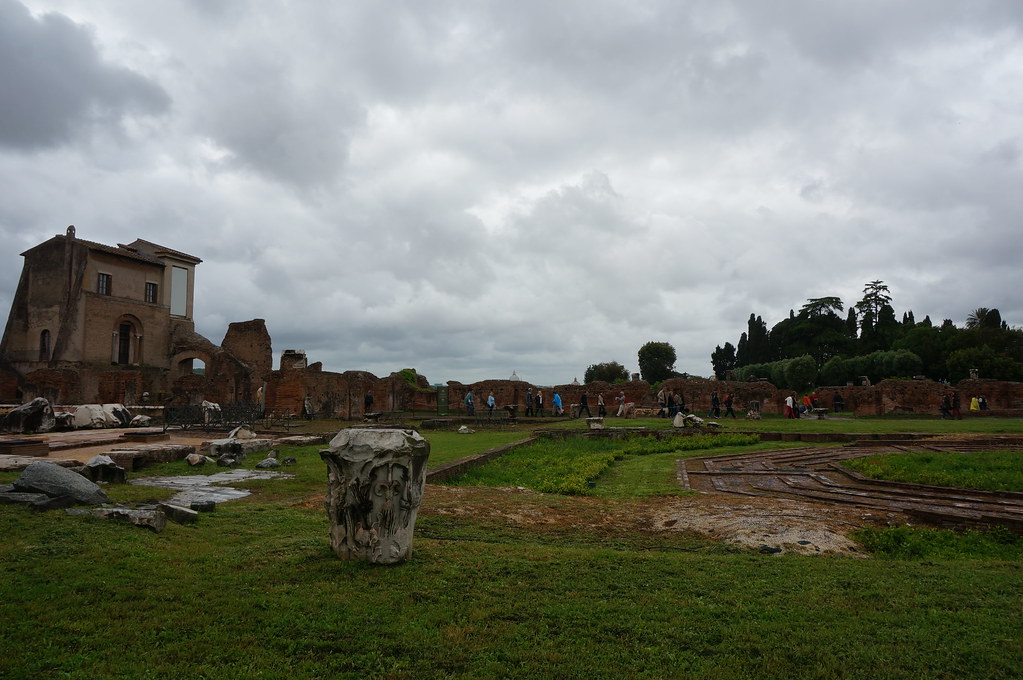
On top of the Palatine hill stands the Imperial Palace. The palace occupies much of the hill and its slopes. It was built by the architect Rabirius on the orders of Domitian (81-96 AD) and inaugurated in 92 AD. It was the official residence of all later emperors. The palace was divided into three sectors: an official or "public" area (the so-called Domus Flavia), a sector hosting private apartments (Domus Augustana), and a large garden in the form of a stadium with its annexes (called the Stadium).
 |
| Palatino, Imperial Palace |
The palace was made of brick and its massive foundations were superimposed on earlier buildings, some of which can be visited underneath the Domitianic structures. Conserved to almost its original extent, the palace represented a turning point in the history of Roman architecture, codifying the typology of the dynastic palace in Rome. Its importance is evident from the fact that the word "palace" itself comes from the Latin
palatium or
palatine because this is where the first imperial residence was built, a model for all later palaces. Its construction made a deep impression on Domitian's contemporaries. Statius and Martial, his court poets, composed admiring descriptions of it, praising its extraordinary size, the beauty of its decorations, and the luxury of its furnishings. "The palace was so vast," Martial wrote, "that one's eyes became tired looking at it, and so tall that in comparison the pyramids of Egypt seemed laughable." (That seems like a wee biiiiit of an exaggeration there, Martial. Tsk tsk).
 |
| Circo Massimo with Palatino Hill above |
In the afternoon, I walked back to the Vittorio Emanuele II monument for a while. After hanging out there until the guards began chasing people off of the steps, I wandered over to
Dante's Bar for some gelato (I tried chocolate, strawberry, and tiramisu). Then, when the person I had met at the hostel who had been accompanying me sight-seeing needed to charge her phone, we wandered over to the
Theatre Cafe to find an outlet. Since apparently we were doing dessert before dinner, I kept up with the trend and ordered a delicious, authentic Italian canoli.
 |
| Delicious canoli with Grapefruit juice. |
For dinner, my friend from the Geneva program had recommended a restaurant called
Trattoria Da Lucia (
map) for amazing pasta. Unfortunately, by the time I found it that night wandering through some beautiful streets and hidden plazas, it was full and the restaurant only takes reservations. So, if you are going to Rome any time soon,
call ahead for good restaurants to make your reservations.
Since that place was full and it was raining hard by this point, I found a different restaurant that was full but did have some room called
Taverna della Scala (
Italian;
English;
map), where I had some pretty delicious penne all'arrabbiata.
 |
| Like a real midwestern American, I added the Parmesan cheese. |
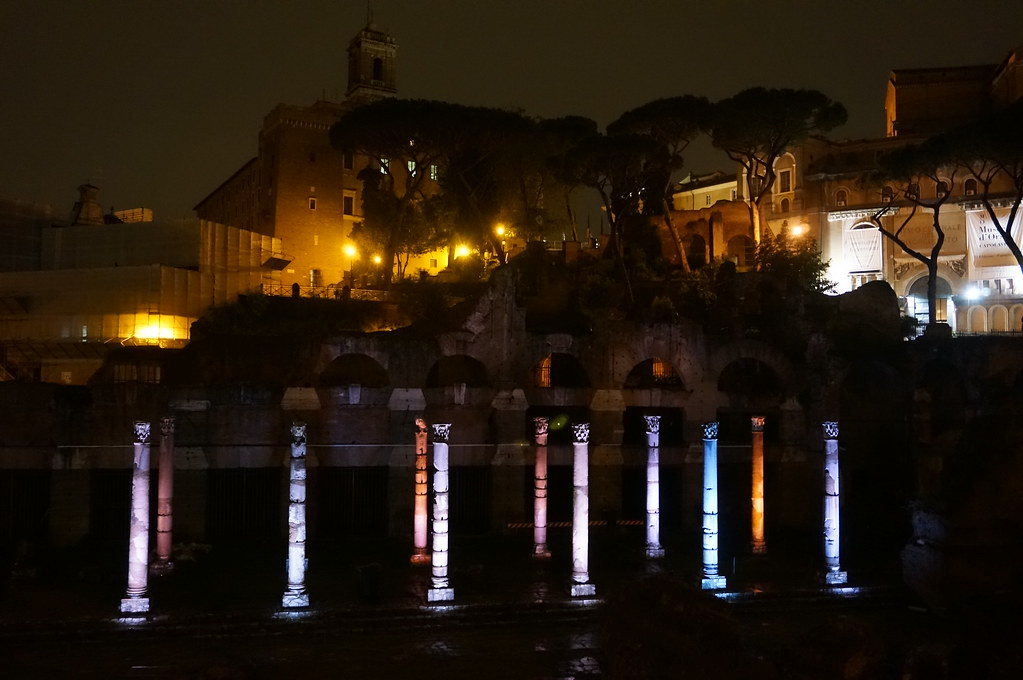
Friday night, I was able to come back to the Colosseum to see it lit up. Along the way, we passed part of Foro Romano illuminated as well as a couple bridges on the Tiber River. It was raining on and off all day and the rain had started again at night. While this meant fumbling between umbrella and camera, the bonus was that the Colosseum was beautiful illuminated and no one was there because of the rain. It was really nice to be able to walk around it and admire the structure without having to push through lines of tourists. Definitely one of the major highlights of my trip to Rome.
 |
| Roman Forum at Night |
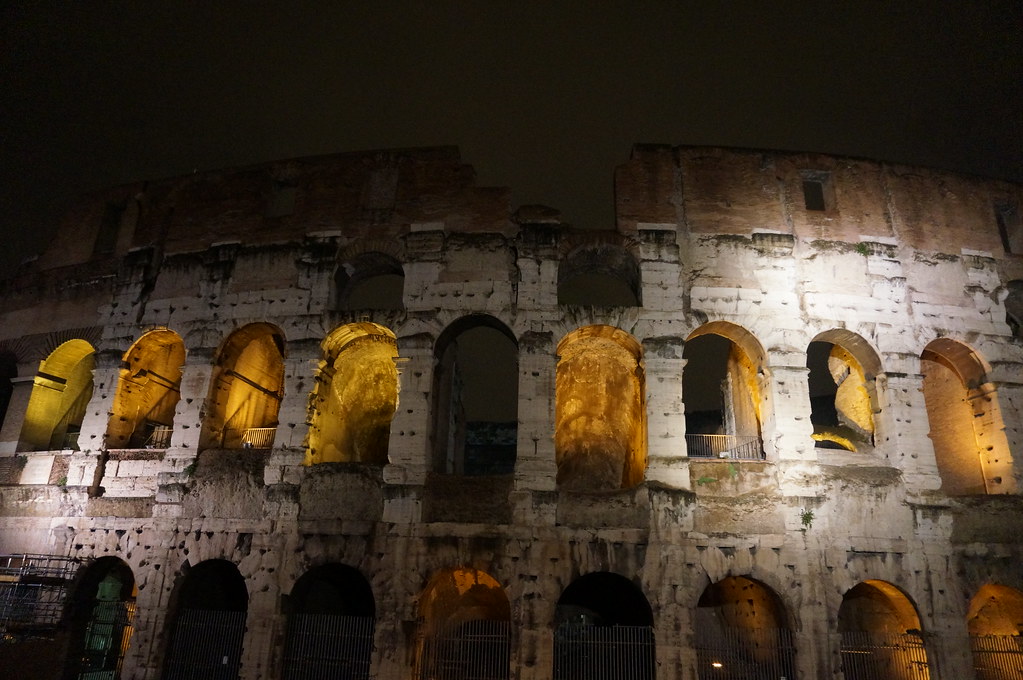 |
| Colosseum at Night |




 11:30 PM
 J-Mad




 Posted in:


